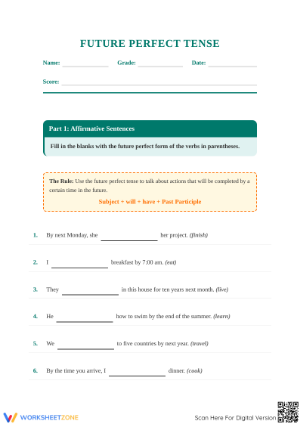
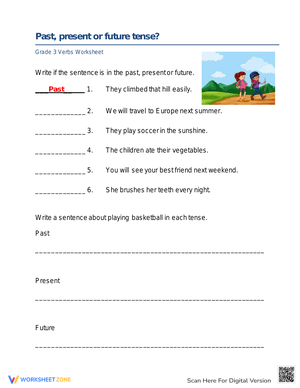
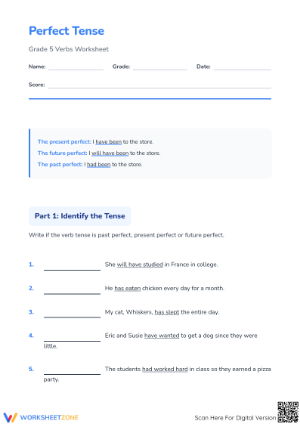
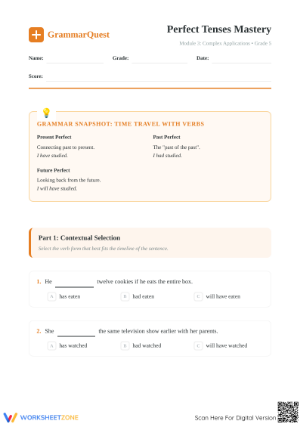
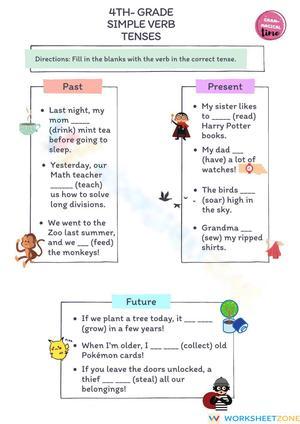
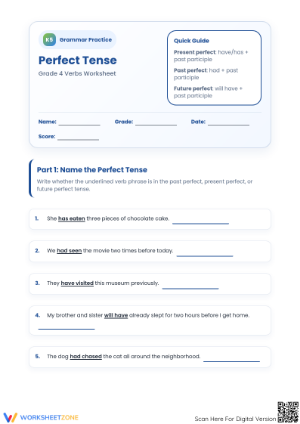
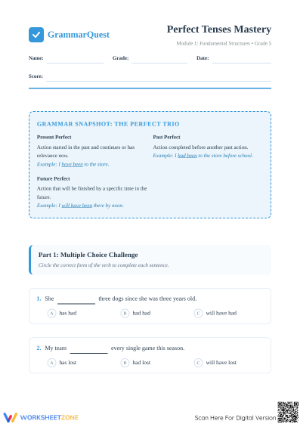
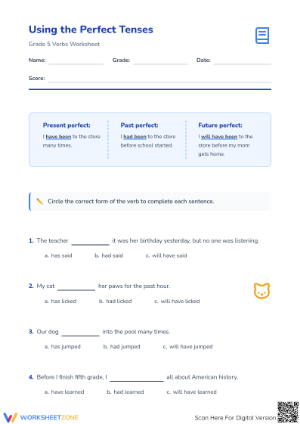
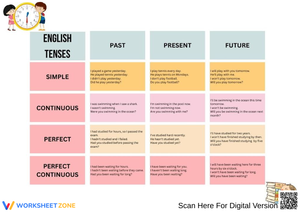
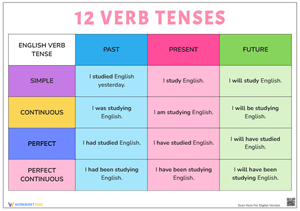
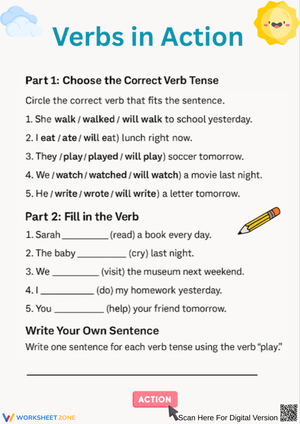
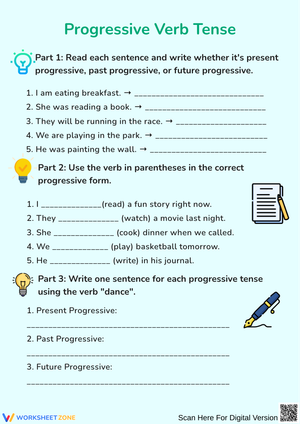
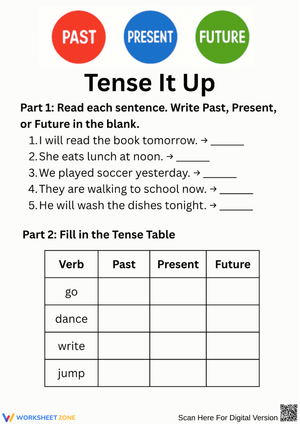
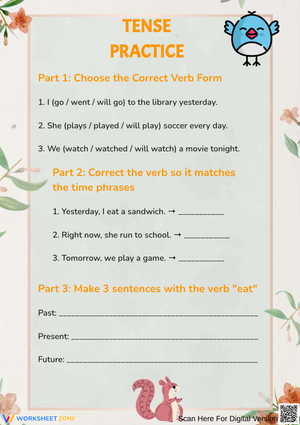
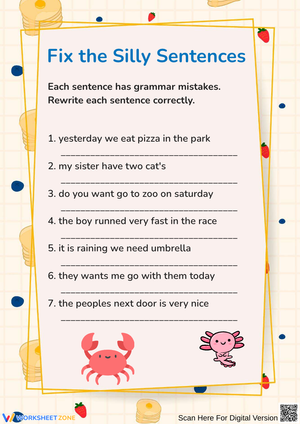
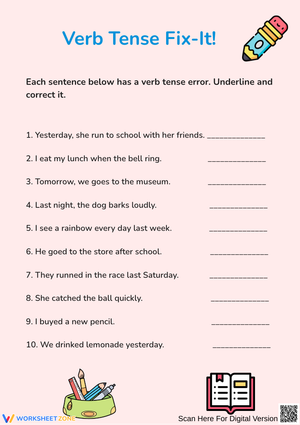
These 4th grade verb tenses printable worksheets give teachers targeted practice in three areas that derail Grade 4 writers most often: distinguishing simple from progressive forms, sorting out the irregular past tenses that follow no predictable rule, and catching the tense shifts that surface once students start writing longer paragraphs. The set addresses the specific demands of the Grade 4 grammar year — not the full K–5 tense arc.
What Each Worksheet Targets
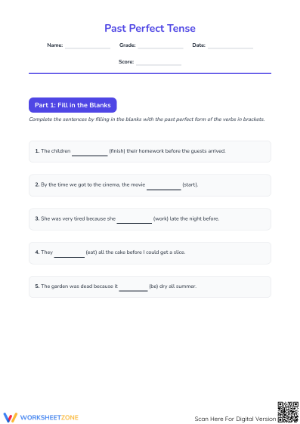
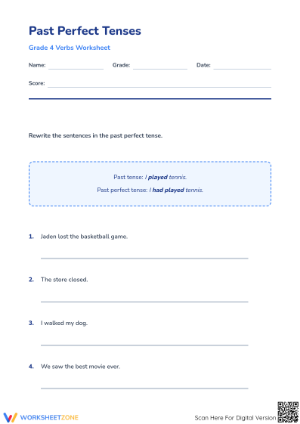
The worksheets fall into three skill clusters. One group focuses on simple versus progressive identification and production: students read sentences, label the tense, then rewrite simple-tense sentences in progressive form and the reverse. A second group addresses irregular past-tense verbs through matching exercises and fill-in-the-blank tasks built around high-frequency words — go/went, bring/brought, know/knew, see/saw. The third group asks students to read short paragraphs, underline every verb, and mark any that break the tense established in the opening sentence.
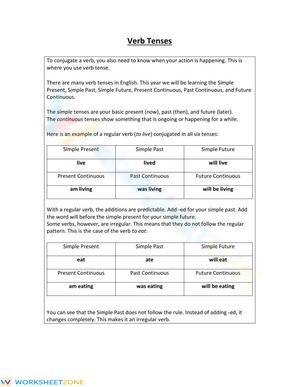
Progressive forms receive the most worksheet coverage because that is where the Common Core puts the instructional weight at this grade. Forming a progressive correctly requires coordinating a helping verb with a present participle, and the pairing has to match both subject and time frame. Students practice shifting "she reads" to "she is reading," "they played" to "they were playing," and "he will finish" to "he will be finishing." The future progressive gets less classroom time than it deserves at Grade 4, and including it here prevents the confusion that shows up in Grade 5 when students encounter it for the first time without any prior exposure.
Student Errors Worth Watching — and Correcting
The most predictable error across all three skill areas is irregular verb overgeneralization. When a student writes "I seed the bird" or "we goed to the store," that is not carelessness — it is the "-ed" rule working against itself. The same student who correctly writes "walked" and "talked" applies the same logic to "saw" and "went." Oral review before a worksheet session helps, but what catches overgeneralization in writing is repeated exposure with immediate feedback, which is the job the fill-in exercises do best.
Tense shifting in paragraph-level work is the other error that shows up constantly. A student writes an entire narrative in past tense, then — right at the most exciting moment — drifts into present: "We ran to the corner and then my dog jumps the fence." That shift typically happens when the student mentally re-enters the scene. The paragraph-editing worksheets make this visible in other people's writing first, which is considerably less threatening than seeing it flagged in your own story. Once students can catch the shift in a stranger's paragraph, they are far more likely to notice it during revision.
Fitting These Worksheets Into Your Grammar Week
Tense identification and rewriting exercises work well as Monday warm-ups — five to eight minutes to reactivate grammar vocabulary before a writing block. The paragraph-editing worksheets fit better mid-week, ideally after students have done some of their own drafting, so the proofreading transfer is direct. Saving a tense-detective task for Thursday or Friday review gives you a read on whether students can catch the errors they are most likely still making in independent writing.
These 4th grade verb tenses printable worksheets also serve as efficient formative checks at the close of a mini-lesson. Hand one worksheet out after a fifteen-minute lesson on progressive forms; what students get wrong tells you exactly which students need a small-group reteach the following day. That kind of quick, low-stakes data is more useful than waiting for a finished draft to surface tense problems that could have been addressed two weeks earlier.
Standard Alignment
Teachers reaching for 4th grade verb tenses printable worksheets to address CCSS.ELA-LITERACY.L.4.1.B will find the progressive-tense coverage maps directly to the standard's language: form and use the progressive verb tenses. In classroom terms, this standard appears in two distinct instructional moments — direct grammar instruction, where students study tense formation in isolation, and the editing stage of the writing process, where accurate tense use is expected in student paragraphs. The identification and production tasks support direct instruction; the paragraph-editing tasks support transfer to writing. The irregular-verb work reinforces L.4.1 broadly, since correct irregular forms thread through the entire Grade 4 language strand.
Tailoring the Set for Different Levels of Writers
Students who are still consolidating simple tenses benefit most from the worksheets that include a word bank and a model sentence at the top. The model sentence gives them something to pattern-match against rather than generating the tense form entirely from memory, which removes one layer of cognitive demand from the task. For those students, brief oral practice before they write anything helps — saying "she is reading" aloud a few times before writing it reduces the blank-stare paralysis that hits some Grade 4 writers when they face an unfamiliar construction cold.
Students who have simple and progressive forms solid but still shift tenses in their own paragraphs are ready for the editing worksheets without word banks or model sentences. Push those students further by asking them to correct the errors and annotate each correction with the rule they applied. That step — naming the grammar principle while fixing the sentence — tends to stick in revision in a way that simply circling mistakes does not. For the strongest writers, have them compose a short paragraph deliberately full of tense inconsistencies for a partner to edit. That task demands a more precise command of the rules than any fill-in exercise provides.
Frequently Asked Questions
Why are progressive tenses introduced specifically in Grade 4?
By Grade 4, students write multi-sentence narratives and informational paragraphs where simple tenses alone cannot carry the full meaning. Progressive forms describe actions in progress or interrupted by another event — both of which appear constantly in narrative writing. The Common Core places this skill at Grade 4 because the writing complexity demands it, not as an isolated grammar exercise. Students who understand the difference between "she wrote" and "she was writing" can make deliberate choices that strengthen their storytelling.
What is the most effective way to help students who keep overgeneralizing irregular verbs?
Group irregular verbs by internal pattern rather than presenting them as a random list. Verbs that follow a vowel shift — run/ran, begin/began, sit/sat — are easier to remember as a cluster. The 4th grade verb tenses printable worksheets in this set use that grouping approach in the irregular-verb exercises, giving students a hook for memory rather than relying on sheer repetition. Oral practice alongside the written exercises — reading the pairs aloud, using them in spoken sentences — reinforces what the written work alone cannot fully establish.
Can these worksheets work for homework or independent practice at home?
Yes. Each worksheet includes a brief example before the exercise begins, which gives students enough context to work without teacher guidance. These hold up particularly well as take-home review after a classroom lesson — students have the concept in short-term memory, and the worksheet extends that into deliberate practice. Parents who want to support grammar work at home find the format straightforward: the tasks are clear, the examples are there, and the directions do not require a teacher to interpret them.
What if my class enters Grade 4 with very uneven tense knowledge?
Start with a short diagnostic — hand out one of the identification worksheets without any prior instruction and see who catches the progressive forms and who does not. That tells you in about ten minutes who needs to back up to simple tense review and who is ready to move into progressive production and paragraph editing. Differentiate the sequence rather than the worksheets themselves: some students work through the identification tasks first while others jump directly to the paragraph-level work.












 Interactive Worksheet Maker
 Quiz Maker
 Word Search Maker
 Crossword Puzzle Maker
 Word Scramble Generator
 Sentence Scramble Generator
 Handwriting Worksheet Generator
 Name Tracing Generator
 Fill In The Blank Generator