


























Views
Downloads




Essential Grade 5 Perfect Tenses Mastery Worksheet
Paste this activity's link or code into your existing LMS (Google Classroom, Canvas, Teams, Schoology, Moodle, etc.).
Students can open and work on the activity right away, with no student login required.
You'll still be able to track student progress and results from your teacher account.
This comprehensive Grade 5 grammar resource helps students master the complexities of perfect verb tenses through structured practice. By identifying and applying present, past, and future perfect forms, learners gain the precision needed for advanced writing. This packet provides a clear pathway from conceptual understanding to independent application in varied sentence contexts.
At a Glance
- Grade: 5 · Subject: ELA
- Standard:
CCSS.ELA-LITERACY.L.5.1.B— Form and use the perfect present, past, and future verb tenses- Skill Focus: Perfect Verb Tenses Mastery
- Format: 4 pages · 17 problems · Answer key included · PDF
- Best For: Grammar reinforcement and formative assessment
- Time: 25–35 minutes
This 4-page instructional packet includes a Grammar Snapshot reference guide that defines the present, past, and future perfect trio with clear examples. Students progress through three distinct sections: a multiple-choice challenge, a skill expansion fill-in-the-blank area, and a high-order tense transformation task. A full answer key is provided for immediate feedback and grading efficiency.
Skill Progression
- Guided practice: Part 1 features 8 multiple-choice questions where students identify the correct verb form from three options, reinforcing the snapshot patterns.
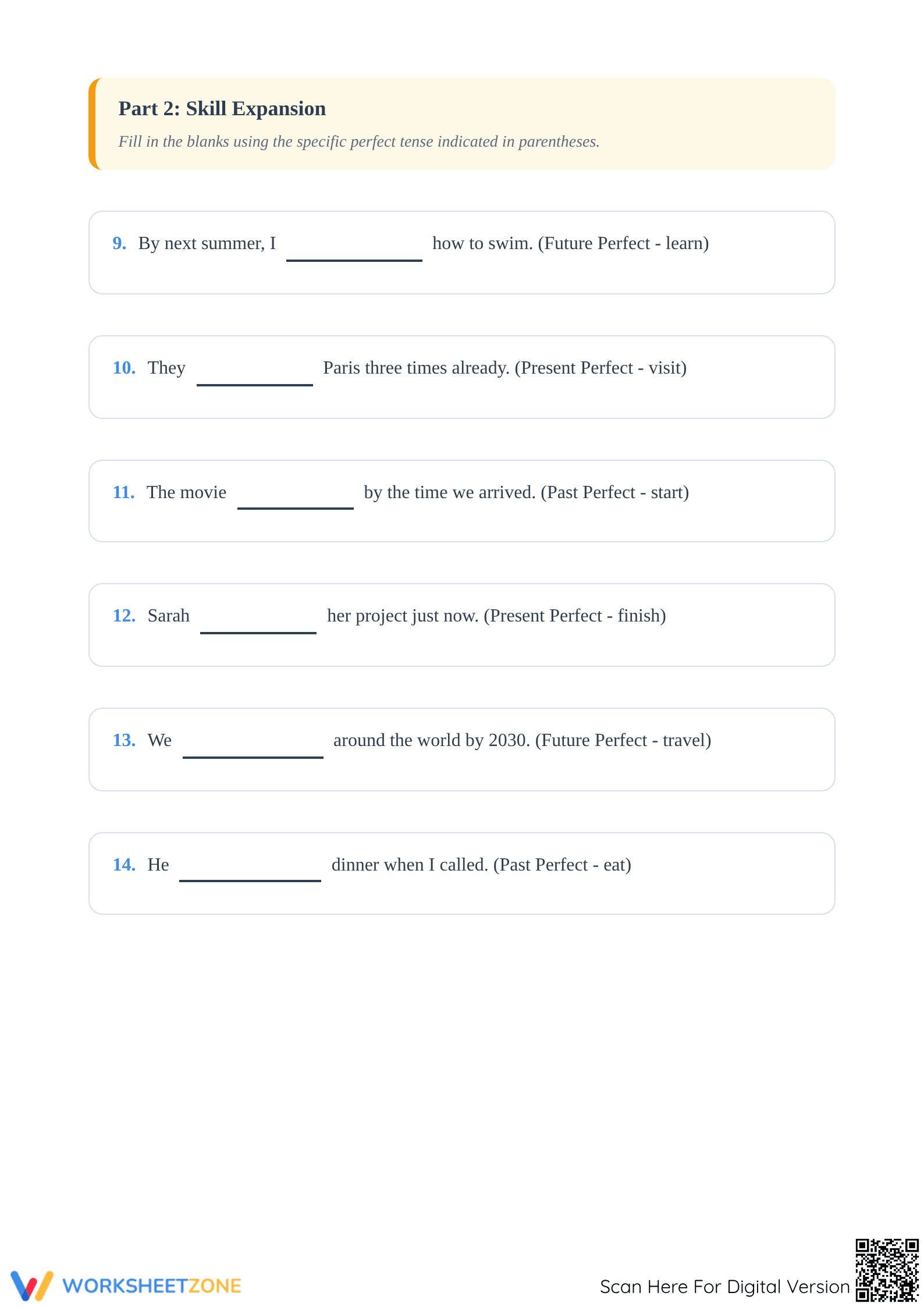
- Supported practice: Part 2 includes 6 fill-in-the-blank items where students must conjugate specific verbs into the perfect tense indicated in parentheses.
- Independent practice: Part 3 requires 3 tense transformations, challenging students to rewrite simple sentences into complex perfect forms without direct prompts.
This gradual-release model moves from recognition to production, employing the I Do, We Do, You Do instructional framework for lasting retention.
Standards Alignment
The primary focus is `CCSS.ELA-LITERACY.L.5.1.B`, which requires students to form and use the perfect (e.g., I had walked; I have walked; I will have walked) verb tenses. This resource also supports L.5.1 by demonstrating command of the conventions of standard English grammar and usage when writing. Both standard codes can be copied directly into lesson plans, IEP goals, or district curriculum mapping tools.
How to Use It
Distribute this worksheet as a mid-unit formative assessment after introducing the perfect tense concepts to gauge individual student progress. During the Skill Expansion phase, observe how students handle the temporal markers like "by next summer" or "already" to identify those struggling with chronological sequencing. This activity typically takes 30 minutes and works well as a focused independent work block.
Who It's For
This resource is designed for Grade 5 students but serves as an excellent review for Grade 6 learners or a stretch goal for advanced Grade 4 writers. It is particularly effective for English Language Learners (ELL) who need explicit instruction on auxiliary verb combinations. Pair this practice with a short narrative passage to have students identify perfect tenses in a real-world text.
The mastery of perfect tenses is a critical milestone in the development of linguistic complexity for upper elementary students. According to a RAND AIRS 2024 analysis of curriculum efficacy, explicit practice with auxiliary verb structures significantly improves a student's ability to convey precise temporal relationships in their narrative and informational writing. This worksheet directly addresses the requirements of `CCSS.ELA-LITERACY.L.5.1.B` by providing 17 targeted items that span the present, past, and future perfect spectrum. By moving from recognition in multiple-choice formats to active transformation of sentences, students build the cognitive flexibility required for college and career readiness. The inclusion of a grammar reference snapshot ensures that students have the necessary scaffolds to work independently, reducing cognitive load while practicing new syntax. This structured approach to grammar instruction aligns with the NAEP frameworks for writing fluency and effective communication in standard English.


