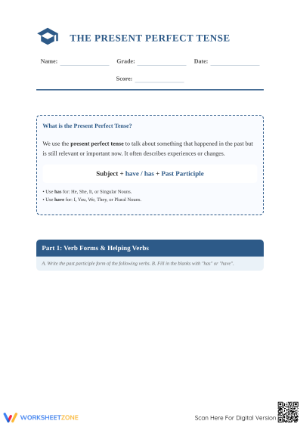
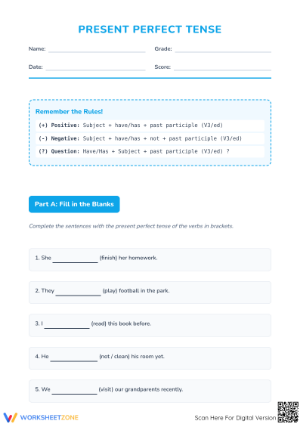
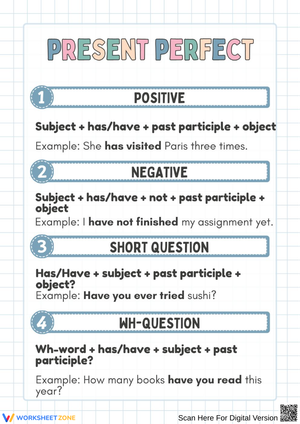
Teachers who download these 4th grade present perfect tense printable worksheets get a focused set built around one of the trickier grammar shifts in Grade 4 ELA — moving students from confident simple-past writers into writers who can form and use present perfect without collapsing it into simple past. Each worksheet in the set targets a specific point of difficulty, from helping-verb agreement to irregular past participles, and moves from recognition into production so students are applying the structure by the end of the practice session.
What Each Worksheet Targets
Present perfect lands at the intersection of verb agreement and irregular verb knowledge, which is precisely why Grade 4 is the right time to bring it forward — students have spent two or three years building a mental list of irregular verbs, and now they need to pair those forms accurately with has or have. The worksheets address that demand through a deliberate sequence of task types:
- Choosing has or have based on sentence subject (She has / They have)
- Matching base verbs to their past participles — pairs such as go/gone, eat/eaten, write/written, and see/seen
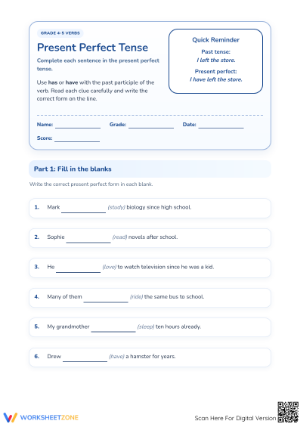
- Completing sentences with the missing helping verb or participle
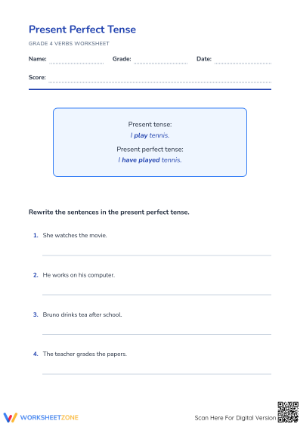
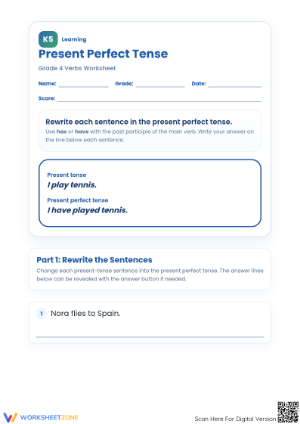
- Rewriting simple past sentences in present perfect form
- Identifying and correcting tense errors in short model sentences
- Writing one or two original sentences using present perfect in a prompt-driven context
That final writing step matters. Students who can fill in blanks correctly but cannot produce an original present perfect sentence have partially understood the pattern — the writing task surfaces that gap before it becomes a habit.
Verb Mistakes That Show Up Consistently in Grade 4 Work
Present perfect produces a small, predictable cluster of errors, which makes targeted practice genuinely useful. The most common pattern is substituting the simple past form for the past participle: students write has went, have ate, or has saw because those forms feel natural after years of simple past use. A worksheet that places has went beside the corrected has gone — with a brief note that went stands alone but gone needs a helper — clarifies the issue faster than oral explanation.
The second persistent error is helping-verb agreement. Students who write They has finished or He have studied know the structure exists but haven't yet made the subject-helper match automatic. Error correction items where students read and rewrite those exact sentences work well because the task forces direct comparison rather than passive recognition. A third error worth watching is dropping the helping verb entirely: a student asked to write a present perfect sentence produces She finished already, which is grammatically valid simple past but not the target form. That response tells you the concept is still loosely held — the student is reaching for something that sounds similar without committing to the full structure.
Building These Worksheets Into a Weekly Grammar Sequence
A single worksheet does not teach present perfect — it gives students structured practice after direct instruction has established the pattern. The most productive approach spans three to four days. On day one, open with two side-by-side sentences on the board: I cleaned my desk yesterday versus I have cleaned my desk. Ask students what they notice about the verbs, then name the structure explicitly. Complete the first worksheet together, working the first several items as a class before students finish independently.
On day two, use an error correction worksheet during the 8 to 10 minutes before the full ELA block begins — students are focused in that slot and error correction requires minimal teacher direction. Day three works well for a short independent worksheet that doubles as a formative check: fill-in items plus one original writing sentence. If most students can produce a correct original sentence, the concept is solid enough to carry into composition work. By day four, the goal shifts from tense formation to tense choice — when does present perfect fit, and when does simple past serve better? The 4th grade present perfect tense printable worksheets set supports that full arc without requiring new materials each day.
Standard Alignment
The specific CCSS standard for forming and using perfect verb tenses is CCSS.ELA-LITERACY.L.5.1.b — "Form and use the perfect (e.g., I had walked; I have walked; I will have walked) verb tenses" — which formally belongs to Grade 5. Grade 4 teachers use these worksheets as an early introduction or as enrichment for students ready to move ahead, with the understanding that full mastery is the Grade 5 expectation. The Grade 4 anchor standard is CCSS.ELA-LITERACY.L.4.1, which covers command of standard English grammar conventions, and present perfect builds naturally on the multi-verb structures introduced in L.4.1.b for progressive tenses. Teachers using TEKS or other state-specific frameworks should verify the grade placement in their own standards documents, as some curricula address perfect tenses explicitly at Grade 4.
Adjusting the Worksheets for Mixed-Ability Classrooms
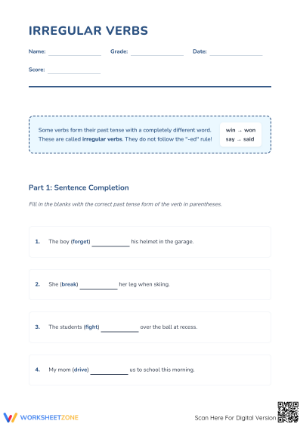
For students still building irregular verb knowledge, a small reference list of base verbs and their past participles placed alongside each worksheet reduces the cognitive load enough that students can focus on tense structure rather than retrieving word forms from memory. Include the ten or twelve irregular verbs that appear most often in Grade 4 reading — go, eat, see, write, take, give, come, do, run, grow — and remove the list once students can access those forms reliably. A follow-up error correction worksheet confirms whether the knowledge has held without the reference in place.
Students ready to move beyond fill-in practice benefit from a short comparative writing task: produce three present perfect sentences, rewrite each in simple past, then write one sentence explaining when you would choose each form. That task requires metalinguistic reasoning — thinking about language as a system — and most Grade 4 students find it genuinely demanding. For students who struggle specifically with the helping verb, five minutes of oral practice before the worksheet (just saying subject-helper pairs aloud: I have, she has, they have, he has) measurably reduces written errors. These 4th grade present perfect tense printable worksheets resources also lend themselves to station work, where different groups tackle different worksheets in the set simultaneously without requiring separate lesson planning.
Frequently Asked Questions
How do I explain present perfect to 9- and 10-year-olds without losing them?
The clearest entry point is the connection to now. Tell students that present perfect describes something that happened before this moment but still has relevance — I have eaten lunch means the eating is done, but it matters now (you are full; you do not need to eat again). Contrasting it immediately with I ate lunch at noon — which anchors the action to a specific finished time — tends to click faster than a grammatical definition. Most Grade 4 students grasp the distinction when it is tied to a scenario from their own day.
Should I teach present perfect before or after progressive tenses?
After. Progressive tenses are addressed at Grade 4 under L.4.1.b, and students who are already comfortable with is walking / was walking / will be walking understand that English uses multi-word verb phrases to express time distinctions. That prior knowledge transfers directly. Introducing present perfect before students are solid on progressive tenses adds unnecessary complexity and increases the likelihood of confusion between the two structures.
Do I need to cover past perfect and future perfect at the same time?
No, and trying to usually backfires. Present perfect is the most common and most immediately useful form in Grade 4 writing. Past perfect (had walked) and future perfect (will have walked) appear far less frequently in what students read and write at this level. Address them when they surface in a text the class is reading together, but do not hold off on present perfect mastery in order to introduce all three forms simultaneously.
What if students keep using irregular simple past forms instead of past participles?
Build a short anchor chart with the irregular verbs students encounter most in Grade 4 texts — go, eat, see, write, take, give, come, do, run, grow — and keep it visible during grammar practice. The 4th grade present perfect tense printable worksheets set works most efficiently when students are not spending cognitive attention retrieving word forms from scratch. Once they have those participles solid, remove the chart and run an error correction worksheet to see what has held independently.












 Interactive Worksheet Maker
 Quiz Maker
 Word Search Maker
 Crossword Puzzle Maker
 Word Scramble Generator
 Sentence Scramble Generator
 Handwriting Worksheet Generator
 Name Tracing Generator
 Fill In The Blank Generator




 BACK TOSCHOOL