


























Views
Downloads


Perfect Tenses Worksheet | Grade 5 Essential Practice
Paste this activity's link or code into your existing LMS (Google Classroom, Canvas, Teams, Schoology, Moodle, etc.).
Students can open and work on the activity right away, with no student login required.
You'll still be able to track student progress and results from your teacher account.
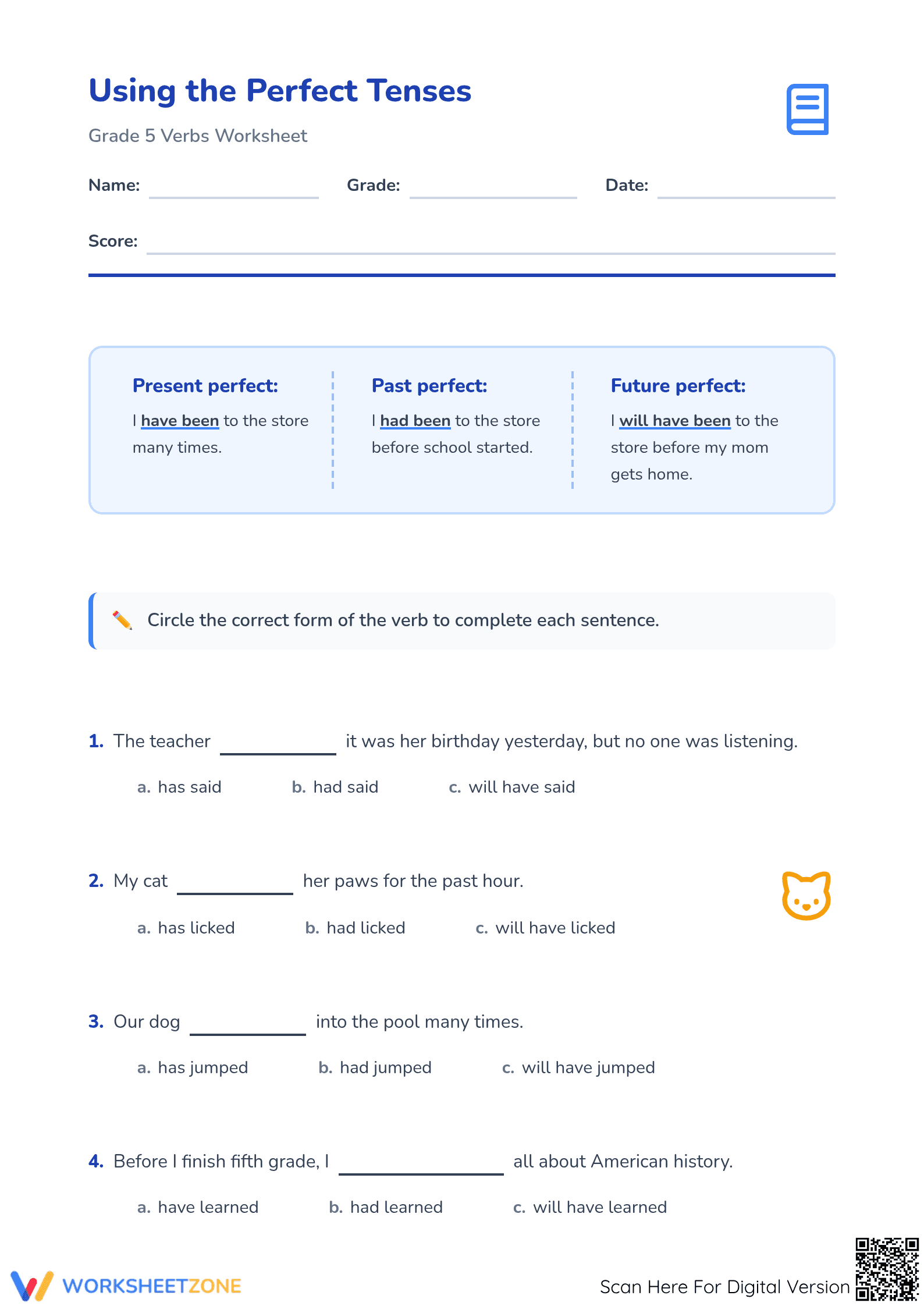
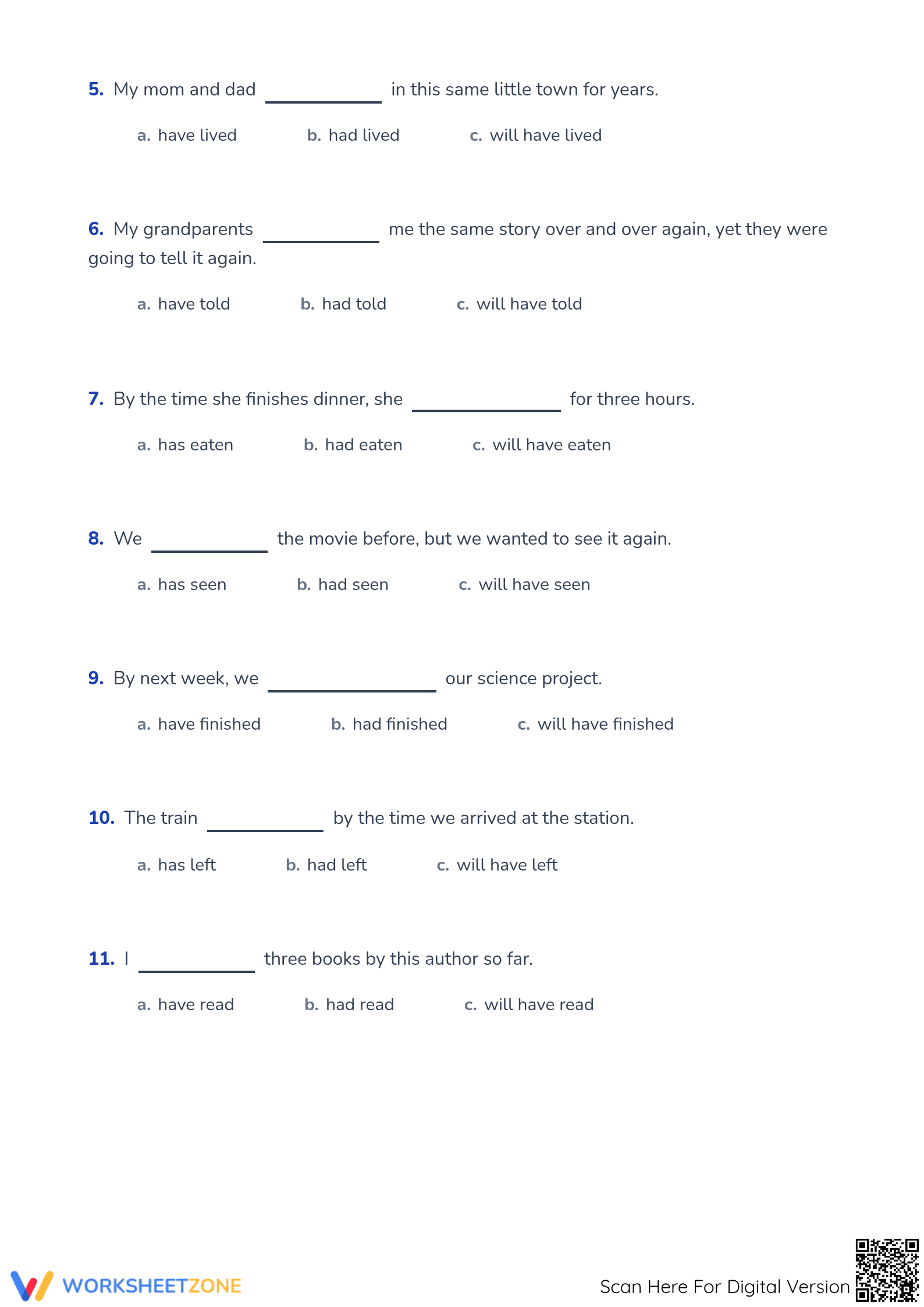
This Grade 5 ELA worksheet provides targeted practice for students to master the nuances of perfect verb tenses. By engaging with 12 structured multiple-choice problems, learners develop the ability to distinguish between past, present, and future perfect forms. The clear layout ensures students can focus on verb conjugation and temporal context to achieve grammatical mastery.
At a Glance
- Grade: 5 · Subject: ELA
- Standard:
CCSS.ELA-LITERACY.L.5.1.B— Form and use the perfect verb tenses in sentences- Skill Focus: Perfect Tense Identification
- Format: 3 pages · 12 problems · Answer key included · PDF
- Best For: Independent practice and formative assessment
- Time: 15–20 minutes
What's Inside: This comprehensive 3-page PDF includes a visual anchor chart at the top of the first page, serving as a quick-reference guide for students. It defines and provides examples for present perfect, past perfect, and future perfect tenses. Following the guide are 12 multiple-choice questions that challenge students to select the correct verb form based on sentence context. A full answer key is provided to facilitate quick grading.
The worksheet follows a logical instructional flow. It begins with a Guided Practice phase where the anchor chart provides immediate scaffolding for the first few problems. As students move into the Supported Practice phase, they must rely more on their understanding of time markers like "by next week" or "before school started." Finally, the Independent Practice phase allows students to demonstrate mastery across all 12 items. This gradual release ensures students build confidence before tackling complex sentence structures.
Standards Alignment: The primary focus of this resource is CCSS.ELA-LITERACY.L.5.1.B, which requires students to form and use the perfect (e.g., I had walked; I have walked; I will have walked) verb tenses. Additionally, it supports general language conventions under L.5.1. Both standard codes can be copied directly into lesson plans, IEP goals, or district curriculum mapping tools to ensure instructional compliance and tracking.
How to Use It: This resource is ideal for use during the independent portion of a direct instruction lesson on verb tenses. Teachers can also assign it as a high-quality homework task or a quick check-for-understanding after a mini-lesson. For a formative assessment tip, observe which students struggle with the future perfect items, as these often require the most cognitive load regarding temporal sequencing. Completion typically takes 15 to 20 minutes.
Who It's For: This worksheet is designed for Grade 5 students but is also effective for Grade 4 students ready for enrichment or middle schoolers requiring remedial support. It is particularly useful for English Language Learners (ELLs) who often struggle with the auxiliary verb combinations required for perfect tenses. Pair this with a mentor text or a tense-focused anchor chart for a complete instructional unit.
Research by Fisher & Frey (2014) emphasizes the gradual release of responsibility in literacy instruction. This worksheet aligns with that framework by providing a visual anchor chart before transitioning to 12 targeted items. Mastering CCSS.ELA-LITERACY.L.5.1.B requires students to recognize temporal relationships, a task that benefits from the structured multiple-choice format. By isolating past, present, and future perfect tenses, students focus on auxiliary verb shifts (has/have, had, will have) without complex construction distractions. This approach is supported by NAEP data suggesting that discrete grammar practice improves writing clarity and syntactic variety in upper elementary students. Educators can use these results for small-group interventions or as a diagnostic tool for identifying specific tense confusion.


