




























Views
Downloads

Linking Verbs Worksheet | Grade 3 Essential Practice

Paste this activity's link or code into your existing LMS (Google Classroom, Canvas, Teams, Schoology, Moodle, etc.).
Students can open and work on the activity right away, with no student login required.
You'll still be able to track student progress and results from your teacher account.
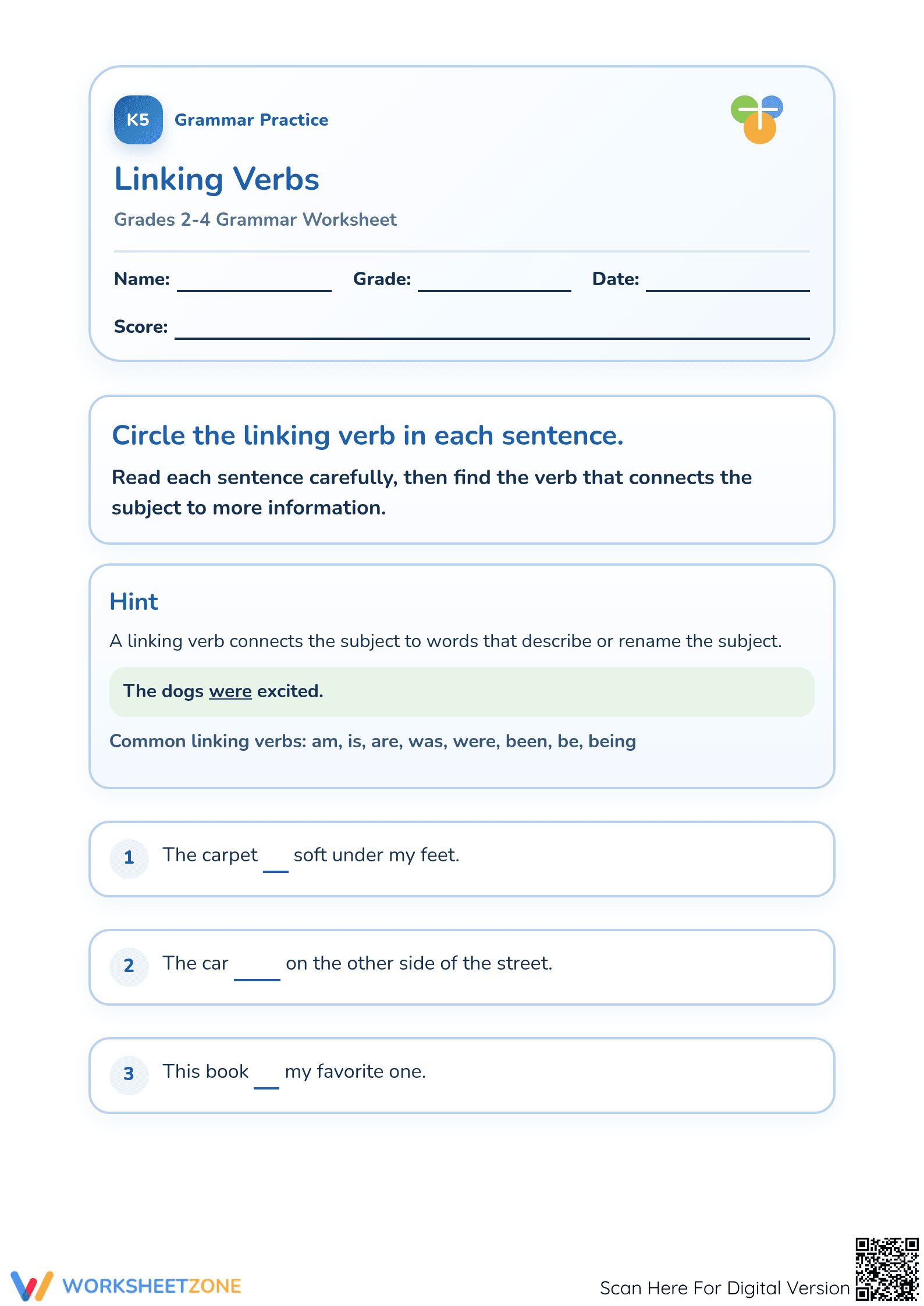
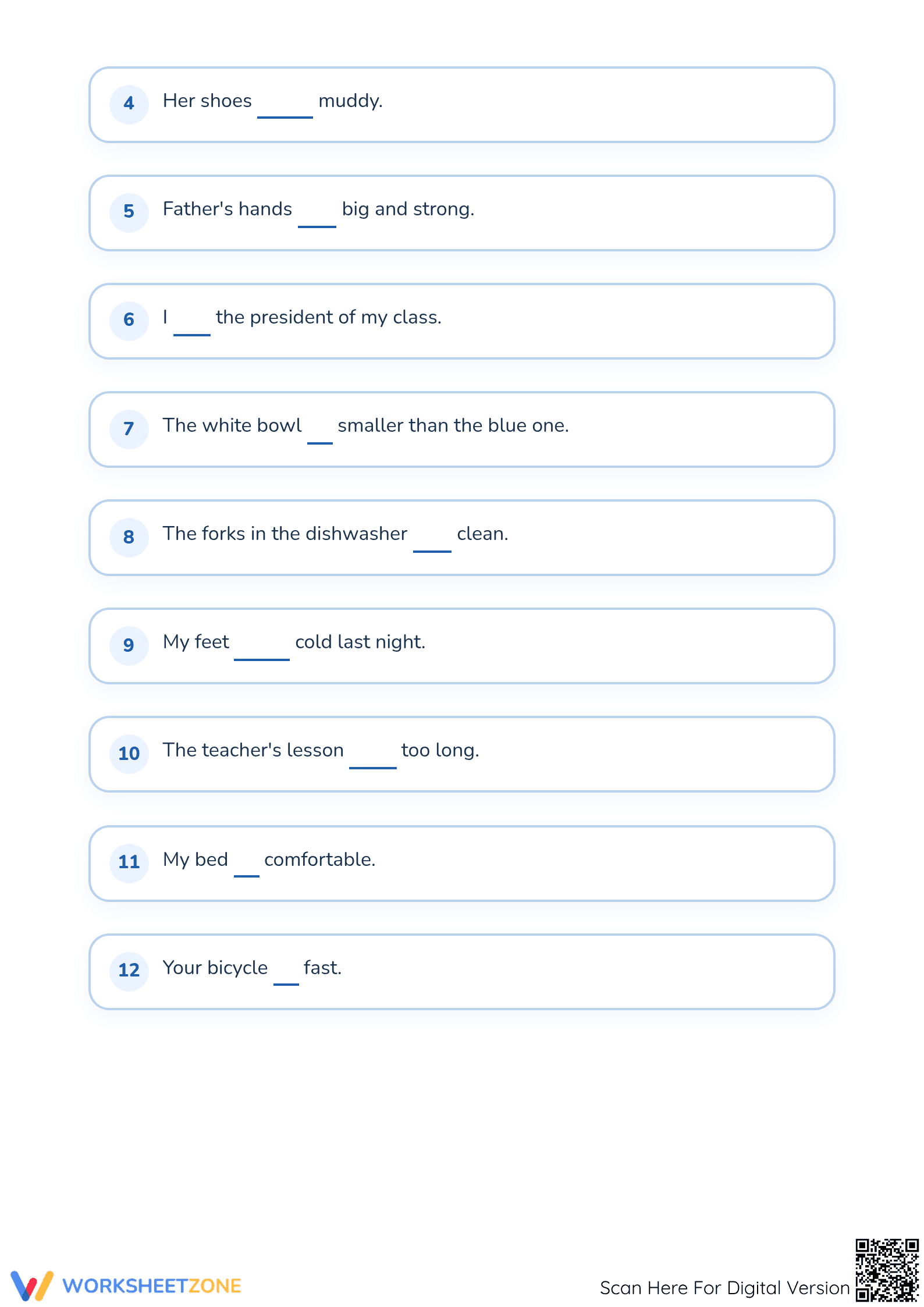
This Grade 3 linking verbs worksheet helps students identify and use verbs that connect subjects to descriptive words. By completing 12 targeted sentences, learners distinguish between action and state-of-being, improving their overall sentence structure and grammatical accuracy. It provides immediate clarity on how "is," "are," "was," and "were" function in context.
At a Glance
- Grade: 3 · Subject: ELA
- Standard:
CCSS.ELA-LITERACY.L.3.1— Demonstrate command of the conventions of standard English grammar and usage- Skill Focus: Linking Verb Identification
- Format: 2 pages · 12 problems · Answer key included · PDF
- Best For: Independent practice or homework reinforcement
- Time: 15–20 minutes
The resource contains a two-page student activity featuring 12 fill-in-the-blank sentences. A dedicated "Hint" box at the top of the first page defines linking verbs and provides a list of common examples like "am," "is," "are," "was," and "were." A comprehensive answer key is included for rapid grading or student self-correction.
Teachers can implement this resource in under two minutes. Simply print the two-page PDF (1 minute), distribute it to the class (30 seconds), and use the provided answer key for a quick verbal review or individual grading (30 seconds). Its self-contained "Hint" section makes it an ideal candidate for emergency sub plans or quiet morning work.
This worksheet aligns with `CCSS.ELA-LITERACY.L.3.1`, which requires students to demonstrate command of the conventions of standard English grammar and usage when writing or speaking. Specifically, it targets the foundational understanding of verb types necessary for complex sentence construction. Both standard codes can be copied directly into lesson plans, IEP goals, or district curriculum mapping tools.
Use this worksheet during the "You Do" phase of a gradual release lesson on word classes. After introducing the concept with an anchor chart, assign these 12 problems to assess individual student understanding. For a formative assessment, observe if students correctly identify plural subjects (like "shoes" or "forks") to select the appropriate plural linking verb. Completion typically takes 15 to 20 minutes.
This resource is designed for Grade 3 students, though it serves as excellent remediation for Grade 4 or enrichment for Grade 2. It is particularly helpful for English Language Learners (ELLs) who need explicit practice with auxiliary and linking verb agreement. Pair this with a short reading passage to have students hunt for linking verbs in a narrative context.
According to Fisher & Frey (2014), the use of scaffolded grammar practice—such as providing a "Hint" box with common examples—is vital for moving students toward independent mastery of linguistic conventions. This worksheet addresses `CCSS.ELA-LITERACY.L.3.1` by isolating linking verbs within 12 distinct sentence structures, allowing students to focus on the specific relationship between subjects and predicates. Research from the NAEP indicates that consistent, targeted practice with verb agreement significantly correlates with higher writing proficiency scores in the elementary years. By providing a clear definition and a list of common verbs like "is," "are," "was," and "were," this resource reduces cognitive load while reinforcing the "state of being" concept. This 2-page PDF is a reliable tool for ensuring students can accurately describe subjects in their own writing.


