




























Views
Downloads

Back-to-School Vocabulary Review | Essential Grade 3-5

Paste this activity's link or code into your existing LMS (Google Classroom, Canvas, Teams, Schoology, Moodle, etc.).
Students can open and work on the activity right away, with no student login required.
You'll still be able to track student progress and results from your teacher account.
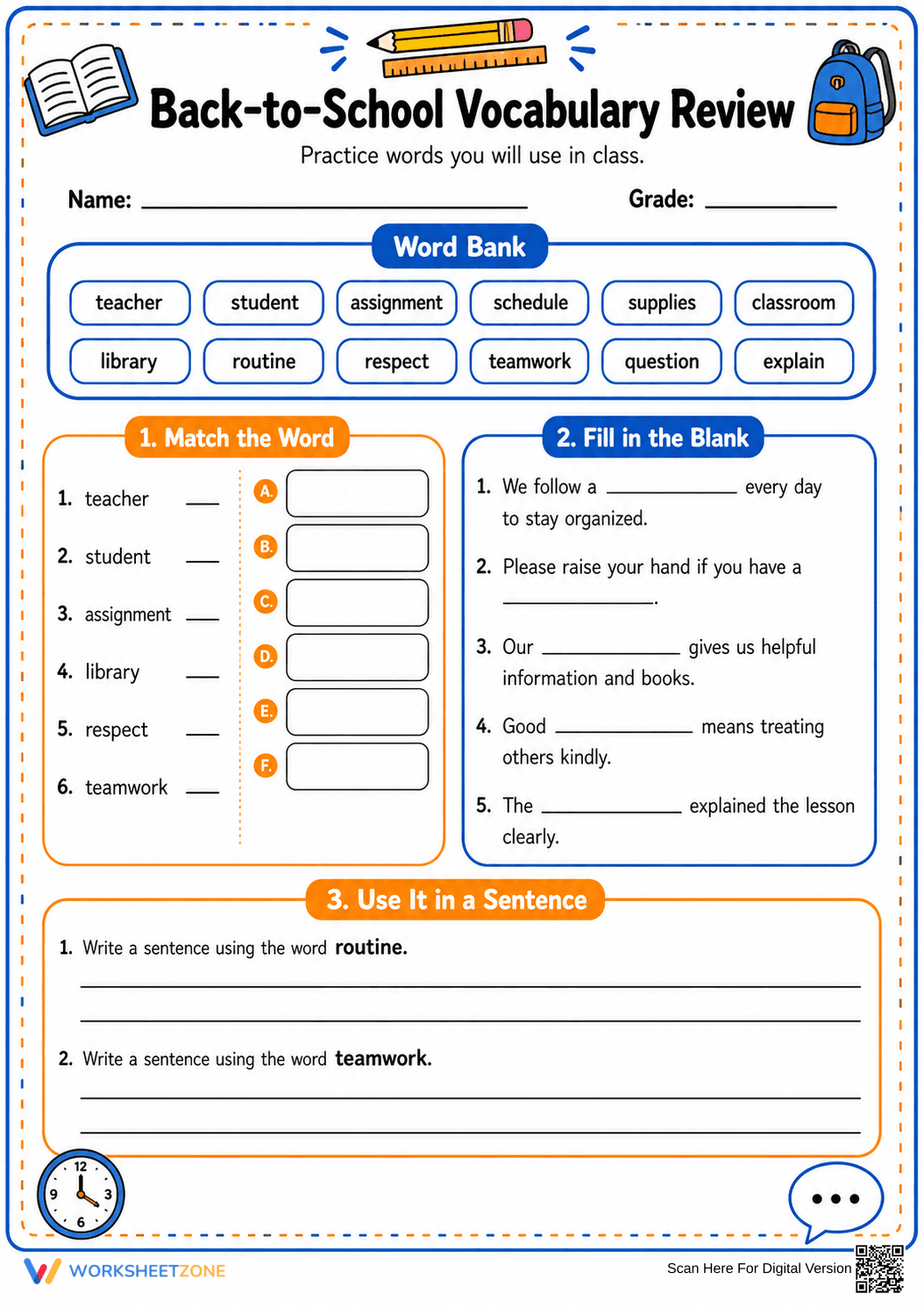
This Back-to-School Vocabulary Review worksheet helps students master 12 essential academic terms used in daily classroom life. By engaging with words like assignment, routine, and teamwork, learners build the linguistic foundation necessary for successful communication. This resource ensures students can identify, define, and apply key terminology across various learning contexts.
At a Glance
- Grade: 3 · Subject: ELA
- Standard:
CCSS.ELA-LITERACY.L.3.6— Acquire and use accurately grade-appropriate general academic and domain-specific words- Skill Focus: Academic Vocabulary
- Format: 1 page · 13 problems · Answer key included · PDF
- Best For: First week of school review
- Time: 15–20 minutes
The worksheet features a comprehensive word bank containing 12 high-frequency academic terms. It is organized into three distinct activity zones: a matching section for definitions, a fill-in-the-blank section for context clues, and a sentence-writing section for application. The layout includes clear headers and helpful school-themed icons to keep students engaged while providing a structured environment for independent work.
This resource is designed for a zero-prep classroom workflow. First, print the single-page PDF (30 seconds). Next, distribute the copies to students as they enter the room or during a transition (1 minute). Finally, review the answers using the included key or through a quick peer-grading session (5 minutes). Total teacher preparation time is under 2 minutes, making it an ideal choice for morning work.
This worksheet is primarily aligned with `CCSS.ELA-LITERACY.L.3.6`, which focuses on acquiring and using grade-appropriate general academic words and phrases. It also supports `CCSS.ELA-LITERACY.L.4.6` by requiring students to demonstrate mastery of vocabulary that is essential for comprehension. Both standard codes can be copied directly into lesson plans, IEP goals, or district curriculum mapping tools.
Use this worksheet as a formative assessment during the first week of school to gauge students' familiarity with classroom expectations. It works well as a "Do Now" activity to settle the class after the morning bell. Teachers should observe students during the sentence portion to identify those who may need additional support with syntax. Completion typically takes 15 to 20 minutes.
This resource is tailored for students in Grades 3 through 5, including English Language Learners who benefit from the visual word bank. It pairs naturally with a classroom expectations anchor chart or a direct instruction lesson on school routines. The clear layout and limited text density make it accessible for students with diverse learning needs.
According to the RAND AIRS 2024 report, explicit instruction in academic vocabulary is a critical predictor of long-term reading comprehension and academic success. This worksheet addresses that need by providing structured practice with the CCSS.ELA-LITERACY.L.3.6 standard, focusing on words that appear across multiple subject areas. By moving from simple recognition in the matching section to complex application in sentence construction, the resource follows a research-backed progression of vocabulary acquisition. The inclusion of context-rich sentences helps bridge the gap between isolated word knowledge and functional literacy. Educators can use this tool to ensure that all students, regardless of their starting point, gain the linguistic tools required for classroom participation. This systematic approach to word study supports the development of a robust mental lexicon, which is essential for navigating the increasingly complex texts encountered in upper elementary grades.


