These human life cycle pdf worksheets for 3rd grade give teachers a practical set of standalone resources covering each developmental stage — from infancy through old age — organized so individual worksheets can be pulled for warm-ups, center rotations, or end-of-unit review without needing to run the full set in sequence.
The Skills These Worksheets Target
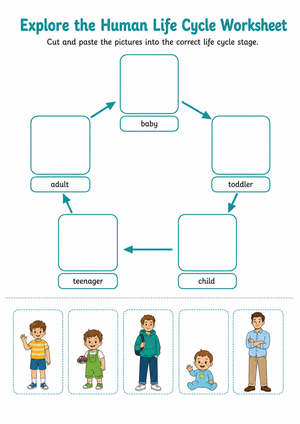
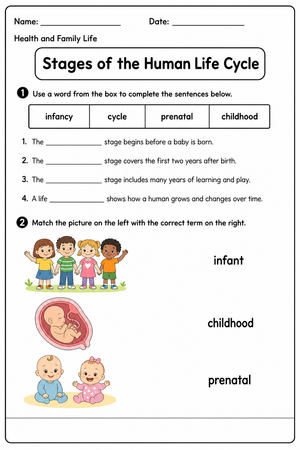
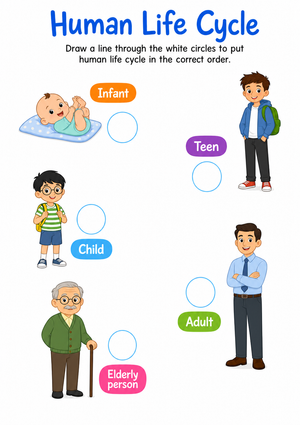
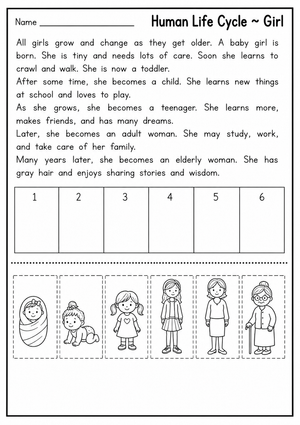
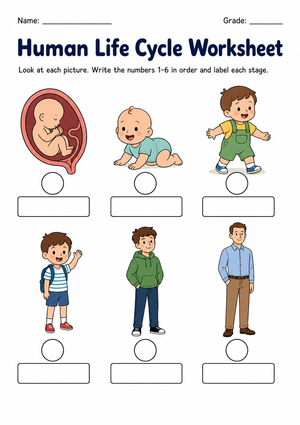
The set works through five stages of human development: infancy, childhood, adolescence, adulthood, and old age. Rather than repeating one format across every worksheet, the activities shift between task types. Students sequence the stages using cut-and-paste diagrams, label body illustrations at different points in the lifespan, match vocabulary terms to definitions, and sort physical characteristics — such as "loses primary teeth" or "height and weight increase steadily" — to the stage where they belong.
That last task type, sorting by characteristic rather than by name, does more cognitive work than a standard vocabulary match. It asks students to think functionally about each stage, which is closer to the reasoning NGSS performance expectations actually require. A student who has only memorized stage names will stall on a sorting task; a student who understands the stages will not.
Building These Worksheets Into Your Lesson Sequence
Most teachers reach this unit after covering plant or insect life cycles, which means students already carry a working mental model of birth → growth → reproduction → death. Starting with human life cycle pdf worksheets for 3rd grade at that point in the year is strategic: the familiar pattern transfers, and students spend attention on the specifics of human development rather than on figuring out what a life cycle is in the first place.
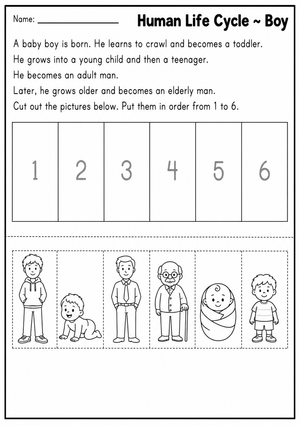
The sequencing worksheets have proven most useful as an opening move — a five-minute cut-and-paste at the start of the science block before direct instruction begins. Done early, they surface who already knows the correct order and who is guessing, which shapes the whole-class debrief that follows. Labeling and vocabulary worksheets land better after instruction, either as end-of-lesson consolidation or as a small-group activity during rotations. Pairing completed worksheets with a personal student timeline — a baby photo on one end, a self-portrait now, a drawn prediction for the future — creates a display that shows what students actually understand rather than just what they colored in.
Recurring Errors to Address Before They Stick
The most consistent sequencing error is placing adolescence after adulthood. Students read "adult" as the natural end point and drop old age and adolescence wherever space remains on the strip. Even students who perform correctly on a matching task will misorder the stages when asked to sequence from a blank. Running both task types in the same unit catches both error patterns — they are not the same skill.
A subtler problem shows up in characteristic-sorting tasks. Students assign "can reproduce" only to adulthood, skipping the biological reality that this capacity first emerges during adolescence. That confusion is worth naming during instruction rather than just marking wrong on the worksheet, because it connects directly to what the NGSS standard actually emphasizes: reproduction as a life cycle stage, not a single moment.
Some students at this grade also insert toddlerhood as its own named stage, creating a six-category sequence. This usually comes from having younger siblings — they know the word from home and apply it logically. Acknowledging that the instinct makes sense, then clarifying that childhood in the five-stage framework spans toddler years through late childhood, keeps the correction from feeling arbitrary to a student who is clearly paying attention.
Standard Alignment
These resources align directly to NGSS 3-LS1-1, which asks students to develop models showing that organisms have unique and diverse life cycles but all share birth, growth, reproduction, and death. The sequencing and diagram activities function as that model-development step — students aren't recalling vocabulary in isolation but constructing a visual representation of a biological process. Teachers using these worksheets as the entry point for the life cycles strand should plan to extend the standard's full scope with companion work on plant and animal life cycles. The human model works best as the anchor example students return to for comparison, not as the only case they examine. Human life cycle pdf worksheets for 3rd grade naturally provide that anchor because students can locate themselves on the diagram they're studying, which makes the abstract standard feel genuinely concrete.
Adjusting the Set for a Range of Learners
For students who need additional support, the cut-and-paste sequencing worksheets remove the writing demand and let them focus purely on ordering. Pairing those with a posted vocabulary reference — stage names and one defining phrase each — reduces the working memory load without removing the intellectual challenge of the task itself. For students ready to move further, the characteristic-sorting activities extend naturally into comparative work: students sort the same characteristic cards against a second organism's life cycle, such as a frog or a butterfly, and identify which features are shared and which are unique to humans. This extension connects directly to the NGSS expectation that students compare life cycles across species.
One honest limitation: the worksheets that pair a short reading passage with follow-up questions can frustrate students who hit unfamiliar vocabulary mid-task and stall. In those cases, reading the passage aloud as a class before releasing students independently resolves the access problem without simplifying the science. The concept understanding is often present; the barrier is text load, not the life cycle content itself.
Frequently Asked Questions
Which stage do 3rd graders belong to, and does that affect how they engage with this material?
Third graders are solidly in childhood — most are eight or nine years old, placing them past the rapid motor development of early childhood but still years from adolescence. This makes human life cycle pdf worksheets for 3rd grade particularly engaging at this specific grade: students can locate themselves on the diagram they're labeling, which shifts the activity from abstract biology to something personally meaningful. That self-location moment is worth pausing on during instruction.
How do these worksheets connect to a butterfly or frog life cycle unit?
They work well as the human anchor in a broader life cycles unit. Butterflies and frogs undergo metamorphosis, producing young that look nothing like the adult form. Humans develop directly — a newborn is recognizably human and simply grows over time. Using both organisms in the same unit sharpens comparative thinking: students start to see that "life cycle" is a pattern with variation, not a single script every organism follows. The human case is the one students find easiest to reason about, so returning to it during frog or butterfly instruction reinforces both.
Are these worksheets suited for science center use?
The cut-and-paste sequencing and labeling formats work well at a center because the task is self-contained and the directions are largely visual rather than dependent on multi-step written instructions. Vocabulary matching works as independent practice once the terms have been introduced in class. Short reading-response worksheets are better suited to whole-class or small-group use — students who hit an unfamiliar word mid-task will stall at a center without someone nearby to clarify, and that stall tends to spread to neighboring stations quickly.
Do the worksheets address more than physical growth?
Several worksheets in the set include both physical and cognitive or social characteristics at each stage — distinguishing, for example, "weight triples in the first year" from "begins to produce short sentences" within infancy alone. That dual focus gives teachers a natural opening to discuss what development actually means beyond height and weight charts. Using human life cycle pdf worksheets for 3rd grade that include both types of characteristics reflects the way students actually experience growing up: they can name physical changes easily, but the cognitive and social markers are often what they find most interesting to discuss once the conversation opens.