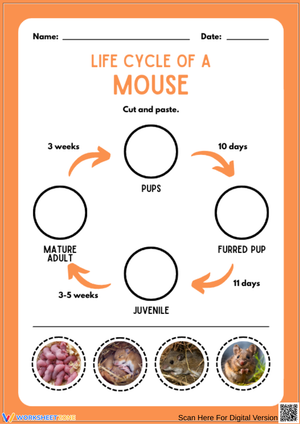
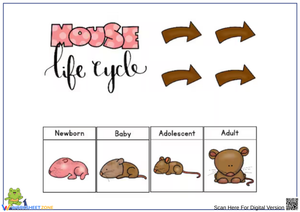
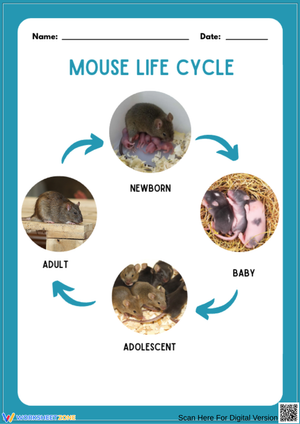
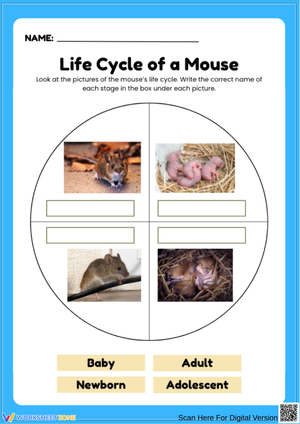
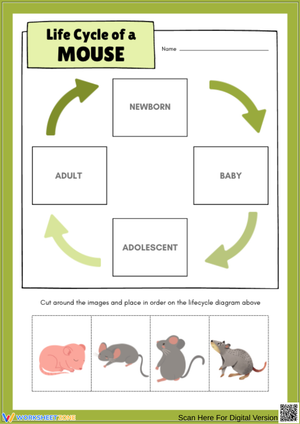
These mouse life cycle worksheets for 3rd grade give students a structured path through one of the fastest-developing mammals in North America — from a blind, hairless newborn to a reproductively mature adult in roughly six weeks. The set covers sequencing, labeled diagram work, vocabulary building, and cross-animal comparison tasks that map directly onto the modeling work NGSS 3-LS1-1 requires.
The Specific Skills These Worksheets Build
Sequencing activities ask students to arrange the four stages — newborn (pinky), pup, juvenile, adult — and annotate each with at least one physical marker that signals the transition. Labeling activities require students to identify specific traits in a diagram: hairless skin in the pinky, emerging fur in the pup, and the functional distinction between a hopper pup (still nursing, beginning to explore the nest) and a juvenile (fully furred, eating solid food, not yet sexually mature). Most resources conflate those two stages, and most students will too, until the labeling task forces them apart.
Vocabulary exercises pair key terms — warm-blooded, live birth, nurse, juvenile — with definitions students apply in context, and one worksheet asks for a brief written explanation of what marks the transition from juvenile to adult. The cross-animal comparison task rounds out a mouse life cycle worksheets for 3rd grade set, placing the mouse's four stages next to a frog's or butterfly's life cycle so students identify both what the mouse shares with every other organism and what the mammalian developmental path looks like when set against metamorphosis.
The mouse's compressed timeline makes each stage genuinely distinct for third graders. A house mouse moves from pinky to sexually mature adult in five to eight weeks. Each stage carries observable, nameable physical changes — eyes opening, fur growing, the shift from nursing to solid food — which means students can attach the abstract concept of growth to something they can describe and draw rather than simply memorize.
Student Misconceptions Worth Catching Before They Stick
The most consistent error is what teachers sometimes call metamorphosis contamination. After units on butterflies and frogs, third graders carry a mental model in which a life cycle must involve transformation into something unrecognizable. When asked to sequence a mouse life cycle unprompted, a significant portion of students invent a stage that does not exist — a cocoon, an egg, a "change phase" somewhere in the middle. The sequencing worksheet surfaces this immediately, but the correction requires explicit instruction, not just marking the answer wrong. Students need to hear directly that mammals do not undergo metamorphosis, and that growing larger while still looking like a mouse is a valid and complete developmental arc.
A second reliable error involves collapsing the pup and juvenile stages into one. Students call both "baby mouse" and treat the juvenile as simply a smaller adult. The labeling worksheet addresses this with three targeted prompts at each stage: Are the eyes open? Is this mouse still nursing? Can this mouse reproduce? Those questions reveal the developmental logic better than a paragraph of teacher explanation — and the detail about nursing becomes a useful anchor for the broader unit on mammalian traits.
Working These Worksheets Into the Science Block
The sequencing worksheet in a mouse life cycle worksheets for 3rd grade set works best as a Day 1 diagnostic — hand it out before any direct instruction and ask students to arrange the stages by physical appearance alone. Their predictions will be wrong in predictable ways, and those specific errors become the lesson. When students return to the same task after instruction, they see exactly what they missed. That before-and-after structure produces stronger retention than any single post-instruction activity.
The labeling worksheet belongs mid-unit as a formative check. If students can accurately label the pinky's traits (hairless, eyes closed, wholly dependent) against the juvenile's (fully furred, independent, pre-reproductive), they are ready for the comparison task. If not, the errors are specific and visible enough to address in 10 minutes before the next science block. Save the cross-animal comparison for the final days of the unit — students hold two life cycle models simultaneously, which carries higher cognitive load, and the task pays off most when both structures are already stable.
Standard Alignment
These worksheets address NGSS 3-LS1-1: Develop models to describe that organisms have unique and diverse life cycles but all have in common birth, growth, reproduction, and death. The mouse's four stages map cleanly onto the standard's four named elements, and because the mammalian life cycle rarely appears before third grade — butterflies and frogs dominate K–2 life science — a mouse life cycle worksheets for 3rd grade set fills a real curriculum gap. The "unique and diverse" clause specifically requires students to see more than one developmental pattern, which is what the cross-animal comparison task delivers. The sequencing and labeling work is cumulative: it builds the individual model before asking students to set it alongside another.
Matching These Worksheets to Different Student Levels
Students who need more support work better on the sequencing task when a word bank and a partially labeled diagram are provided. The task becomes placing and matching rather than generating from memory — lower retrieval demand, same conceptual content. Run the supported version first, then return to the blank version after students have had a day or two with the material. The repetition builds toward independent recall without the frustration of a cold-start blank diagram.
Students working above grade level benefit from an extension that stretches the cross-animal comparison beyond the built-in prompt. After completing the mouse-versus-frog task, they can research a mammal with a dramatically longer developmental arc — elephant gestation runs approximately 22 months, and juvenile elephants remain dependent on the herd for years. Placing those numbers next to the mouse's six-week timeline makes the phrase "unique and diverse" concrete in a way that no textbook definition achieves. A short written response asking students to hypothesize what drives the difference — body size, lifespan, predator pressure — opens into ecology and evolutionary reasoning without leaving the 3-LS1-1 frame.
Frequently Asked Questions
What are the four stages of the mouse life cycle?
The four stages are the newborn (pinky), the pup, the juvenile, and the adult. The pinky is hairless, blind, and wholly dependent on the mother. The pup stage covers rapid fur growth and sensory development, including the opening of eyes and the gradual shift toward solid food. The juvenile looks like a small adult but has not reached sexual maturity. The adult stage begins when the mouse becomes capable of reproduction.
Why use a mouse for a life cycle unit rather than a more familiar mammal?
The mouse's compressed timeline — five to eight weeks from birth to reproductive maturity — makes each stage visually distinct and describable in a way a longer-lived mammal's stages would not be. Students can anchor each transition to specific, observable physical changes rather than to an abstract passage of months or years. That specificity is what makes the mouse workable as a third-grade modeling task under NGSS 3-LS1-1.
What should teachers address before students begin these worksheets?
The worksheets build most vocabulary from scratch, so extensive pre-teaching is not necessary. The one concept worth addressing before students begin is the difference between metamorphosis and direct development. Without it, students reliably impose the butterfly or frog model onto the mouse — drawing transformation stages that do not exist — and the sequencing task becomes about correcting a structural misconception rather than learning the mouse's actual developmental arc.