




























Views
Downloads

Grade 3 Human Life Cycle — Printable No-Prep Worksheet

Paste this activity's link or code into your existing LMS (Google Classroom, Canvas, Teams, Schoology, Moodle, etc.).
Students can open and work on the activity right away, with no student login required.
You'll still be able to track student progress and results from your teacher account.
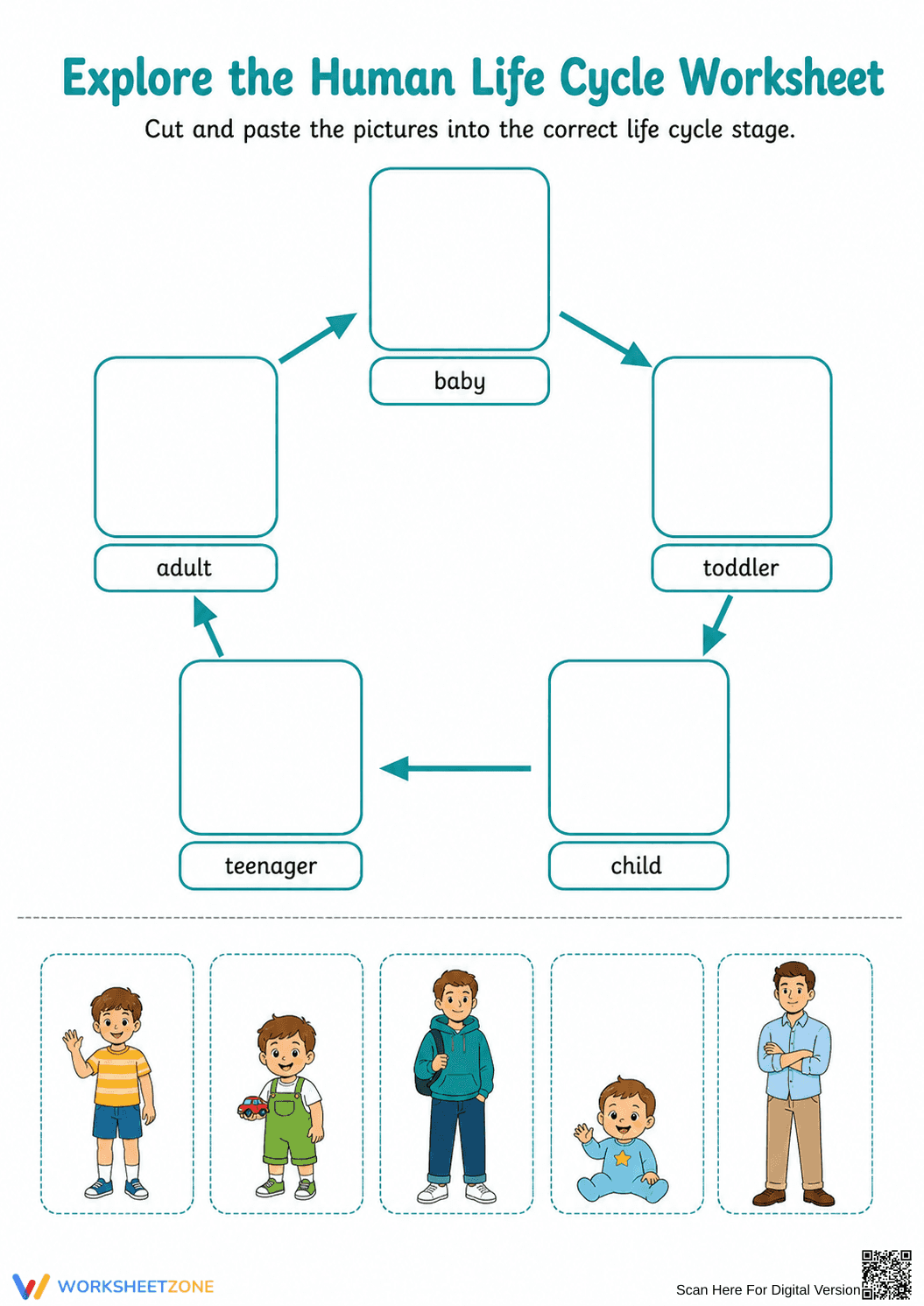
This printable science worksheet helps students sequence the human life cycle by identifying and organizing key developmental stages. By cutting and pasting illustrations of a baby, toddler, child, teenager, and adult into a continuous circular diagram, learners actively build their understanding of biological growth and chronological sequencing.
At a Glance
- Grade: 3 · Subject: Science
- Standard:
3-LS1-1— Describe that organisms have unique and diverse life cycles- Skill Focus: Sequencing life cycle stages
- Format: 1 page · 5 problems · PDF
- Best For: Independent practice and science centers
- Time: 15–20 minutes
This single-page resource features a clear, circular graphic organizer with five labeled boxes representing the stages of human development. At the bottom, students find five illustrations depicting a male at various ages. The activity requires students to cut out these cards and paste them into the corresponding sections, reinforcing science concepts and fine motor skills.
Designed for immediate classroom implementation, this activity requires no teacher setup.
- Print (1 min): Print the single-page PDF. No special materials are needed beyond standard scissors and glue.
- Distribute (1 min): Hand out the worksheets. The visual instructions are self-explanatory.
- Review (2 mins): Quickly check the completed diagrams visually to ensure the chronological sequence is correct.
With total prep under two minutes, this is an excellent addition to emergency sub plans.
This worksheet aligns with 3-LS1-1, requiring students to develop models describing that organisms have unique life cycles including birth, growth, and death. By mapping the human journey from infancy to adulthood, learners create a visual model of biological progression. Both standard codes can be copied directly into lesson plans, IEP goals, or district curriculum mapping tools.
This cut-and-paste activity works perfectly as an independent practice task following a whole-class lesson on animal and human life cycles. Teachers can also place it in a science center for collaborative small-group work. As a formative assessment tip, observe students while they work to see if they can independently distinguish between the toddler and child stages before gluing them down. Expected completion time ranges from 15 to 20 minutes.
This resource is ideal for early elementary students, specifically second and third graders, who are building foundational biology knowledge. The highly visual nature of the task makes it an excellent differentiation tool for English Language Learners and special education students who benefit from tactile, hands-on sorting activities. It pairs naturally with introductory science texts about human growth.
Understanding biological progression is a fundamental component of early science education. This activity directly supports standard 3-LS1-1 by having students describe that organisms have unique and diverse life cycles through a hands-on modeling task. According to a ScienceDirect TpT Analysis, integrating tactile elements like cutting and pasting into conceptual science lessons significantly improves retention and engagement for elementary learners. By physically moving the developmental stages into a continuous loop, students internalize the chronological sequence more effectively than through passive observation alone. This multimodal approach ensures that abstract biological concepts become concrete, accessible, and memorable for young minds. Engaging with the material in this interactive format helps solidify foundational knowledge, laying the essential groundwork for more complex life science topics they will encounter in upper grades.


