




























Views
Downloads
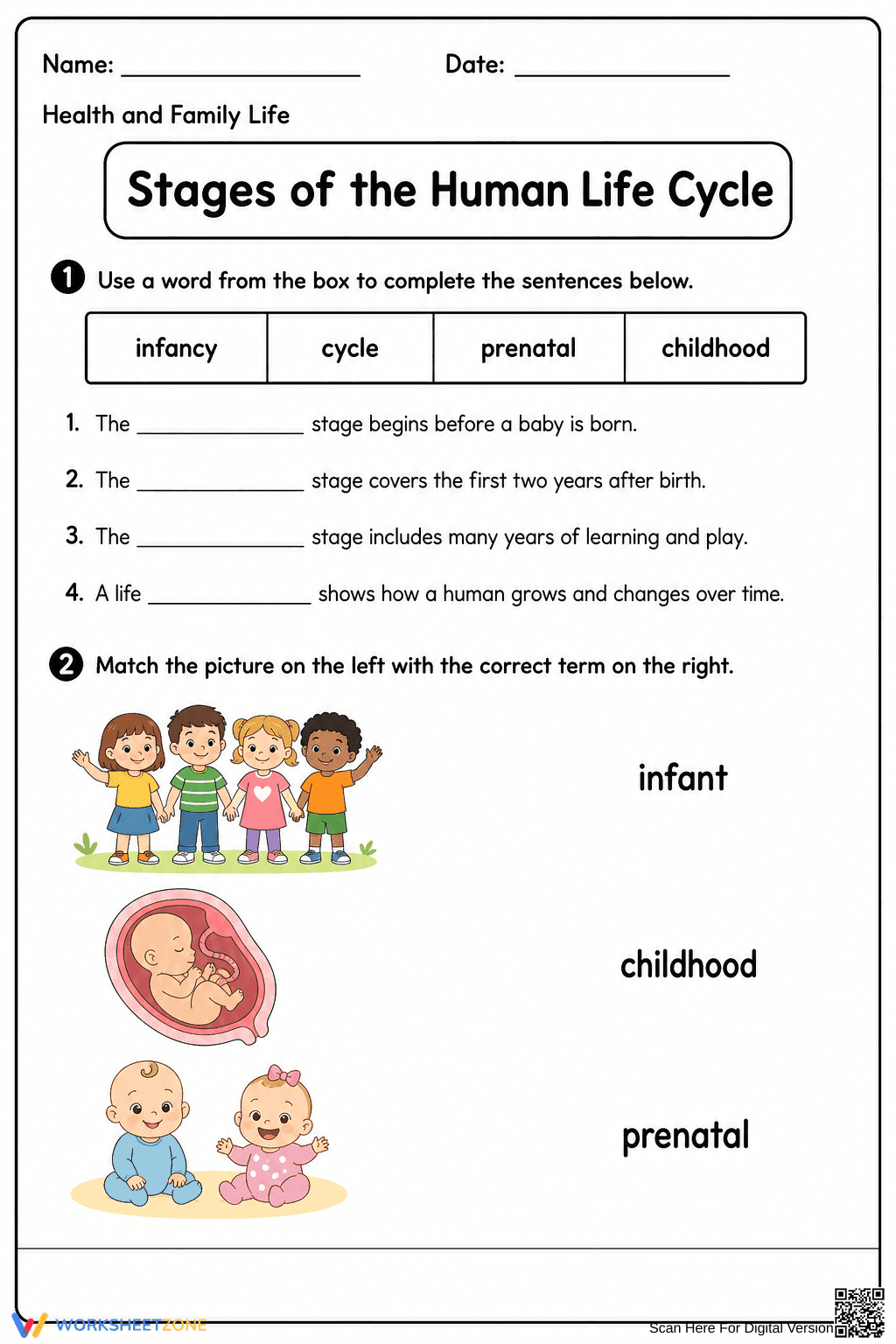

Human Life Cycle Worksheet | Grade 3 Printable

Paste this activity's link or code into your existing LMS (Google Classroom, Canvas, Teams, Schoology, Moodle, etc.).
Students can open and work on the activity right away, with no student login required.
You'll still be able to track student progress and results from your teacher account.
This Grade 3 science worksheet helps students identify and define the primary stages of human development. By engaging with both vocabulary and visual aids, learners build a foundational understanding of how humans grow and change over time. It provides a clear, structured approach to life science concepts and student outcomes.
At a Glance
- Grade: 3 · Subject: Science
- Standard:
3-LS1-1— Develop models to describe that organisms have unique and diverse life cycles- Skill Focus: Human development stages
- Format: 1 page · 7 problems · Answer key included · PDF
- Best For: Introduction to life science units
- Time: 15–20 minutes
What's Inside: The worksheet contains two distinct sections across a single page. The first part features a word bank with four key terms—infancy, cycle, prenatal, and childhood—used to complete descriptive sentences. The second part provides three high-quality illustrations representing different developmental milestones, requiring students to match the image to the correct scientific term.
The zero-prep workflow is designed for maximum efficiency. Teachers can print the single-page PDF in under 30 seconds. Distribution to a standard class takes approximately 1 minute. Reviewing the 7 tasks using the included answer key allows for a rapid 2-minute formative assessment check at the end of the lesson. This makes it an ideal resource for emergency sub plans or quick morning work.
Standards Alignment: This resource aligns with `3-LS1-1`, which requires students to understand that while life cycles vary, they all share common patterns of growth. It specifically addresses the human component of biological development. Both standard codes can be copied directly into lesson plans, IEP goals, or district curriculum mapping tools.
How to Use It: Use this as a "hook" activity during the first 15 minutes of a life science lesson to gauge prior knowledge. Alternatively, assign it as an exit ticket to verify that students can distinguish between prenatal and infancy stages. Expected completion time is 15 to 20 minutes depending on student reading level and familiarity with the terms.
Who It's For: This is ideal for third-grade students beginning their study of biology. It is also highly effective for English Language Learners (ELLs) due to the heavy reliance on visual matching and sentence frames. Pair this with a classroom anchor chart showing a full human growth timeline or a direct instruction lesson on mammalian development.
According to Fisher & Frey (2014), the use of visual non-linguistic representations paired with academic vocabulary significantly improves retention in early science education. This worksheet utilizes that dual-coding approach by requiring students to map the term "infant" or "childhood" to specific physiological characteristics shown in the illustrations. By focusing on the 3-LS1-1 standard, the material ensures that students move beyond simple naming to understanding the sequence of biological growth. Research indicates that structured worksheets with clear word banks reduce cognitive load, allowing students to focus on the conceptual transition between life stages rather than spelling or syntax. This resource provides the necessary scaffolding to move from guided observation to independent identification of human milestones. It serves as a reliable tool for documenting student progress toward mastery in life science domains.


