


























Views
Downloads

Grade 3 Human Life Cycle — Printable No-Prep Worksheet
Paste this activity's link or code into your existing LMS (Google Classroom, Canvas, Teams, Schoology, Moodle, etc.).
Students can open and work on the activity right away, with no student login required.
You'll still be able to track student progress and results from your teacher account.
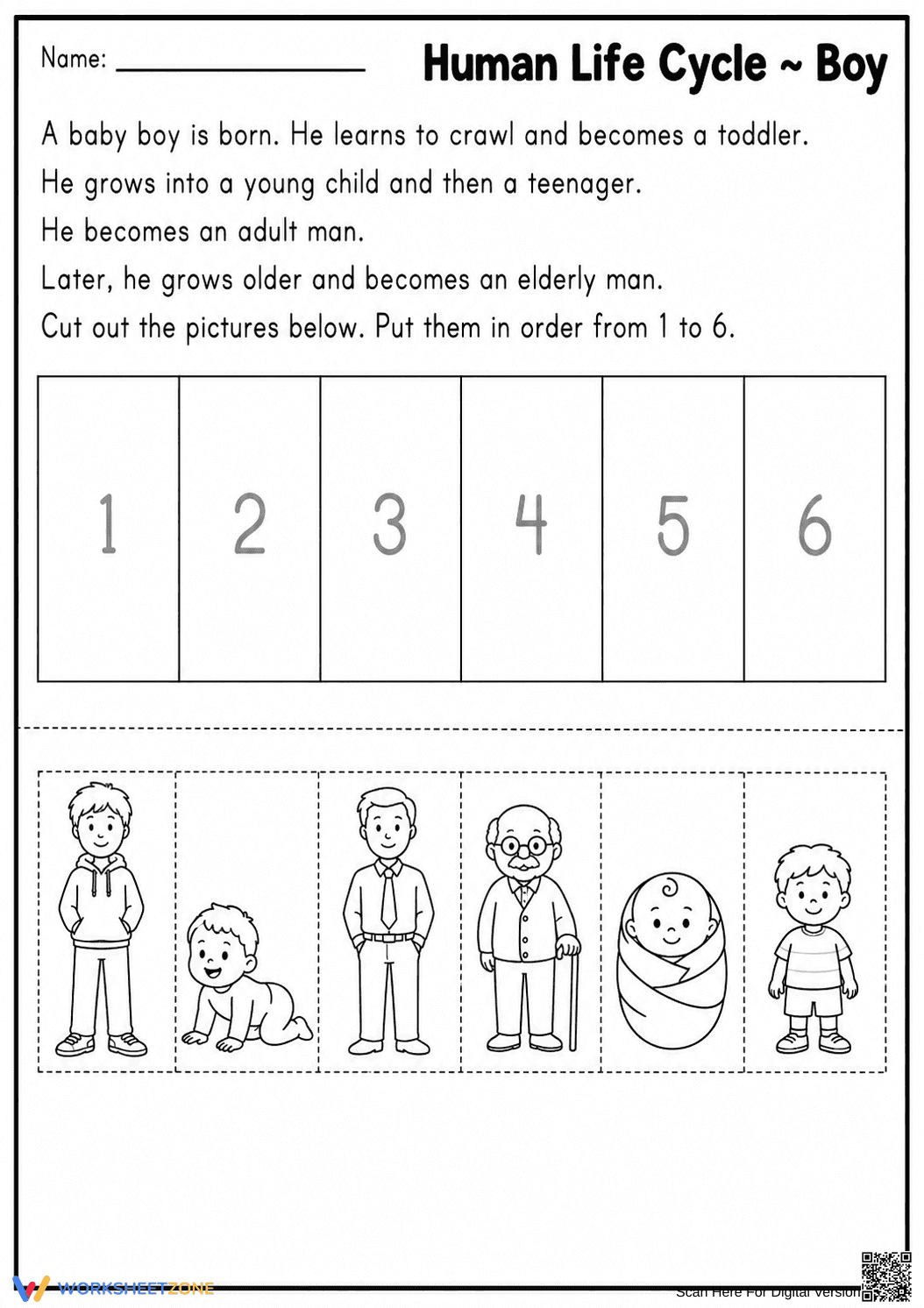
This Grade 3 human life cycle worksheet helps students master biological sequencing by identifying and ordering the six developmental stages of a male. Students read a descriptive passage and use visual cues to demonstrate their understanding of growth and development. It provides a clear, hands-on way to visualize the progression from infancy to old age.
At a Glance
- Grade: 3 · Subject: Science
- Standard:
3-LS1-1— Develop models to describe that organisms have unique and diverse life cycles- Skill Focus: Chronological sequencing of life stages
- Format: 1 page · 6 problems · Cut-and-paste · PDF
- Best For: Introduction to biological growth and development
- Time: 15–20 minutes
The resource features a concise reading passage that defines the stages: baby, toddler, child, teenager, adult, and elderly. Below the text, a numbered grid provides a structured workspace for the 6 cut-and-paste illustrations. The black-and-white line art is designed for easy printing and allows students to color the stages after completing the sequencing task.
This activity is designed for immediate classroom implementation with a total teacher prep time of under 2 minutes. Simply print the single-page PDF and distribute it to students. The clear instructions allow for independent work, making it an ideal choice for science centers, morning work, or emergency sub plans where minimal explanation is required.
This worksheet aligns with `3-LS1-1`: "Develop models to describe that organisms have unique and diverse life cycles but all have in common birth, growth, reproduction, and death." It specifically addresses the "growth" component by illustrating the human maturation process. Both standard codes can be copied directly into lesson plans, IEP goals, or district curriculum mapping tools.
Use this as a formative assessment after a direct instruction lesson on animal and human growth. Observe students as they arrange the pictures to identify any misconceptions about the transition between childhood and adulthood. The expected completion time is 15 to 20 minutes, including the cutting and pasting phase.
This resource is tailored for Grade 3 students but is accessible for Grade 2 learners or English Language Learners (ELLs) due to the heavy visual support. It pairs naturally with a classroom anchor chart showing various animal life cycles for a comparative biology unit.
According to the RAND AIRS 2024 report, visual sequencing tasks significantly improve retention of biological concepts in early elementary learners. This worksheet targets the 3-LS1-1 standard by requiring students to construct a physical model of the human life cycle. By identifying the 6 distinct stages—from baby to elderly man—students develop a foundational understanding of the "growth" phase common to all organisms. Research by Fisher & Frey (2014) suggests that combining short informational texts with tactile activities, such as this cut-and-paste format, supports the gradual release of responsibility. This 1-page resource provides the necessary scaffolding for students to move from reading comprehension to independent application of scientific sequencing. It serves as a reliable tool for documenting student progress toward NGSS mastery in life science units focused on inheritance and variation of traits.


