




























Views
Downloads

Grade 2 Human Life Cycle — Printable No-Prep Worksheet

Paste this activity's link or code into your existing LMS (Google Classroom, Canvas, Teams, Schoology, Moodle, etc.).
Students can open and work on the activity right away, with no student login required.
You'll still be able to track student progress and results from your teacher account.
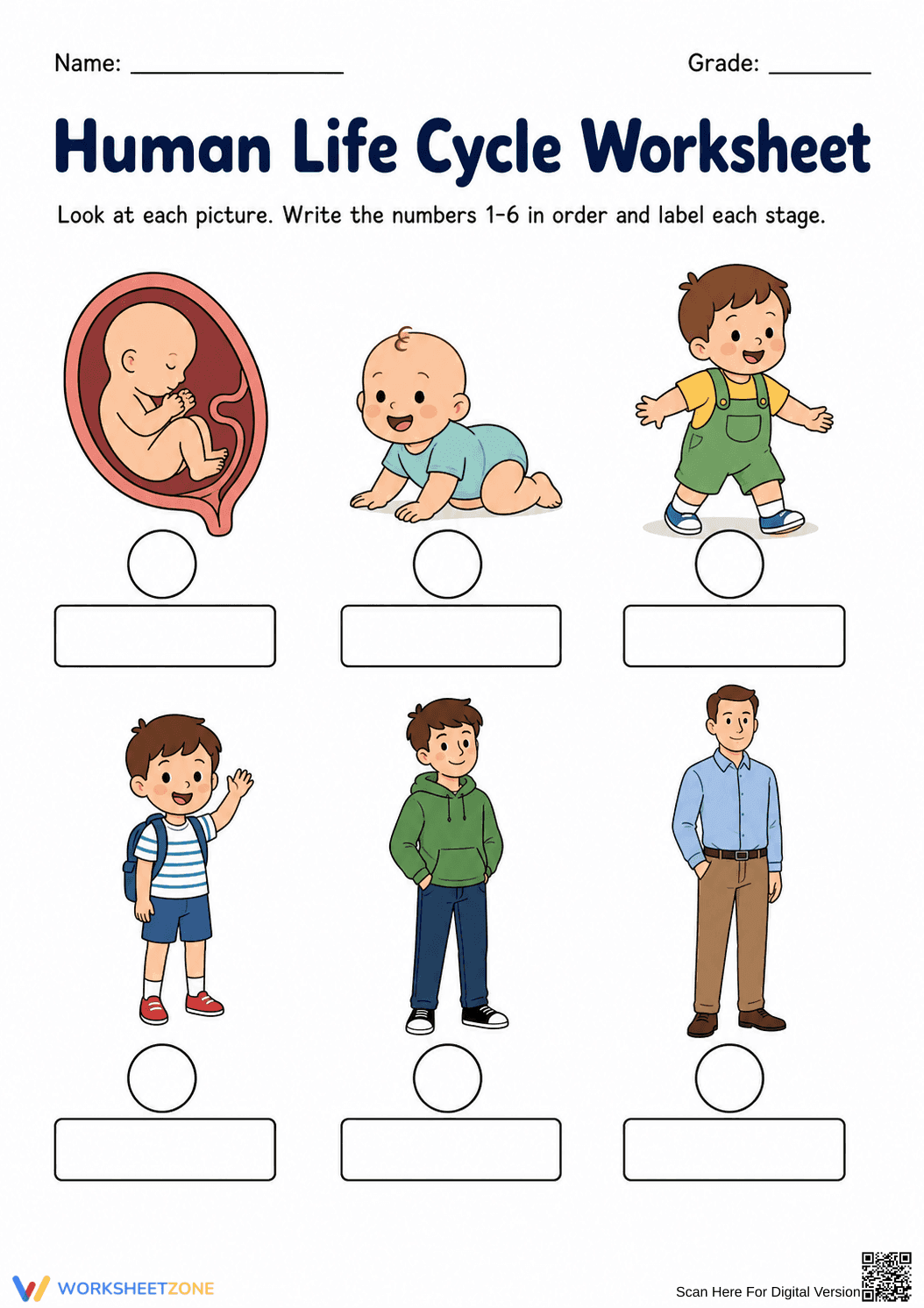
This Grade 2 science worksheet provides a clear way for students to sequence the primary stages of human development. By matching visual representations with labels, learners build a concrete understanding of how humans grow from pre-natal development through adulthood. It simplifies biological concepts into manageable, observable steps for young scientists.
At a Glance
- Grade: 2 · Subject: Science
- Standard:
3-LS1-1— Describe that organisms have unique life cycles but common birth and growth- Skill Focus: Sequencing and labeling life stages
- Format: 2 pages · 6 problems · Answer key included · PDF
- Best For: Individual practice or formative science assessment
- Time: 10–15 minutes
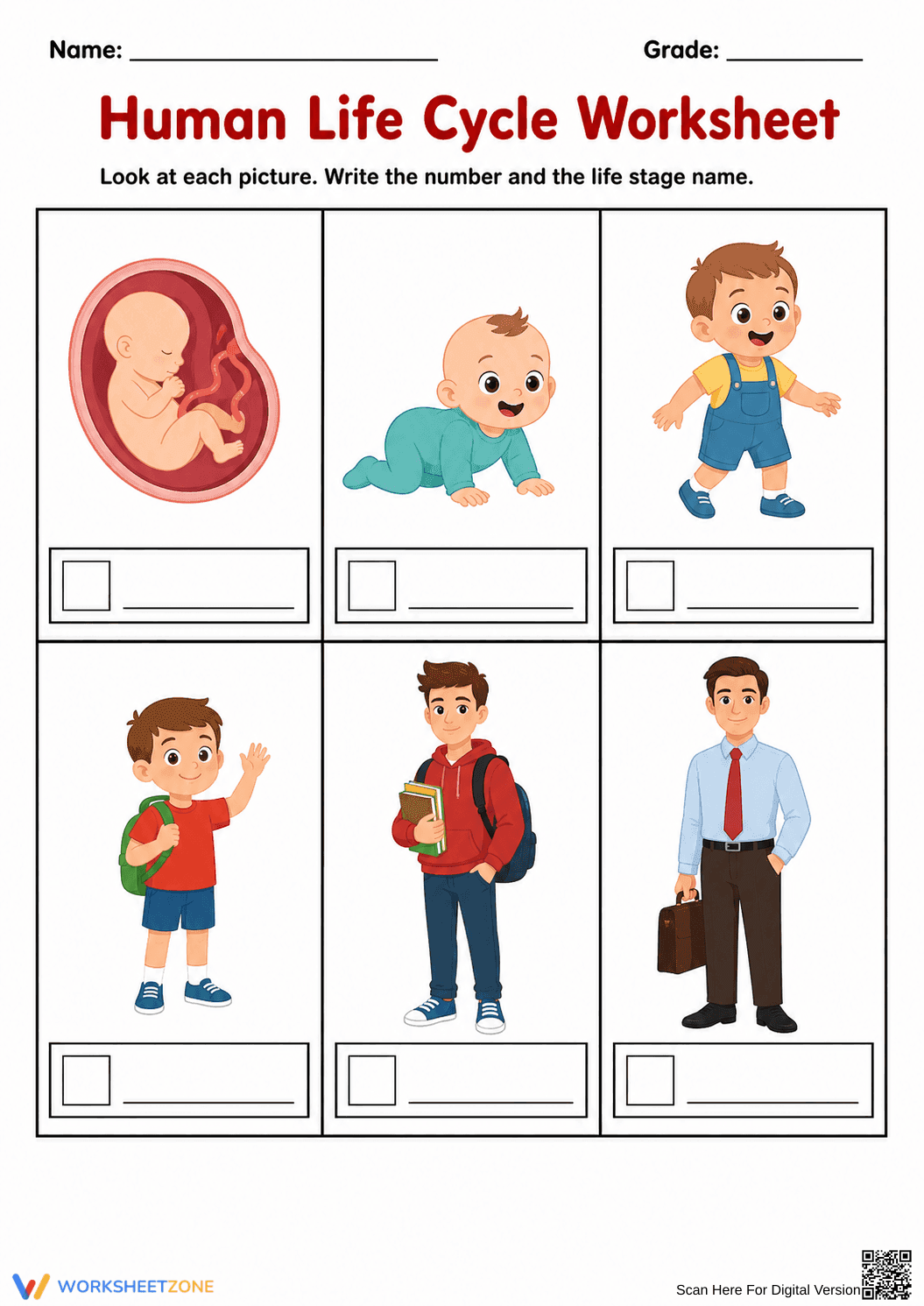
The download contains two PDF pages. The first is the student worksheet featuring six illustrations of a human at various stages: pre-natal, infant, toddler, child, teenager, and adult. Students must number these stages chronologically and write labels in the provided boxes. The second page is a comprehensive answer key for quick grading or student self-correction.
This resource follows a zero-prep workflow. You can print the worksheet in 30 seconds and distribute it immediately. Students can complete the sequencing in 10 minutes, followed by a brief group review using the answer key. This makes it an ideal choice for emergency sub plans or as a quick wrap-up for a science lesson.
This worksheet is aligned to 3-LS1-1: "Develop models to describe that organisms have unique and diverse life cycles but all have in common birth, growth, reproduction, and death." Although introduced in third grade, these foundational concepts are essential for second-grade students. This standard code can be copied directly into lesson plans, IEP goals, or district curriculum mapping tools.
Use this as a check at the end of a unit on growth. Before the activity, discuss what students were like as babies versus now. During the task, observe if students correctly identify the pre-natal stage as the start. The 15-minute completion time allows it to fit perfectly within a science station rotation or morning work.
This resource is for second-grade students but is effective for English Language Learners (ELL) due to its high-contrast illustrations. It serves as an excellent companion to a life science textbook or a lesson on maturation. Pairing this with a "then and now" photo project provides a meaningful real-world connection to biological stages.
According to the RAND AIRS 2024 analysis of primary science curricula, visual sequencing tasks are critical for developing early scientific modeling skills in young learners. By requiring students to number and label stages, this worksheet reinforces the concept that growth is a predictable and structured process rather than a series of random events. The standard 3-LS1-1 focus ensures that students are not merely memorizing names but are identifying the sequential patterns common to all human development. This approach aligns with cognitive load theory by reducing textual density and focusing on visual identification, which has been shown to improve retention of biological stages in early elementary education. The inclusion of a pre-natal stage specifically addresses common misconceptions about when the human life cycle begins, providing a more scientifically accurate framework for later middle school biology studies and life science explorations.


