


























Views
Downloads

Printable 3-D Shapes Worksheet | Grade 2 Math
Paste this activity's link or code into your existing LMS (Google Classroom, Canvas, Teams, Schoology, Moodle, etc.).
Students can open and work on the activity right away, with no student login required.
You'll still be able to track student progress and results from your teacher account.
This comprehensive worksheet provides Grade 2 students with focused practice on identifying, analyzing, and reasoning with three-dimensional shapes. Through a series of varied activities, from matching shapes to their names to counting faces and vertices, learners will build a strong foundational understanding of geometry and spatial awareness, preparing them for more complex mathematical concepts.
At a Glance
- Grade: 2 · Subject: Math
- Standard:
CCSS.MATH.CONTENT.2.G.A.1— Recognize and describe shapes based on specified attributes like faces and vertices.- Skill Focus: Identifying and Analyzing 3-D Shapes
- Format: 5 pages · 25 problems · Answer key included · PDF
- Best For: Independent practice, math centers, or formative assessment.
- Time: 25–40 minutes
What's Inside
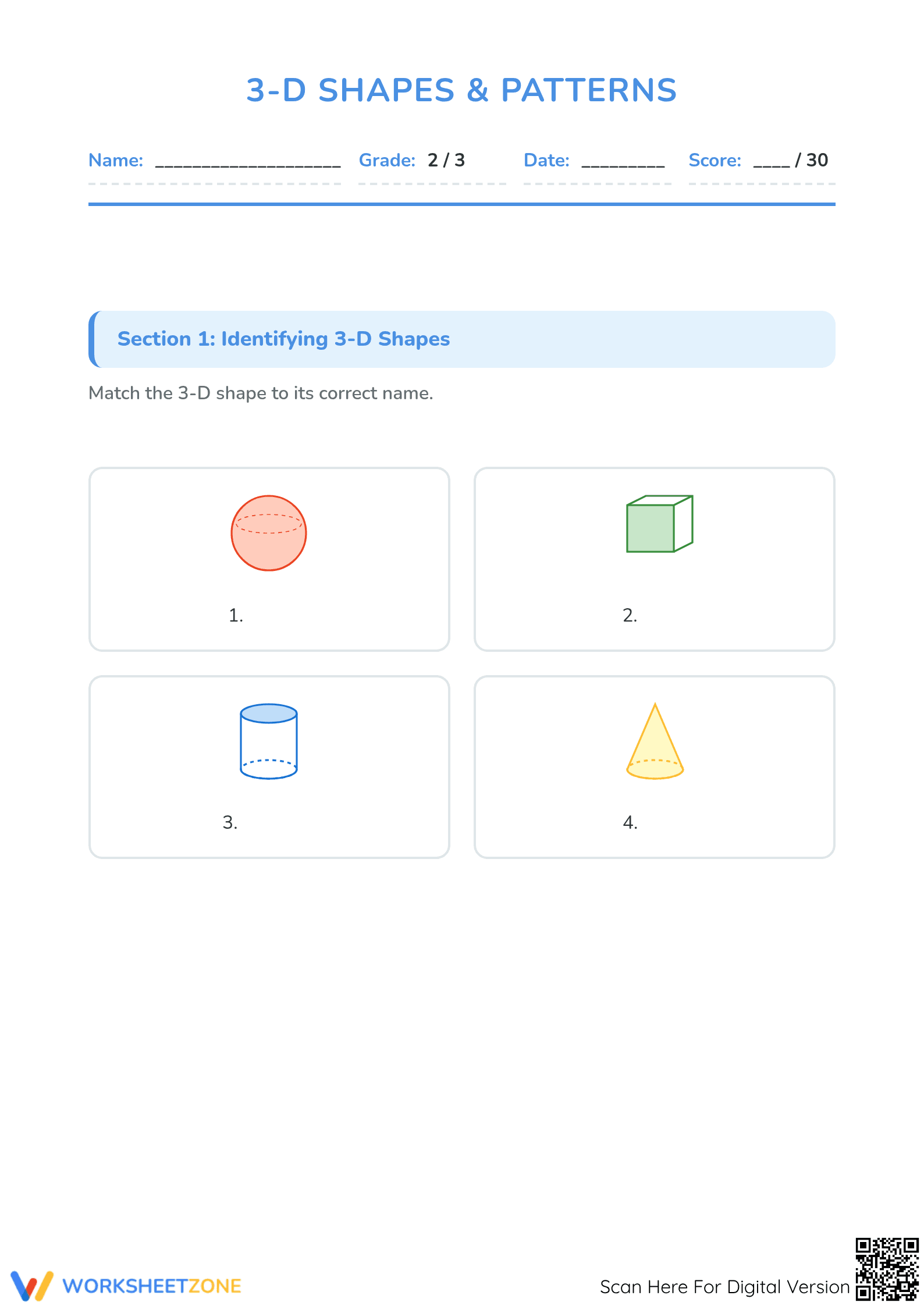
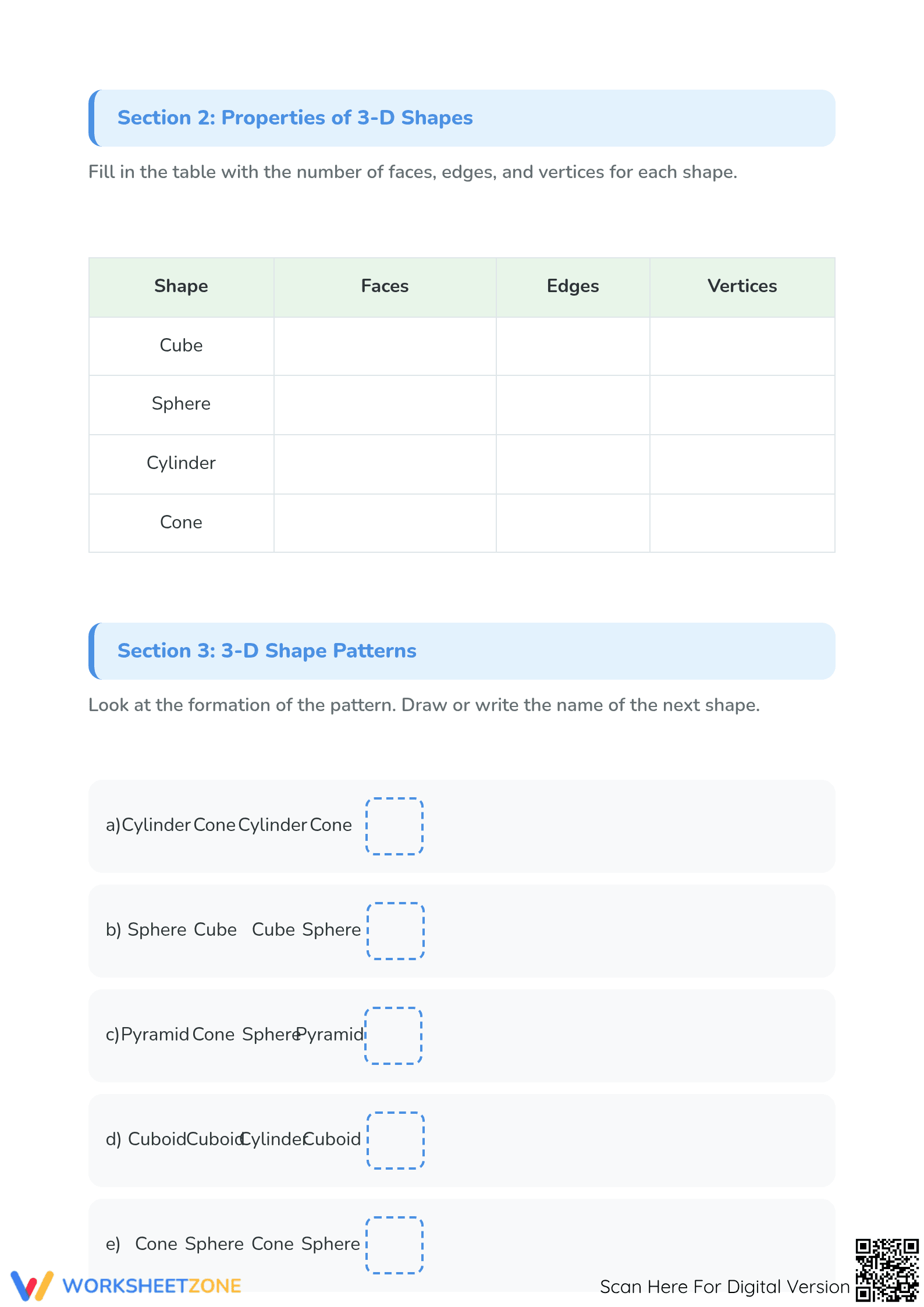
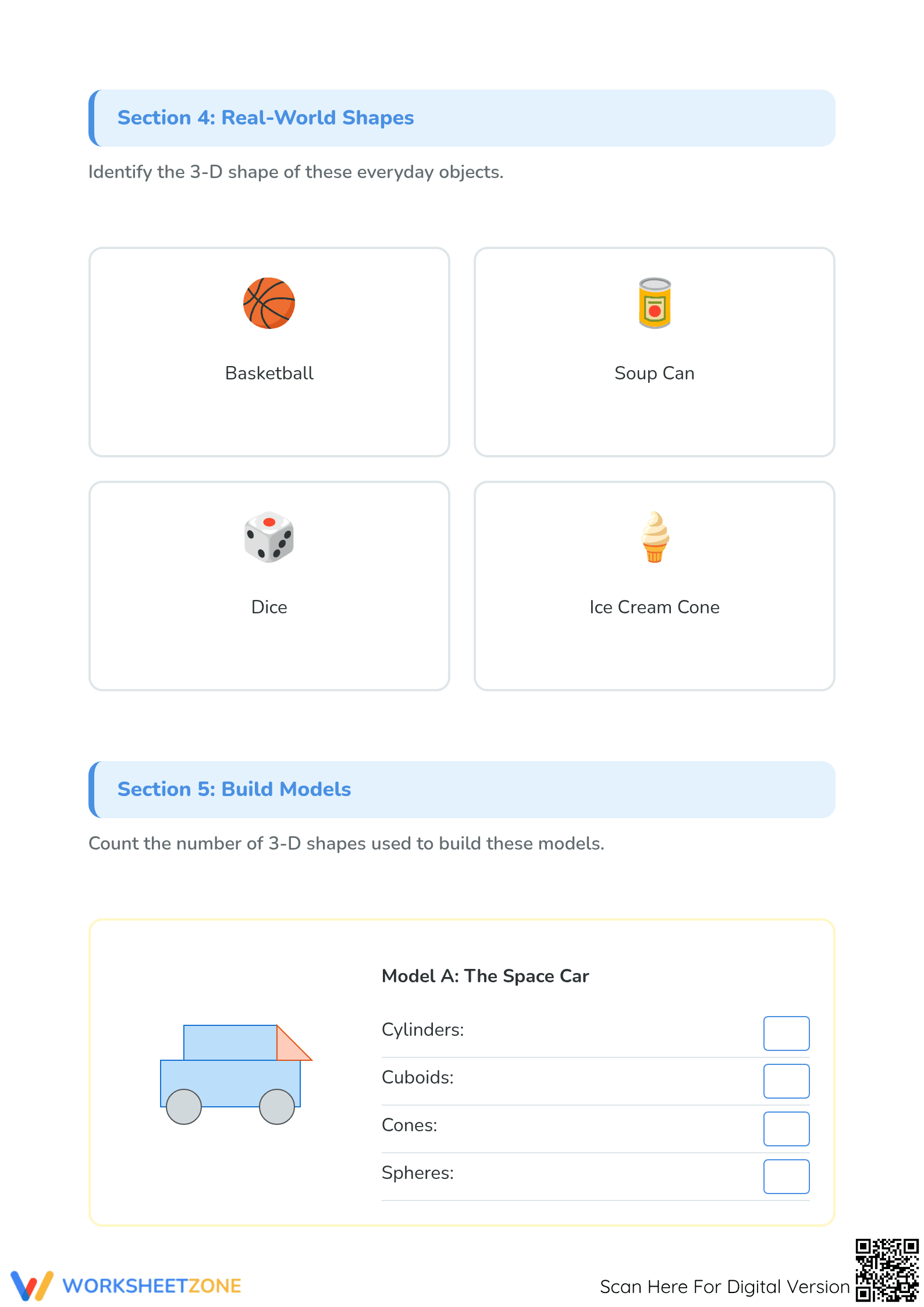
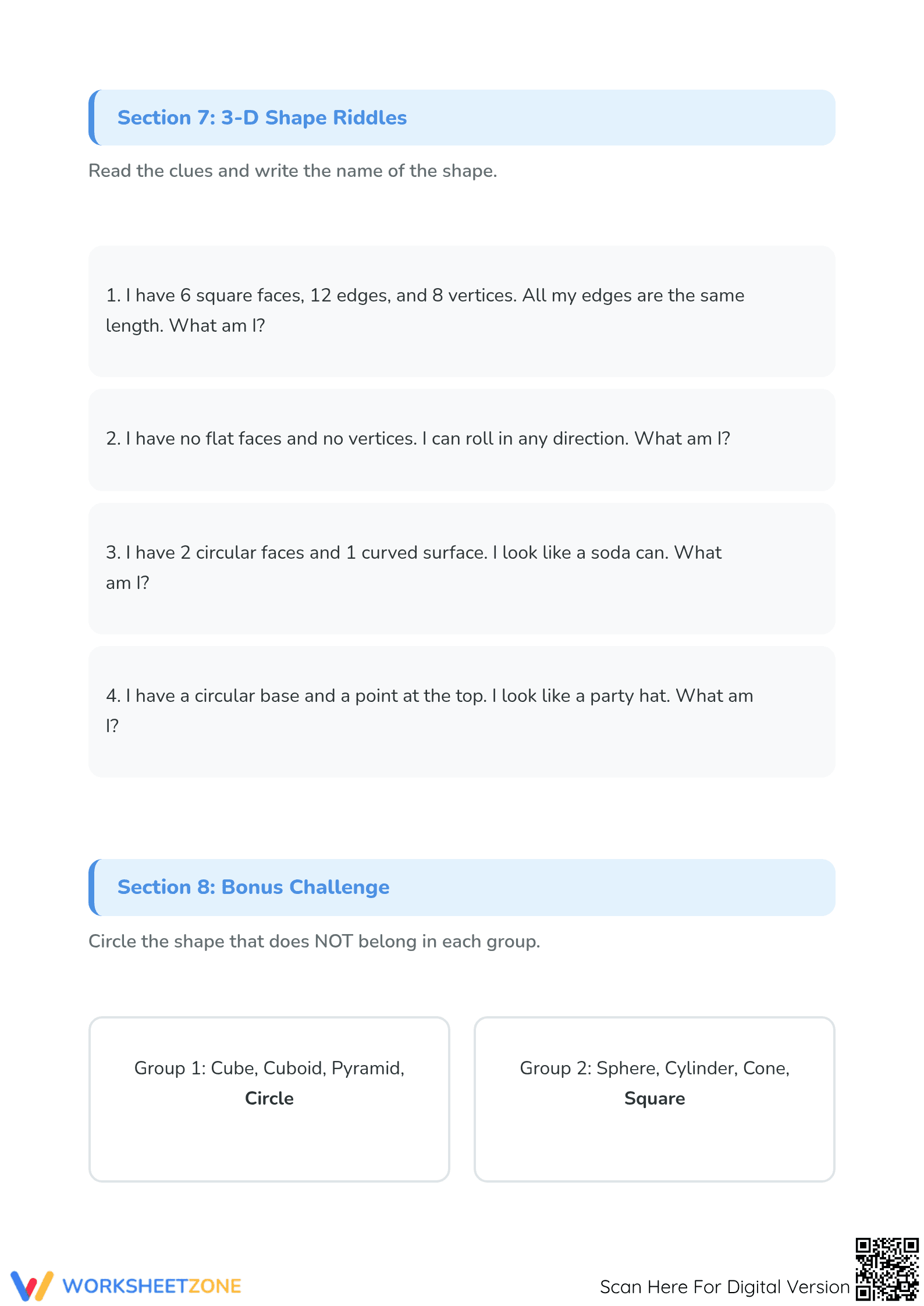
This five-page resource builds understanding of 3-D shapes across eight sections. Tasks include matching shapes (cubes, spheres), filling in a properties table (faces, edges), completing patterns, and identifying shapes in real objects. A full answer key is included.
Skill Progression
This worksheet uses a gradual release model. Activities are structured to provide decreasing levels of support:
- Guided practice: Sections 1-2 provide direct matching and fill-in-the-table tasks with clear visual cues for basic 3-D shapes, helping students learn core properties.
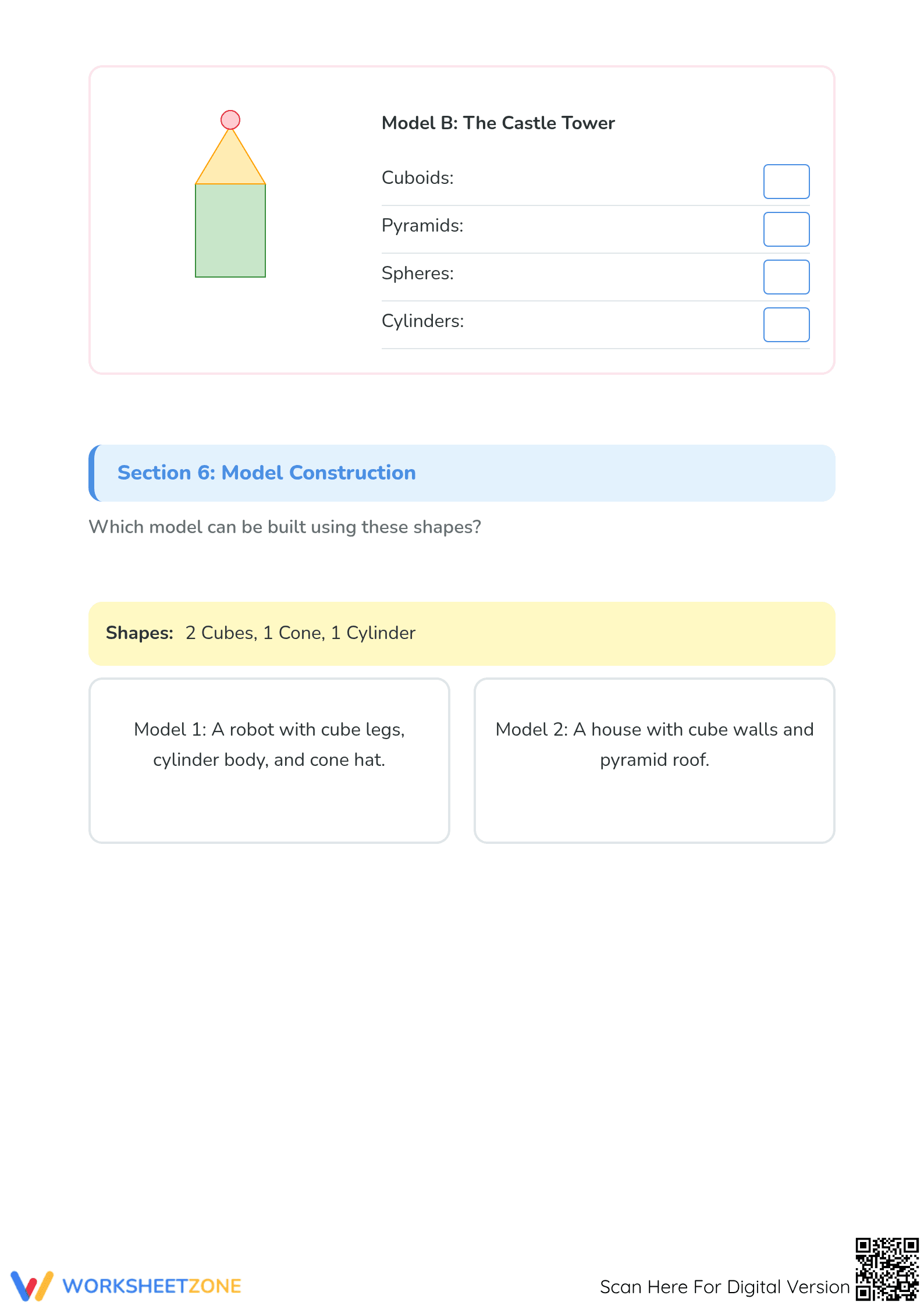
- Supported practice: Sections 3-5 require students to apply knowledge to solve shape patterns, identify shapes in objects, and deconstruct simple models.
- Independent practice: The final sections (6-8) challenge students with riddles and model analysis, demonstrating mastery of the skill with minimal scaffolding.
Standards Alignment
This worksheet is aligned with Common Core standard CCSS.MATH.CONTENT.2.G.A.1, which requires students to "Recognize and draw shapes having specified attributes...Identify...cubes." The tasks specifically address identifying and analyzing cubes and other 3-D forms by their attributes. This standard code can be copied directly into lesson plans or curriculum maps.
How to Use It
This resource works well as independent practice after a lesson on 3-D shape properties or as a structured math center activity. For formative assessment, observe students during Section 2; their ability to count faces and vertices reveals their concrete understanding. Most students will complete the worksheet in 25 to 40 minutes.
Who It's For
Designed for second-grade students learning geometric solids, the clear visuals make it accessible for most learners. For students needing support, provide physical 3-D shape models to manipulate while completing the tasks. This resource pairs well with a classroom anchor chart of 3-D shapes and their properties.
This resource provides structured practice aligned with standard CCSS.MATH.CONTENT.2.G.A.1, focusing on the critical Grade 2 skill of identifying and analyzing 3-D shapes by their attributes. Developing spatial reasoning and geometric vocabulary at this early stage is a key predictor of later success in STEM fields. Research highlighted by the NAEP indicates that consistent exposure to hands-on and visual geometry tasks improves student performance on national assessments. By engaging with concrete properties like faces, edges, and vertices, students move beyond simple recognition to a deeper analytical understanding. This approach, which connects geometric concepts to real-world objects and logical problems, is supported by findings from Fisher & Frey (2014) on the importance of purposeful tasks in building mathematical proficiency. The 25 distinct problems in this worksheet offer the repeated, varied practice needed for students to internalize these foundational geometric concepts.


