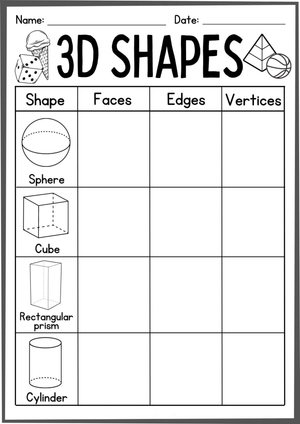
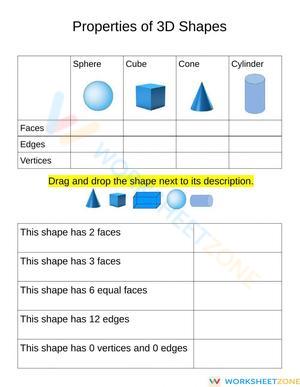
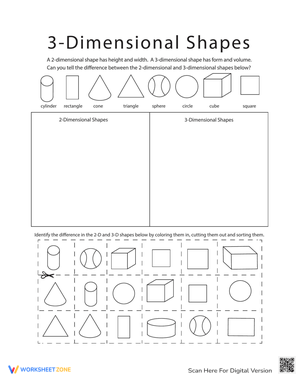
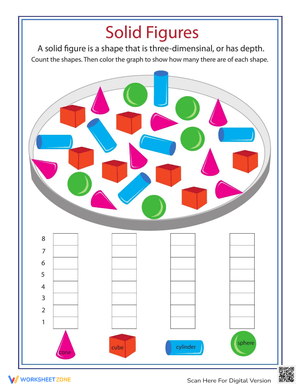
3rd grade 3d shapes worksheets give teachers a targeted way to build the attribute-counting fluency students need before they can reliably name and classify solid figures. The set covers cubes, rectangular prisms, spheres, cylinders, cones, and square pyramids, asking students to identify shapes, count faces and edges and vertices, and connect mathematical vocabulary to the objects they already encounter every day. Each worksheet stands alone — usable as a five-minute warm-up, a small-group task, or independent work during a math rotation.
What Students Practice Across the Set
The central work is accurate attribute counting paired with shape identification. Students move through several task types depending on the worksheet:
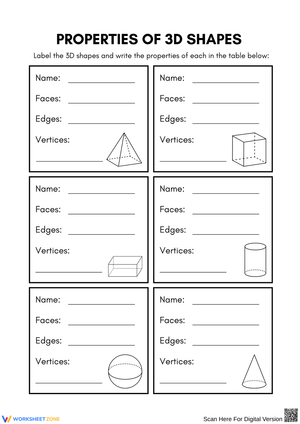
- Count and record the faces, edges, and vertices of a named solid
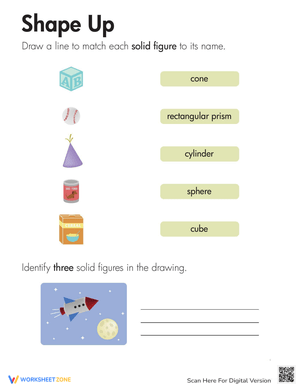
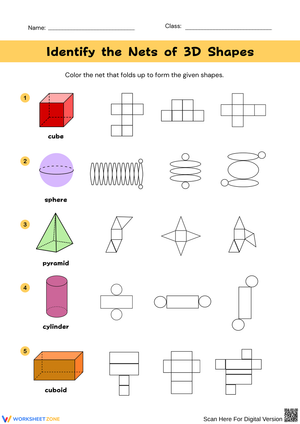
- Match the name of a shape to a labeled or unlabeled drawing
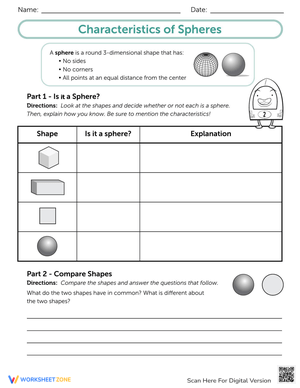
- Sort shapes by attribute — "has vertices" versus "has no vertices," or "has only flat faces" versus "has a curved surface"
- Fill in comparison tables contrasting the cube against the rectangular prism, or the cone against the square pyramid
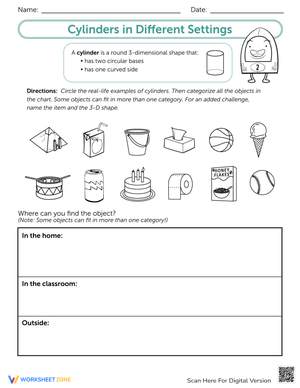
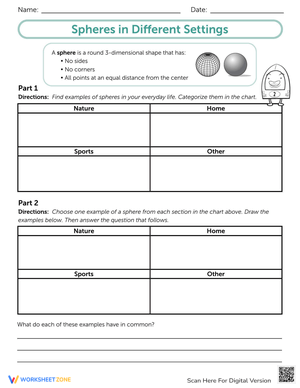
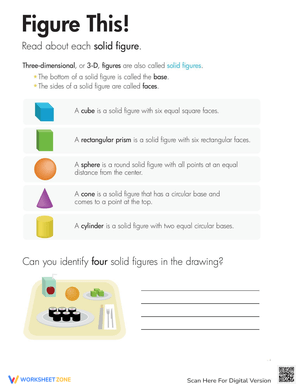
- Identify everyday objects — a can, a cereal box, a party hat — as specific solid figures
Some worksheets narrow their focus to one shape family; others give students a review across all six solids. The 3rd grade 3d shapes worksheets in this set are organized so a teacher can pull one resource that fits wherever the class currently sits in the unit, rather than working through everything in sequence.
Why the Jump to Solid Figures Is Harder Than It Looks
Most third graders arrive with solid instincts about flat shapes — they can spot a square or a triangle without hesitation. But three-dimensional geometry asks something genuinely different: it requires students to reason about depth and about surfaces they cannot see in a drawing. That is a new cognitive demand, and it shows up clearly in their first round of worksheet responses.
A cube drawn on paper typically shows three visible faces. Students who count only what they can see will record three faces and miss the other three entirely — not because they are confused about what a face is, but because their spatial reasoning hasn't yet extended to implied planes. One practical fix before students open a worksheet: hand them a physical cube and have them count aloud while placing a sticky dot on each face. When they return to the paper drawing, they already have the correct number in memory and are looking for a way to account for it rather than starting from scratch. That mental anchor matters more than repeated verbal reminders about hidden faces. On the worksheet itself, asking students to shade each identified face in a different color makes the edges and vertices where colors meet far easier to see and track.
Frequent Student Errors Worth Watching For
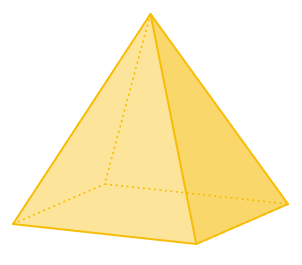
The most consistent error in this unit is the vertex count on the square pyramid. Students learn early that it has a pointy top, and many stop there — recording one vertex. The four corners where the triangular faces meet the square base are also vertices, bringing the correct total to five. On completed worksheets, "1 vertex" appears again and again even after the class has discussed the pyramid directly. Having students touch each vertex on a physical model while counting aloud before they write anything down fixes this more reliably than re-explaining the definition.
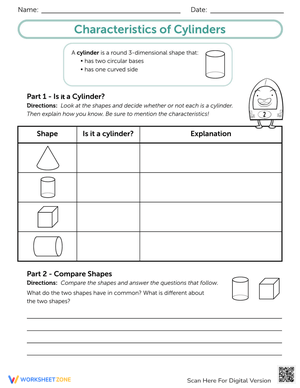
Cylinder attributes cause a different kind of confusion. Because students associate cylinders with roundness, they often mark zero for both faces and edges. The two circular ends are flat faces, and where each circular face meets the curved lateral surface is a curved edge — but still an edge. The standard Grade 3 treatment is two faces and two edges for a cylinder. Students who record zero for both typically need direct re-teaching, not another worksheet round completed the same way.
A subtler problem surfaces with the rectangular prism edge count. Students will correctly find all six faces, then record eight edges instead of twelve. They count the four edges on the front rectangle, add four from the back, and stop — forgetting the four edges connecting front to back. The written answer looks close enough to pass a quick visual scan, so the error slides through unnoticed. The only reliable way to catch it is to ask the student to narrate their counting process aloud.
Fitting These Worksheets Into Your Week
The sequence that holds up most reliably in practice: manipulative-based work first, worksheet practice second. Students who attempt 3rd grade 3d shapes worksheets before handling actual solids tend to reason from the visual appearance of a drawing rather than from real attribute knowledge. A Monday lesson with blocks and sorting mats, followed by a Wednesday worksheet, consistently produces more accurate work than assigning the worksheet the same afternoon as the initial lesson. The gap gives students time to consolidate vocabulary before they are asked to apply it independently in writing.
Math centers are another strong fit. Pairing a building station — toothpick-and-clay constructions or commercial 3D blocks — with a recording worksheet at the adjacent station creates a direct link between constructing a solid and describing its attributes in writing. A student who just built a rectangular prism using twelve straws and eight clay balls is going to count its edges correctly. The worksheet becomes a record of what they learned through building, not a recall test of something from earlier in the week.
Standard Alignment
CCSS 3.G.A.1 asks students to understand that shapes in different categories can share attributes and that shared attributes define a broader category. At the Grade 3 level, this standard is taught primarily through plane figures, but the grade-level geometry unit also expects students to recognize and describe three-dimensional shapes using precise attribute vocabulary — faces, edges, and vertices. These worksheets address that expectation directly. Students are not just labeling shapes by name; they are comparing attributes across shape families and reasoning about why certain solids belong to the same category while others do not. That comparative work is exactly what 3.G.A.1 is pushing toward.
Adjusting the Set for a Range of Learners
For students who are still building geometric vocabulary, pairing each worksheet with a simple reference card removes one layer of difficulty without lowering the mathematical demand. A card that shows each shape, its name, and brief definitions of face, edge, and vertex means students spend their work time counting rather than trying to retrieve terminology. Without that support, students who cannot recall what "vertex" means tend to freeze and guess rather than engage with the actual geometry.
Students who move quickly through the attribute-counting tasks are ready for a different kind of challenge within the same class period. Ask them to write three clues that would allow a classmate to identify a mystery solid — without naming the shape. The clue "I have 5 faces, 8 edges, and 5 vertices" requires the student to hold multiple attributes simultaneously and confirm that the combination points to exactly one shape. The clue "I have a flat bottom and a pointy top" does not — and the difference is immediately visible in what they produce. This extension requires no additional materials.
Frequently Asked Questions
Do students need physical models available while completing these worksheets?
Not every student requires a model, but having solids accessible at the table reduces both errors and frustration, particularly for students who struggle with implied surfaces in two-dimensional drawings. The worksheets work without manipulatives, but accuracy on hidden-face questions improves noticeably when models are available for reference during early encounters with each shape.
How is a cylinder handled in terms of faces and edges?
A cylinder has two flat circular faces — one at each end — and one curved lateral surface. Where each circular face meets the curved surface counts as a curved edge, so the standard treatment at this grade is two faces and two edges. These 3rd grade 3d shapes worksheets apply that definition consistently across every place the cylinder appears in the set, which matters because students who encounter different counts on different resources become genuinely uncertain about which answer to use on assessments.
At what point in the unit should these worksheets be assigned?
After at least one session with physical models. Students who work from flat drawings before any hands-on experience tend to count only what is visually present and miss implied faces and edges. Assigning a worksheet after a manipulative-based lesson means students are consolidating knowledge they have already built through direct experience with the objects, not encountering the concept for the first time through an illustration.
What is the most efficient way to use these for formative assessment?
Look for patterns across a group of worksheets rather than correcting individual responses. If six students in a small group all recorded one vertex for the square pyramid, the class needs re-teaching on that shape before moving forward — not individual feedback on each paper. Reviewing a batch before the next lesson takes under ten minutes and gives enough information to plan a targeted five-minute review at the start of the following period, which is a far better use of instructional time than discovering the gap during the unit assessment.














 Interactive Worksheet Maker
 Quiz Maker
 Word Search Maker
 Crossword Puzzle Maker
 Word Scramble Generator
 Sentence Scramble Generator
 Handwriting Worksheet Generator
 Name Tracing Generator
 Fill In The Blank Generator




 BACK TOSCHOOL