


























Views
Downloads
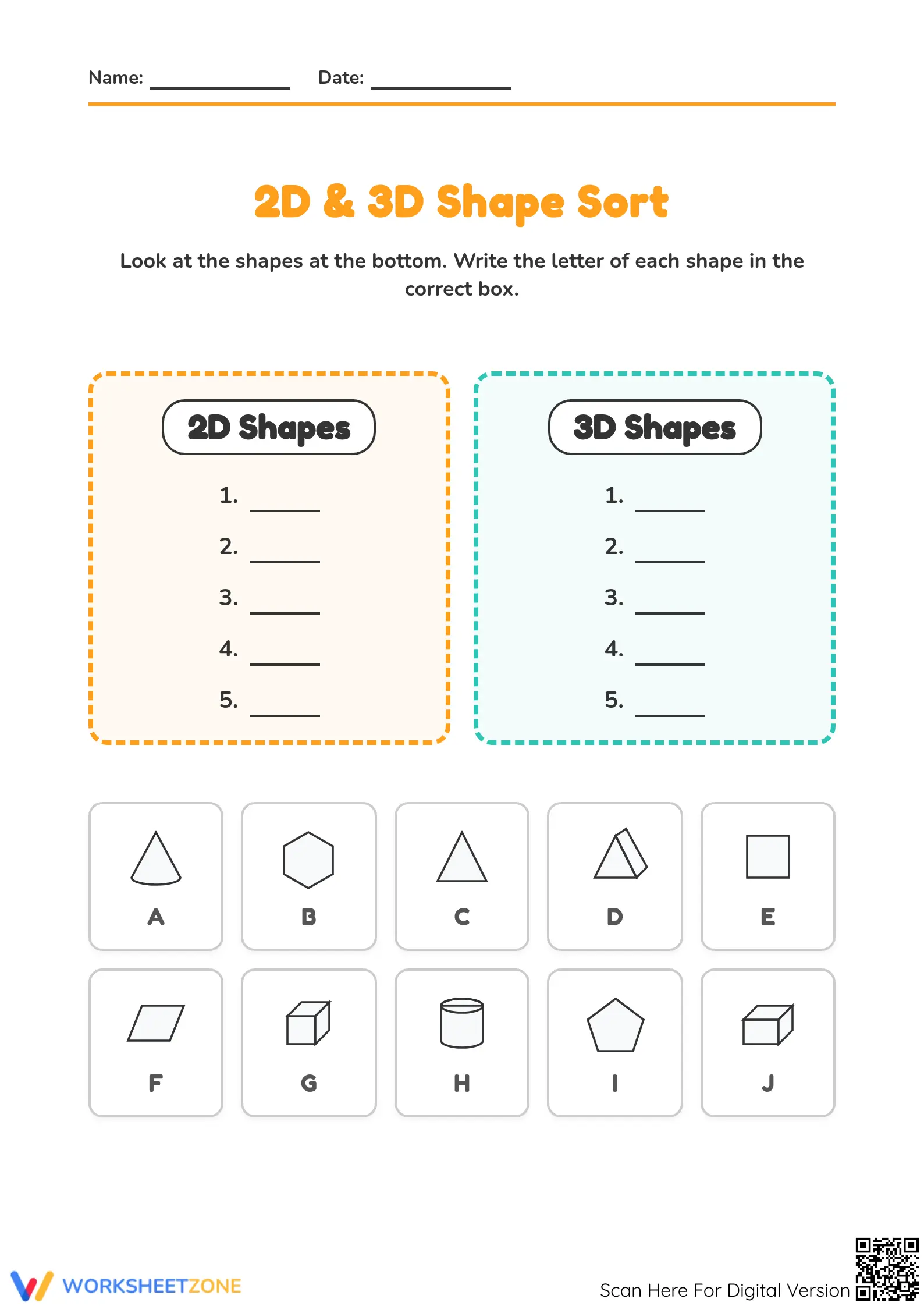

2D and 3D Shape Sort | Grade 2 Math Printable
Paste this activity's link or code into your existing LMS (Google Classroom, Canvas, Teams, Schoology, Moodle, etc.).
Students can open and work on the activity right away, with no student login required.
You'll still be able to track student progress and results from your teacher account.
Identifying the difference between flat and solid figures is a foundational geometry skill. This 2D and 3D shape sort worksheet provides a clear, visual way for students to practice classification. By analyzing ten distinct geometric figures, learners strengthen their spatial reasoning and attribute recognition, ensuring they can distinguish between two-dimensional planes and three-dimensional solids.
At a Glance
- Grade: 2 · Subject: Math
- Standard:
CCSS.MATH.CONTENT.2.G.A.1— Recognize and draw shapes having specified attributes, such as a given number of angles- Skill Focus: 2D vs 3D Classification
- Format: 1 page · 10 problems · Answer key included · PDF
- Best For: Independent practice or quick formative assessment
- Time: 10–15 minutes
This single-page PDF contains a focused sorting activity featuring ten labeled shapes (A through J). The layout includes two distinct columns for 2D and 3D categories. Students observe figures like hexagons, cones, cubes, and pentagons, then record the corresponding letter in the appropriate box. A comprehensive answer key is provided to facilitate rapid grading or student self-correction.
Teachers can implement this resource in under 2 minutes. First, print the required number of copies for the class. Second, distribute the sheets as a transition activity or bell-ringer; the clear instructions mean students can begin immediately without lengthy verbal directions. Finally, review the answers as a whole group to address common misconceptions about depth and flat surfaces.
The primary focus is CCSS.MATH.CONTENT.2.G.A.1, which requires students to recognize and draw shapes based on specific attributes. This worksheet specifically targets the attribute of dimensionality. Both standard codes can be copied directly into lesson plans, IEP goals, or district curriculum mapping tools.
Use this worksheet as a formative assessment after a lesson on solid versus flat shapes. It works well as a check for understanding to see if students can identify 3D objects represented in 2D drawings. Alternatively, assign it as a quick homework task to reinforce vocabulary. Observe if students struggle with the cylinder or cone, which often bridge the conceptual gap between circles and solids.
This resource is designed for Grade 2 students but serves as an excellent review for Grade 3 and 4 learners who need to solidify their geometric vocabulary. It is particularly helpful for visual learners who benefit from clear, uncluttered diagrams. Pair this with physical manipulatives like wooden blocks or pattern blocks for a multi-sensory experience.
According to the RAND AIRS 2024 report on elementary mathematics, visual classification tasks are essential for developing the spatial visualization skills necessary for higher-level geometry. This worksheet addresses the core requirement of CCSS.MATH.CONTENT.2.G.A.1 by asking students to distinguish between 2D and 3D attributes. Research from Fisher & Frey (2014) emphasizes that structured sorting activities provide the necessary scaffolding for students to move from basic recognition to complex attribute analysis. By providing ten distinct examples, this resource ensures that students encounter a variety of polygons and solids, reducing the likelihood of over-generalization. The inclusion of an answer key supports immediate feedback loops, which are proven to increase retention rates in early childhood education. This printable tool offers a high-utility, low-barrier method for assessing geometric mastery in diverse classroom settings, making it a reliable addition to any primary math curriculum.


