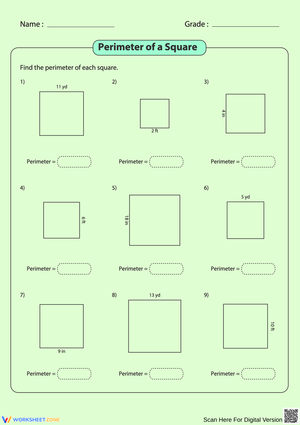
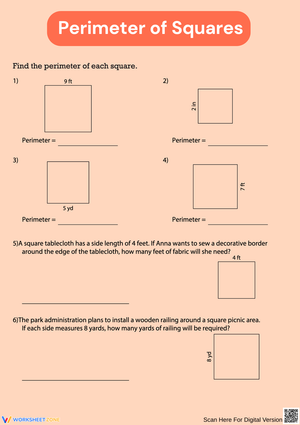
Perimeter of Squares Worksheets for 3rd Grade
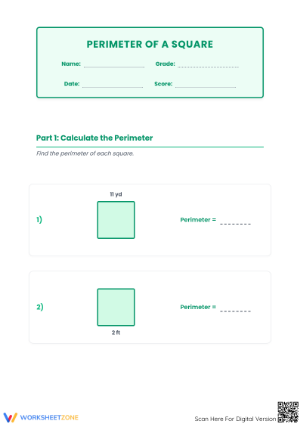
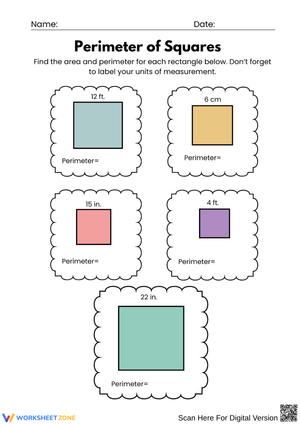
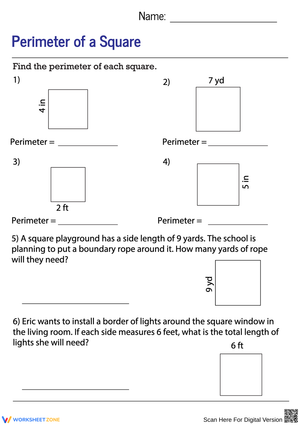
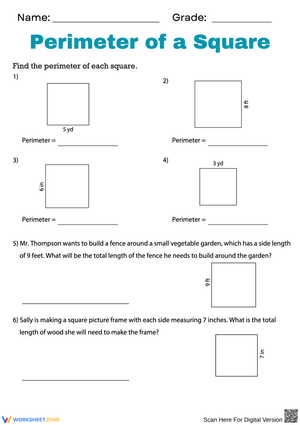
These perimeter of squares worksheets for 3rd grade give teachers ready-to-use practice that tracks the same progression as whole-group instruction — from counting edge units on a grid all the way to applying the formula P = 4s. The set covers enough range that teachers can pull the right worksheet based on where each student actually is, not just where the unit calendar says everyone should be.
Why Squares Come First in Perimeter Instruction
Squares are the right entry point because they reduce the working memory demand to a single number. A rectangle asks students to hold two different side lengths simultaneously while computing; a square requires one. In third grade, when students are also learning new calculation procedures, that reduction matters. The single-side-length property isn't a simplification for struggling students — it's the appropriate starting case for everyone, and the formula P = 4s connects directly to the multiplication work happening in the same unit.
The repeated-addition-to-multiplication transition is one of the core goals of the grade, and perimeter of squares is one of the clearest applied contexts for making it visible. When a student writes 7 + 7 + 7 + 7 = 28 one day and 4 × 7 = 28 a few days later, and can explain that those are the same operation, they've made a connection the curriculum is explicitly trying to build. Worksheets that present both formats on the same problem — an addition sentence alongside a multiplication equation — let teachers see exactly where individual students are in that transition.
What's Inside the Set
Each worksheet targets one stage of the progression so the practice stays matched to where instruction is rather than running ahead of it. Early worksheets use grid-based squares; students count unit edges along each side and record the total. That format keeps the definition literal: perimeter is a path around the boundary, not a count of interior space.
Later worksheets present labeled diagrams with a single side length and ask students to compute. The full range of tasks across the set:
- Counting unit edges on grid squares and writing the total
- Writing addition sentences (s + s + s + s) from labeled diagrams
- Applying the formula 4 × s once the 4s multiplication facts are solid
- Finding an unknown side length when the total perimeter is given
- Recording the correct unit of measurement with every answer
- Solving word problems — framing a square canvas, enclosing a square garden plot — where perimeter has a real purpose
The reverse problems deserve special attention. When the perimeter is 36 inches and students must find the side length, they can't reach for the multiply-by-4 move — they have to divide. That distinction reveals which students understand the relationship and which have learned only one direction of it. Including reverse problems in the set gives teachers diagnostic information without requiring a separate assessment.
Three Errors That Come Up Every Year in This Unit
The most persistent mistake is counting interior grid squares instead of edge units. A student working with a 5-by-5 grid square counts all 25 small squares and writes "25 units" — confident, complete, wrong. That answer is the area; the perimeter is 20 units. The error survives direct instruction more often than expected because the interior squares are visually prominent while the edge units require tracking a path. Grid worksheets that ask students to trace the boundary before counting tend to eliminate this within a few rounds, because the tracing forces attention to the edge rather than the interior.
Unit omission is smaller but reliable. Students calculate 4 × 9 = 36 and write "36" — correct arithmetic, missing unit. They're not wrong about the math; they've been conditioned to see the number as the answer. Requiring the unit in a dedicated answer blank, separate from the number, changes this faster than verbal reminders. Students treat a blank as something to fill; they treat a label as decoration.
On reverse problems, the frequent error is multiplying instead of dividing: given a perimeter of 20 cm, a student writes 4 × 20 = 80 cm. This isn't a multiplication fact problem — it's a structural one. The student knows the formula and applies it in the direction that feels familiar. Asking that student to draw the square, write the unknown length on all four sides, and verify that four of their answer sum to 20 breaks the loop faster than re-explaining the formula from the board.
Where These Worksheets Fit in the Day and the Week
The grid-counting worksheets belong on the day of initial instruction, run as independent practice in the final 10 to 12 minutes after whole-group demonstration. Students who finish quickly can write a multiplication sentence for the same square — a natural bridge to the next stage that doesn't require extending the lesson. Formula worksheets are better placed a day or two later, after the idea of perimeter as a boundary path has had time to settle.
For math centers, the formula worksheets pair well with a bin of square tiles. Students build a square of a given side length, compute the perimeter using the formula, and then verify by counting all four edges by hand. The manual verification matters — it catches formula errors that pencil-and-paper work misses, particularly when students apply the 4s multiplication to the wrong measurement.
The perimeter of squares worksheets for 3rd grade in this set also work well as mid-week warm-ups once calculation is stable. Word-problem worksheets placed on Tuesday or Wednesday — after students have had Monday to rebuild fluency — produce clearer written work than those assigned Monday morning. Friday review blocks are a natural fit for reverse-problem worksheets, which double as a quick formative check before the class moves on to rectangles and irregular polygons.
Standard Alignment
These resources address CCSS 3.MD.D.8, which requires students to solve real-world and mathematical problems involving perimeters of polygons — including finding perimeter from given side lengths and finding an unknown side length when the total perimeter is provided. In classroom terms, 3.MD.D.8 sits at the end of the third-grade measurement unit, after ruler work and standard-unit practice. Teachers who use perimeter of squares worksheets for 3rd grade before introducing rectangles find that students who have worked exclusively with squares first adapt to the two-measurement rectangle case more easily — they already understand what the formula is doing, and the shift requires adding a second variable rather than learning the concept from scratch.
Supporting the Full Range of Learners in Your Class
Students still building addition fluency work best on the grid-counting worksheets. Counting edges along each side and totaling four tallies is a fully valid strategy that produces correct answers without any multiplication, and it keeps the concept intact while computation catches up. There is no benefit in pushing these students to formula work before the arithmetic is ready — the grid worksheets give them accurate practice at the level they're at.
Students who have the 4s facts solid move quickly past the addition-sentence worksheets and spend more time on reverse problems and word problems. For students working above grade level, the most useful extension is composite figures — shapes formed by attaching two or three squares. These problems require identifying which side segments form the outer boundary and which are interior to the shape, a spatial reasoning task that extends naturally from single-square work without introducing new vocabulary or formulas.
For students who freeze when a diagram looks different from what they've practiced, having them redraw the square on their own grid paper before computing gives them a representation they've built themselves. That step costs about 30 seconds and eliminates a lot of stalled pencils. The perimeter of squares worksheets for 3rd grade in this set include enough diagram variety to occasionally unsettle anxious students; the redrawn-square move gives those students a reliable entry point without requiring teacher intervention each time.
Frequently Asked Questions
Why does knowing one side length give you everything you need to find a square's perimeter?
A square is a regular polygon — all four sides are the same length by definition. If one side measures 8 inches, all four sides measure 8 inches. The perimeter is the total of four equal segments, which is why the formula reduces to multiplication: 4 × s. You don't need four separate measurements because all four measurements are identical.
Should I teach the addition method or the formula first?
Start with addition. Writing s + s + s + s keeps the meaning of perimeter visible — students are combining four measured segments, not applying an abstract rule. Once that understanding is solid, introduce 4 × s as a more efficient route to the same result. That sequence also reinforces the third-grade goal of connecting repeated addition to multiplication. The formula lands better as a shortcut students can verify than as a rule handed down from a textbook.
How do I handle the area-perimeter confusion when it keeps resurfacing after direct instruction?
The mix-up tends to return under time pressure even after solid teaching. The most consistent fix is procedural: require students to trace the boundary of the shape with their pencil before counting or calculating anything. The tracing makes the path physical and keeps attention on the edge rather than the interior. Pairing that with "fence vs. grass" language — perimeter is the fence running around the outside, area is the grass covering the inside — gives students a quick self-check they can run without prompting.
What's the best response when a student multiplies instead of divides on a reverse perimeter problem?
Ask the student to draw the square and write their proposed side length on all four sides. Then ask: "Do four of those add up to the given perimeter?" Most students catch the error themselves when the mismatch becomes concrete. If they don't, work the forward direction with a small number — "If each side were 5 cm, what would the perimeter be?" — and let them build the division relationship from the multiplication they already trust.
Clear All