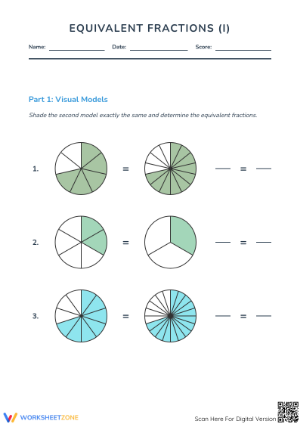
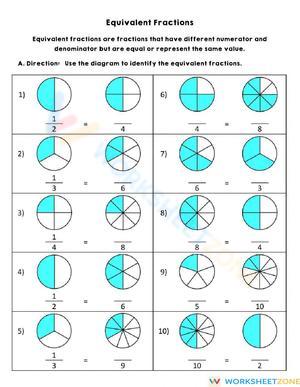
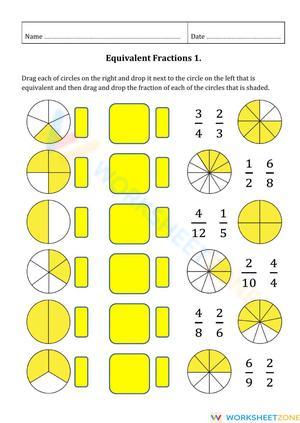
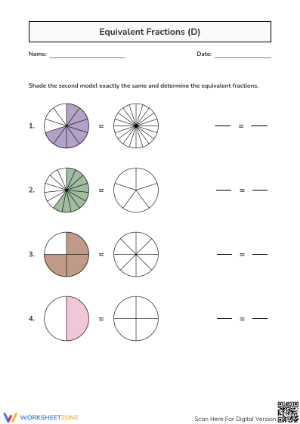
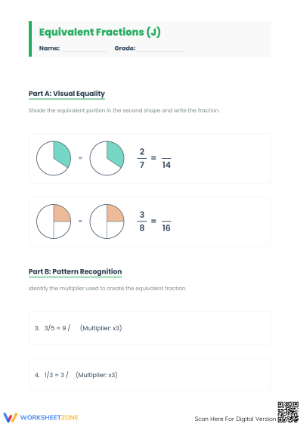
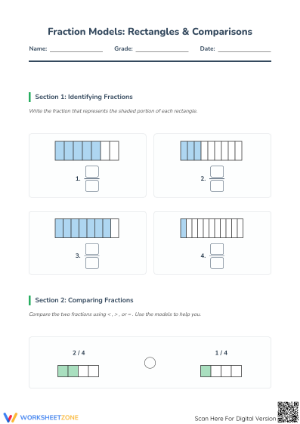
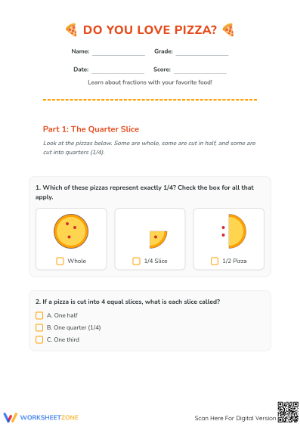
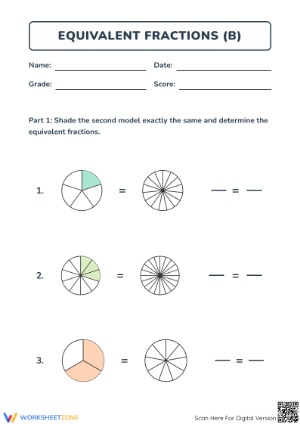
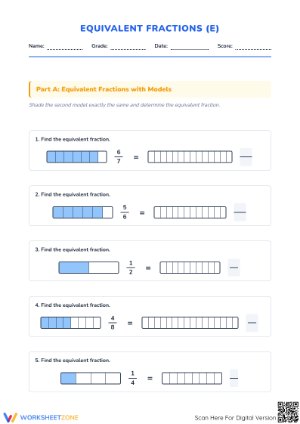
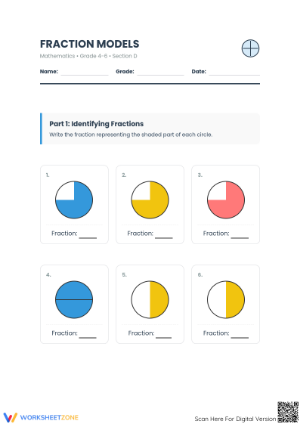
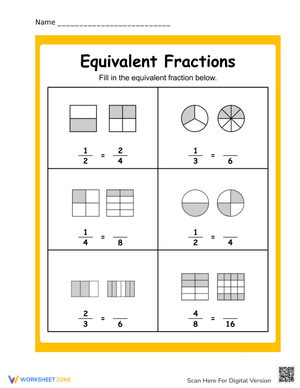
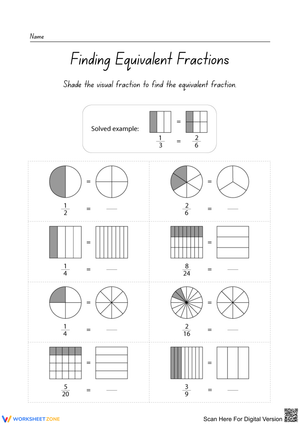
These 3rd grade equivalent fractions with models worksheets give students the visual evidence they need to understand why two fractions can look different and still name the same amount. Each worksheet in the set targets a specific model type — fraction bars, area models, or number lines — so teachers can sequence instruction deliberately rather than dumping every representation on students at once.
What Each Worksheet Has Students Do
The work across this set is genuinely varied. On fraction bar worksheets, students shade a bar divided into fourths to match a pre-shaded half, then write the fraction sentence that names both. On area model worksheets, students see two rectangles side by side — one cut into thirds, one cut into sixths — and mark the equivalent portions before writing the pair. Number line worksheets ask students to partition a segment from 0 to 1 into a given unit, plot a fraction, and then identify where an equivalent fraction from a different partition lands on the same line.
Beyond shading and plotting, several worksheets include sorting tasks where students look at six fraction images and group them into equivalent pairs. Others give a visual model and a partially written fraction sentence — the numerator is blank, the denominator is given — and students use the picture to fill in the missing number. That structure keeps the cognitive load on the visual reasoning rather than the symbolic manipulation, which is exactly where third graders need to be building fluency.
Standard Alignment
These worksheets address CCSS 3.NF.A.3, which requires third graders to understand fraction equivalence and explain it using visual fraction models. The specific sub-standard 3.NF.A.3b asks students to recognize and generate simple equivalent fractions and explain why they are equal using a model — describing how the parts, while different in number, cover the same area or span the same length. Every worksheet in this set is structured around that explanation requirement: students are not just writing the equivalent pair, they are marking, shading, or plotting the visual evidence that justifies it.
Frequent Errors Worth Watching For and Correcting
The most common error on area model worksheets is not a calculation mistake — it is an assumption about shape. When two rectangles are the same physical size on the page, students correctly compare shaded regions. But when one rectangle is wider or taller than the other, a meaningful number of students judge equivalence by the physical area of the shaded marks rather than the fractional amount. They'll correctly identify that 1/2 and 2/4 are equivalent on congruent rectangles, then miss the same relationship when one rectangle is drawn narrower. Worksheets that intentionally vary the rectangle dimensions surface this misconception in a low-stakes setting.
On number line worksheets, the recurring trouble spot is uneven partitioning. Students who draw their own tick marks to divide a segment into fourths will often create unequal intervals, then plot 2/4 in a location that doesn't align with 1/2 on the same line. The error isn't conceptual — they usually know the fractions should be equal — it's a drawing precision problem that corrupts the evidence. Worksheets with pre-partitioned lines remove that variable for initial instruction; worksheets that have students draw their own partitions work better once the concept is established and you want to assess both precision and understanding.
Building These Worksheets Into Your Lesson Sequence
Fraction bar worksheets work well as the first contact activity when you open the equivalence unit, typically during the whole-group block. Project one on the board, work through the shading together, and let students complete a parallel worksheet independently before you release them to centers. The linear model is the most transparent — what students see lines up almost one-to-one with the fraction sentence — so it builds early confidence.
Area model worksheets fit naturally into the small-group rotation three or four days into the unit, after students have the fraction bar logic established. In a 20-minute guided math block, you can run two students through a think-aloud on the first rectangle pair, then have the group finish the remaining pairs while you observe. The errors that appear at this stage — particularly the congruent-rectangle assumption described above — are worth addressing explicitly before students encounter the number line model.
Number line worksheets are most effective in the final third of the unit, either as a Friday consolidation activity or as a Monday warm-up after the weekend gap. That spacing is intentional: students who return to the number line after a few days away and can still locate equivalent fractions accurately are showing retained understanding, not just same-day recall. Mixed-model worksheets, which put a fraction bar, a rectangle, and a number line on the same page, belong at the end of the unit as a formative check before assessment.
Adapting the Set for Different Learners
Students who are still solidifying the basic vocabulary of numerator and denominator do better when the worksheets limit denominators to halves and fourths. That pairing keeps the visual comparison simple enough that the new concept — equivalence — stays in focus rather than getting tangled with unfamiliar fraction names. Fraction bar worksheets with halves and fourths are the right starting point for these students; hold the sixths and eighths until the core idea is secure.
Students who move quickly through the fraction bar and area model work are ready for number line worksheets where they must draw their own partitions without a pre-divided line. A stronger extension is asking them to find a third equivalent fraction for a given pair — if they know 1/2 = 2/4, can they show 3/6 on the same number line? That task requires them to apply the pattern rather than confirm a given pair, and the number line makes the alignment visible in a way that keeps the reasoning grounded in the model rather than jumping to the procedure prematurely.
Frequently Asked Questions
Should I use all three model types at the same time, or introduce them in sequence?
Sequence them. Presenting fraction bars, area models, and number lines simultaneously increases cognitive load without increasing understanding. Start with fraction bars because the length comparison is the most intuitive. Move to rectangular area models once students can articulate what they see on the bar model, then introduce number lines last. Each model adds a new layer of meaning — length, then area, then position — and students who move through them in order arrive at the number line with enough conceptual foundation to use it well.
My students can shade the models correctly but can't explain why the fractions are equal. What's missing?
The gap is usually in vocabulary and sentence structure, not conceptual understanding. Students often see the equivalence but don't have a rehearsed way to articulate it. Try requiring a written sentence on every worksheet: "I know 1/3 = 2/6 because the shaded parts cover the same amount of the rectangle." When that sentence frame appears at the top of the worksheet, students treat the writing as part of the task rather than an afterthought, and the language starts to internalize across repeated practice.
How do these worksheets connect to what students will do with fractions in 4th grade?
The model-based reasoning students build here is the conceptual foundation for 4.NF.A.1, where they generate equivalent fractions using multiplication and division. Students who can look at a fraction bar and explain that doubling the number of parts while keeping the shaded region the same doubles both the numerator and denominator have already grasped the logic behind the procedural rule. They won't be memorizing a trick in fourth grade — they'll be formalizing something they already understand.













 Interactive Worksheet Maker
 Quiz Maker
 Word Search Maker
 Crossword Puzzle Maker
 Word Scramble Generator
 Sentence Scramble Generator
 Handwriting Worksheet Generator
 Name Tracing Generator
 Fill In The Blank Generator