




























Views
Downloads
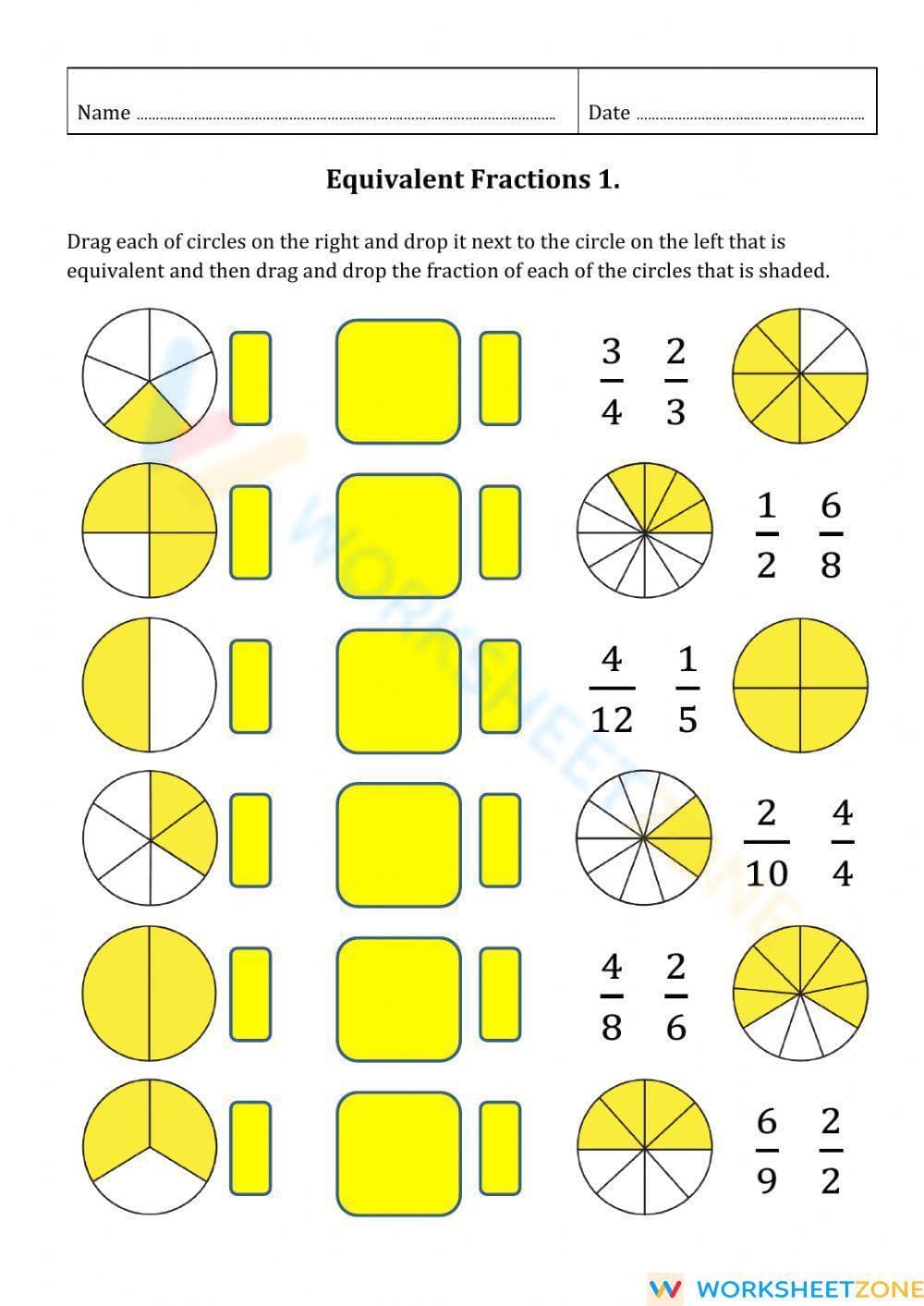

Equivalent Fractions Worksheet | Grade 3 Essential

Paste this activity's link or code into your existing LMS (Google Classroom, Canvas, Teams, Schoology, Moodle, etc.).
Students can open and work on the activity right away, with no student login required.
You'll still be able to track student progress and results from your teacher account.
This Grade 3 equivalent fractions worksheet provides a visual approach to understanding numerical relationships. Students identify equivalent parts of a whole by matching shaded circle models and corresponding numeric fractions. By connecting visual representations to abstract numbers, learners build the foundational fluency required for advanced rational number operations.
At a Glance
- Grade: 3 · Subject: Fractions
- Standard:
CCSS.MATH.CONTENT.3.NF.A.3— Understand two fractions as equivalent if they are the same size- Skill Focus: Visual fraction matching
- Format: 1 page · 12 tasks · Answer key included · PDF
- Best For: Independent practice or math centers
- Time: 15–20 minutes
The worksheet features a clean, one-page layout containing six primary matching rows. Each row requires students to pair two equivalent circular models and then assign the correct numeric fraction label to each. The use of high-contrast yellow shading helps students clearly distinguish between parts and wholes. A full answer key is provided to facilitate quick grading or student self-correction.
This resource is designed for a zero-prep workflow. Teachers can print the PDF in less than 30 seconds. Distribution takes approximately 1 minute during a transition period. Because the instructions are self-explanatory, students can begin working immediately, allowing the teacher to circulate for formative assessment. Total preparation time is under 2 minutes, making it an ideal choice for substitute folders or morning work.
This resource aligns with `CCSS.MATH.CONTENT.3.NF.A.3`, which requires students to explain why fractions are equivalent by using visual fraction models. It specifically addresses sub-standard 3.NF.A.3.B, recognizing and generating simple equivalent fractions. Both standard codes can be copied directly into lesson plans, IEP goals, or district curriculum mapping tools.
Use this worksheet during the independent practice phase of a gradual release lesson. After demonstrating equivalence with manipulatives, assign this page to verify individual student understanding. It also serves as an excellent formative assessment tool; observe if students struggle more with the visual matching or the numeric labeling to identify specific gaps in conceptual versus procedural knowledge.
This worksheet is designed for third-grade students beginning their journey with rational numbers. It is particularly effective for visual learners who need to see the size of a fraction before calculating it. Pair this resource with a fraction tile set or an anchor chart displaying common equivalent pairs like 1/2, 2/4, and 4/8.
Research by Fisher & Frey (2014) emphasizes the importance of visual scaffolding when introducing abstract mathematical concepts like equivalent fractions. By utilizing circular area models, this worksheet reduces the cognitive load on Grade 3 learners, allowing them to focus on the relationship between the numerator and denominator. The CCSS.MATH.CONTENT.3.NF.A.3 standard focuses on the conceptual understanding that fractions are numbers that can represent the same point on a number line or the same area of a shape. This worksheet provides 12 specific opportunities for students to practice this recognition, which is a critical precursor to fraction addition and subtraction. According to NAEP data, students who master visual equivalence early demonstrate significantly higher proficiency in middle school algebra. This printable resource ensures that students move beyond rote memorization toward a durable, image-based understanding of how different numbers can represent identical values.


