




























Views
Downloads

Essential Equivalent Fractions Worksheet | Grade 4 Math

Paste this activity's link or code into your existing LMS (Google Classroom, Canvas, Teams, Schoology, Moodle, etc.).
Students can open and work on the activity right away, with no student login required.
You'll still be able to track student progress and results from your teacher account.
Understanding that fractions like 1/2 and 2/4 represent the exact same part of a whole is a critical milestone in elementary mathematics. This printable worksheet provides students with the visual scaffolding and numerical patterns required to internalize the concept of equivalence. By moving from shading shapes to using multipliers, learners develop a robust conceptual foundation for later operations.
At a Glance
- Grade: 4 · Subject: Math (Fractions)
- Standard:
CCSS.MATH.CONTENT.4.NF.A.1— Explain why fractions are equivalent by using visual fraction models and multipliers- Skill Focus: Visualizing equivalence and applying multiplication rules
- Format: 2 pages · 9 problems · Answer key included · PDF
- Best For: Small group instruction or independent practice
- Time: 20–30 minutes
What's Inside
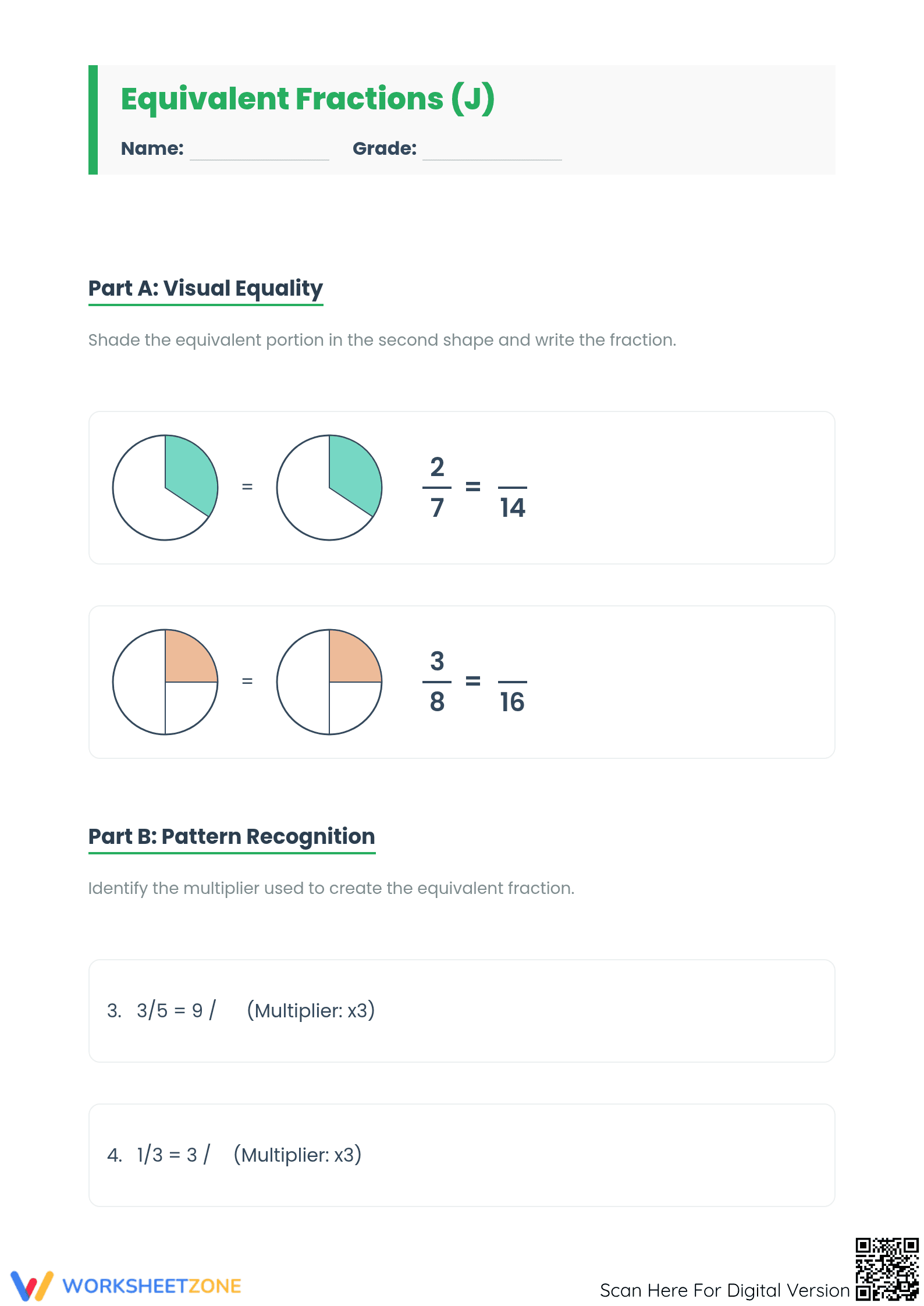
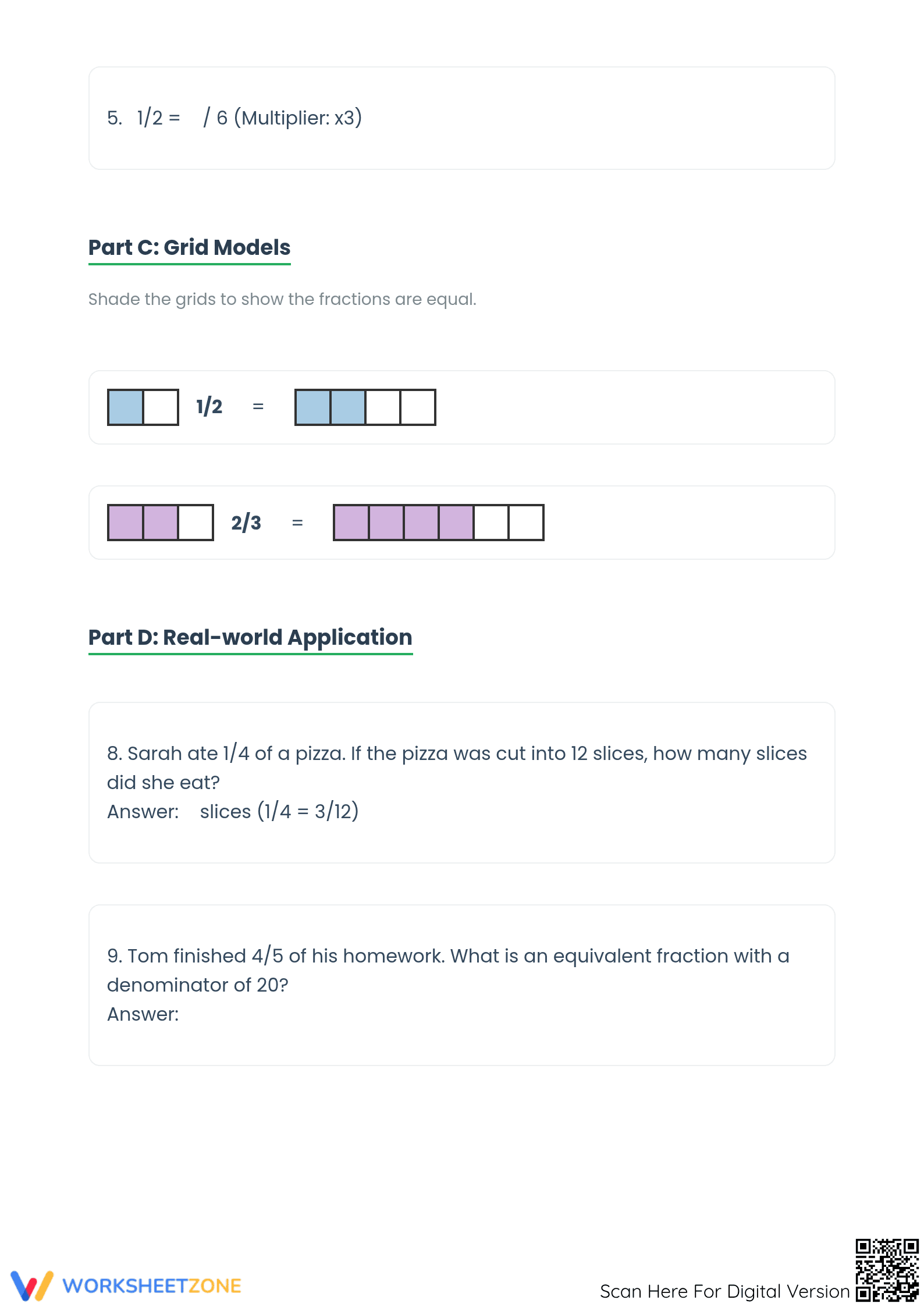
This comprehensive two-page resource is divided into four distinct sections to ensure a multi-modal learning experience. Students begin with circular models before transitioning to numerical pattern recognition where they identify specific multipliers. The second page introduces rectangular grid models to demonstrate that shape does not change the rule of equivalence, concluding with two real-world word problems that test application.
Skill Progression
- Guided practice (Tasks 1-2): Students interact with circular diagrams, shading equivalent portions to visually confirm that different denominators can represent identical areas of a whole.
- Supported practice (Tasks 3-5): Learners shift to the numerical multiplier rule, identifying the specific factor used to scale both the numerator and denominator to create a new equivalent value.
- Independent practice (Tasks 6-9): The final tasks require students to apply their knowledge to grid models and contextualized word problems without immediate visual cues.
This structured path follows a gradual-release model, moving students effectively from concrete visual manipulation to abstract mathematical reasoning.
Standards Alignment
The primary focus of this worksheet is `CCSS.MATH.CONTENT.4.NF.A.1`, which requires students to explain why a fraction a/b is equivalent to a fraction (n × a)/(n × b) by using visual fraction models. It also supports 3.NF.A.3 by reinforcing the basic definition of equivalent fractions. These standard codes can be copied directly into lesson plans, IEP goals, or district curriculum mapping tools.
How to Use It
This resource is best utilized during the guided practice phase of a lesson on fraction equivalence. Teachers can use the circular models on page one as a formative assessment check after direct instruction. If students struggle with the multiplier section, the grid models on page two serve as an excellent intervention tool to re-ground their thinking in a visual context. We recommend a completion time of approximately 25 minutes.
Who It's For
Designed primarily for 4th-grade students, this worksheet is also highly effective for 3rd-grade students ready for extension or 5th-grade learners needing a conceptual refresh. The clear section headings and large diagrams make it an accessible choice for students with IEPs or those who benefit from visual-heavy math instruction. It pairs naturally with fraction tile manipulatives or a digital fraction wall.
Research from NAEP (2024) highlights the importance of visual fraction models for developing algebraic proficiency. This worksheet directly addresses CCSS.MATH.CONTENT.4.NF.A.1, utilizing circular and grid models alongside numerical multipliers to anchor equivalence in visual reality. This approach, supported by Fisher & Frey (2014), prevents common misconceptions and provides targeted practice for conceptual understanding and application. The included answer key facilitates immediate feedback, crucial for correcting misunderstandings about denominator relationships.


