




























Views
Downloads

Printable Equivalent Fractions Practice | Grade 3-5 Math

Paste this activity's link or code into your existing LMS (Google Classroom, Canvas, Teams, Schoology, Moodle, etc.).
Students can open and work on the activity right away, with no student login required.
You'll still be able to track student progress and results from your teacher account.
Mastering the concept of equivalent fractions is a pivotal milestone in elementary mathematics. This comprehensive worksheet provides students with structured opportunities to identify and generate fractions that represent the same part of a whole. By bridging the gap between visual area models and abstract numeric representations, students develop a deep, conceptual understanding of fractional equivalence.
At a Glance
- Grade: 3–5 · Subject: Math
- Standard:
CCSS.MATH.CONTENT.3.NF.A.3— Understand two fractions as equivalent if they are the same size- Skill Focus: Visual and numeric fractional equivalence
- Format: 4 pages · 20 problems · Answer key included · PDF
- Best For: Small group instruction and independent practice
- Time: 25–35 minutes
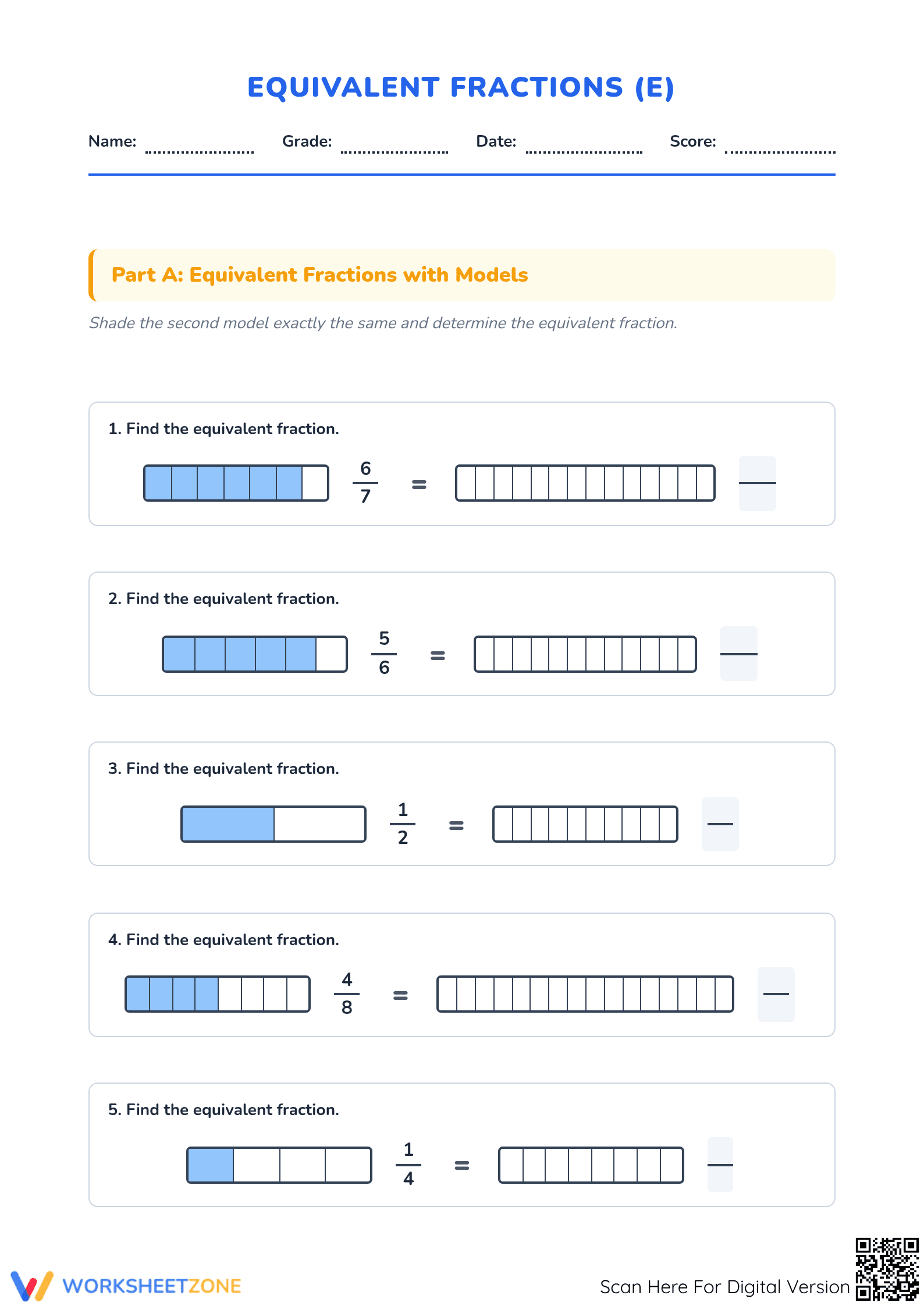
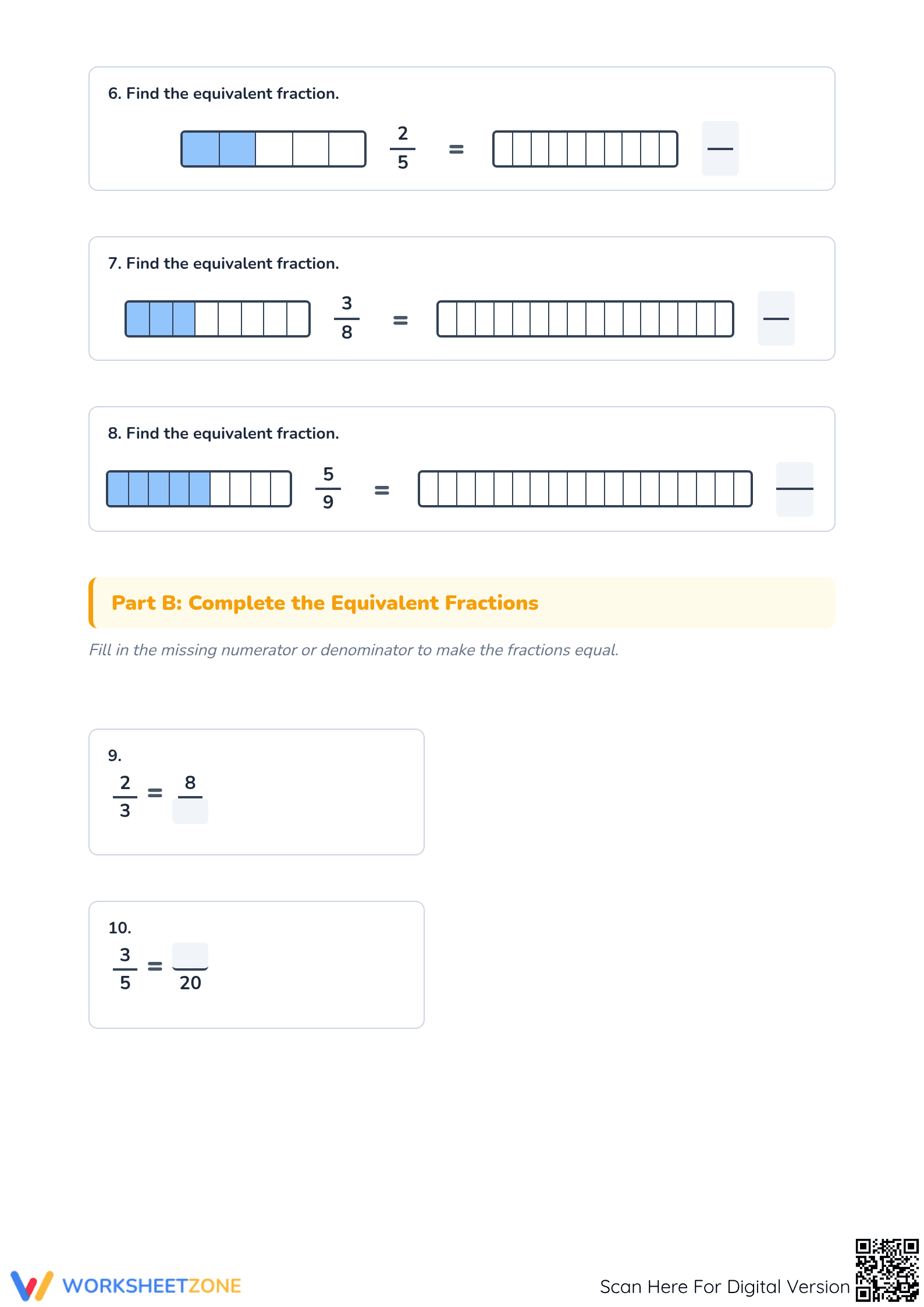
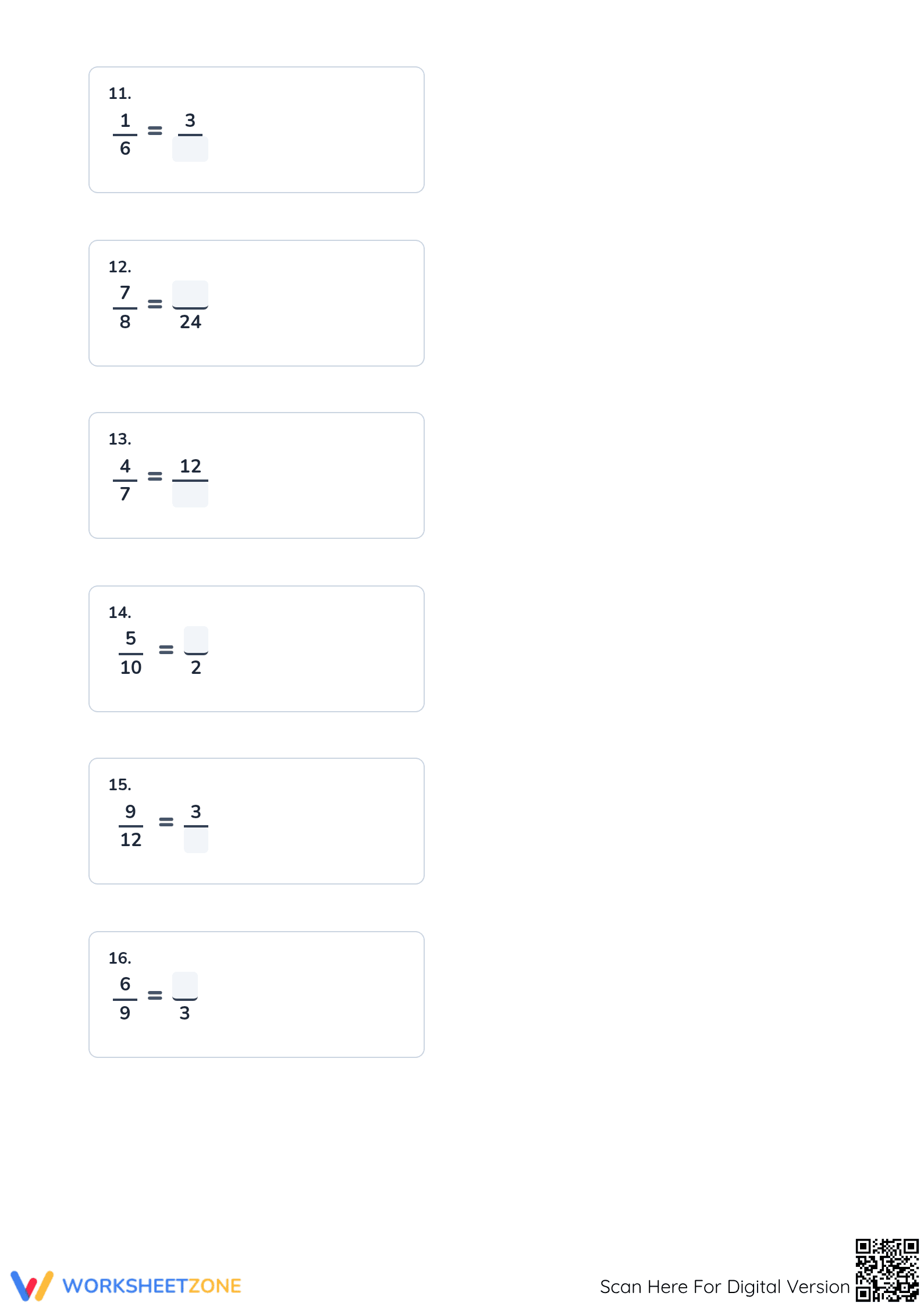
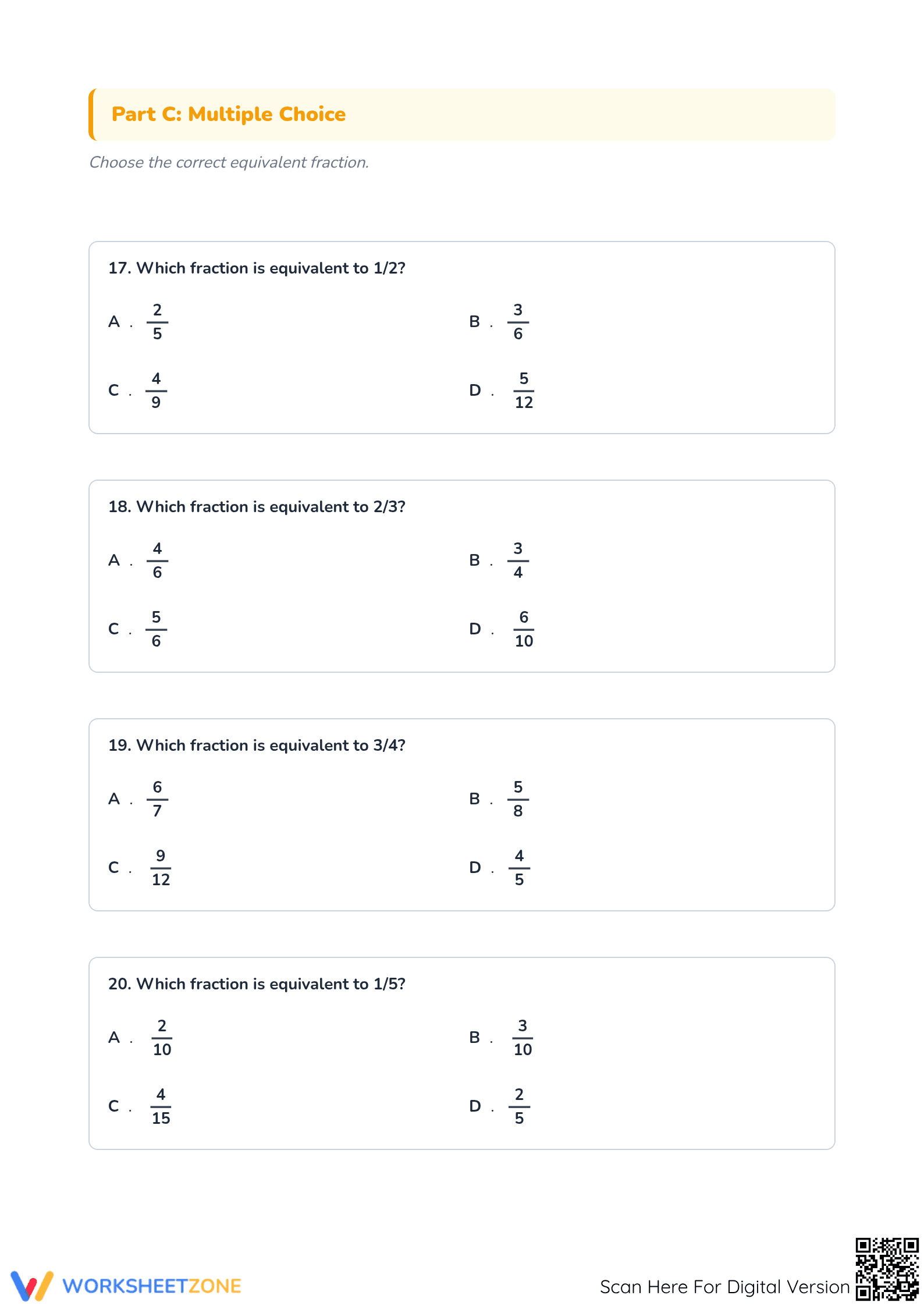
This four-page resource is divided into three distinct pedagogical phases to ensure student success. Part A features eight problems utilizing shaded area models, requiring students to determine equivalent values visually. Part B transitions to eight numeric problems where students find missing numerators or denominators to maintain equality. Finally, Part C offers four multiple-choice questions to assess higher-order recognition. A complete answer key is provided for efficient grading.
Skill Progression
- Guided Visual Practice: 8 tasks using side-by-side area models allow students to see why fractions like 1/2 and 2/4 occupy the same space.
- Supported Numeric Practice: 8 computational problems remove the visual scaffold, challenging students to apply the rule of multiplying or dividing by a fraction equivalent to one.
- Independent Application: 4 multiple-choice assessment items test the ability to recognize equivalent pairs without explicit prompts or matching models.
This "I Do, We Do, You Do" framework ensures students move from concrete visualization to abstract mastery with confidence and accuracy.
Standards Alignment
The primary focus of this worksheet is `CCSS.MATH.CONTENT.3.NF.A.3`, which requires students to explain equivalence of fractions in special cases and compare fractions by reasoning about their size. It specifically addresses sub-standards A and B by using visual fraction models to recognize and generate simple equivalent fractions. This standard code can be copied directly into lesson plans, IEP goals, or district curriculum mapping tools.
How to Use It
Deploy this worksheet as a mid-unit formative assessment during your fractions module. After direct instruction on finding common denominators, have students work through the visual models in Part A to anchor their understanding before moving to the numeric Part B. Use the multiple-choice section as an "exit ticket" to gauge student readiness for more complex fraction operations. Expect completion within 30 minutes.
Who It's For
This resource is designed for Grade 3, 4, and 5 students who are building their foundation in rational numbers. It serves as an excellent intervention tool for older students struggling with fraction basics or as a rigorous practice set for younger learners. Pair this with physical fraction tiles or circles for a multi-sensory learning experience that reinforces the visual models provided on the page.
Aligned with `CCSS.MATH.CONTENT.3.NF.A.3`, this worksheet targets the essential skill of understanding fractional equivalence through dual-coding: visual models and symbolic math. Research from the `RAND AIRS 2024` report emphasizes that students who master visual fraction representations in early grades demonstrate higher proficiency in middle-school algebra. The inclusion of area models alongside numeric equations reflects the "Concrete-Representational-Abstract" instructional sequence, which is proven to reduce cognitive load and improve long-term retention of mathematical concepts. By requiring students to generate and recognize equivalent values across 20 varied tasks, this resource provides the high-dosage practice necessary for conceptual fluency. This standalone practice module is an essential tool for teachers seeking evidence-based resources that align with current national standards and pedagogical best practices in elementary mathematics education.


