


























Views
Downloads

Printable Equivalent Fractions Practice | Grade 4 Math
Paste this activity's link or code into your existing LMS (Google Classroom, Canvas, Teams, Schoology, Moodle, etc.).
Students can open and work on the activity right away, with no student login required.
You'll still be able to track student progress and results from your teacher account.
Students often find the transition from concrete visual fractions to abstract numeric equivalence challenging. This printable math worksheet bridges that gap by requiring learners to shade circle models to match a given fraction before determining the numeric equivalent. By providing a dual-approach to learning, this resource ensures that students internalize why two different-looking fractions represent the same quantity.
At a Glance
- Grade: 4 · Subject: Math (Fractions)
- Standard:
CCSS.MATH.CONTENT.4.NF.A.1— Explain why fractions are equivalent by using visual fraction models- Skill Focus: Visual and Numeric Equivalent Fractions
- Format: 2 pages · 13 problems · Answer key included · PDF
- Best For: Individual practice or formative assessment
- Time: 20–30 minutes
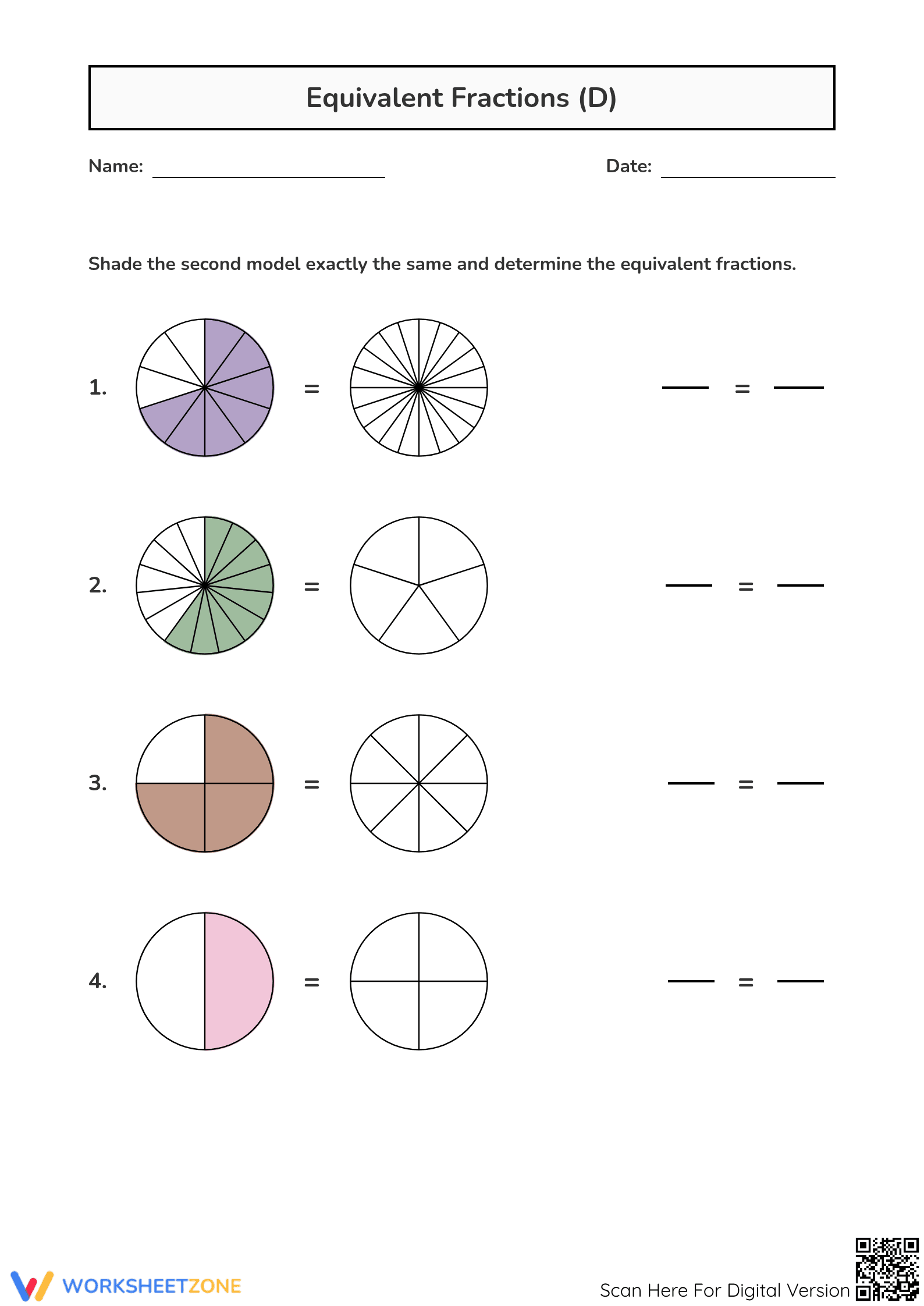
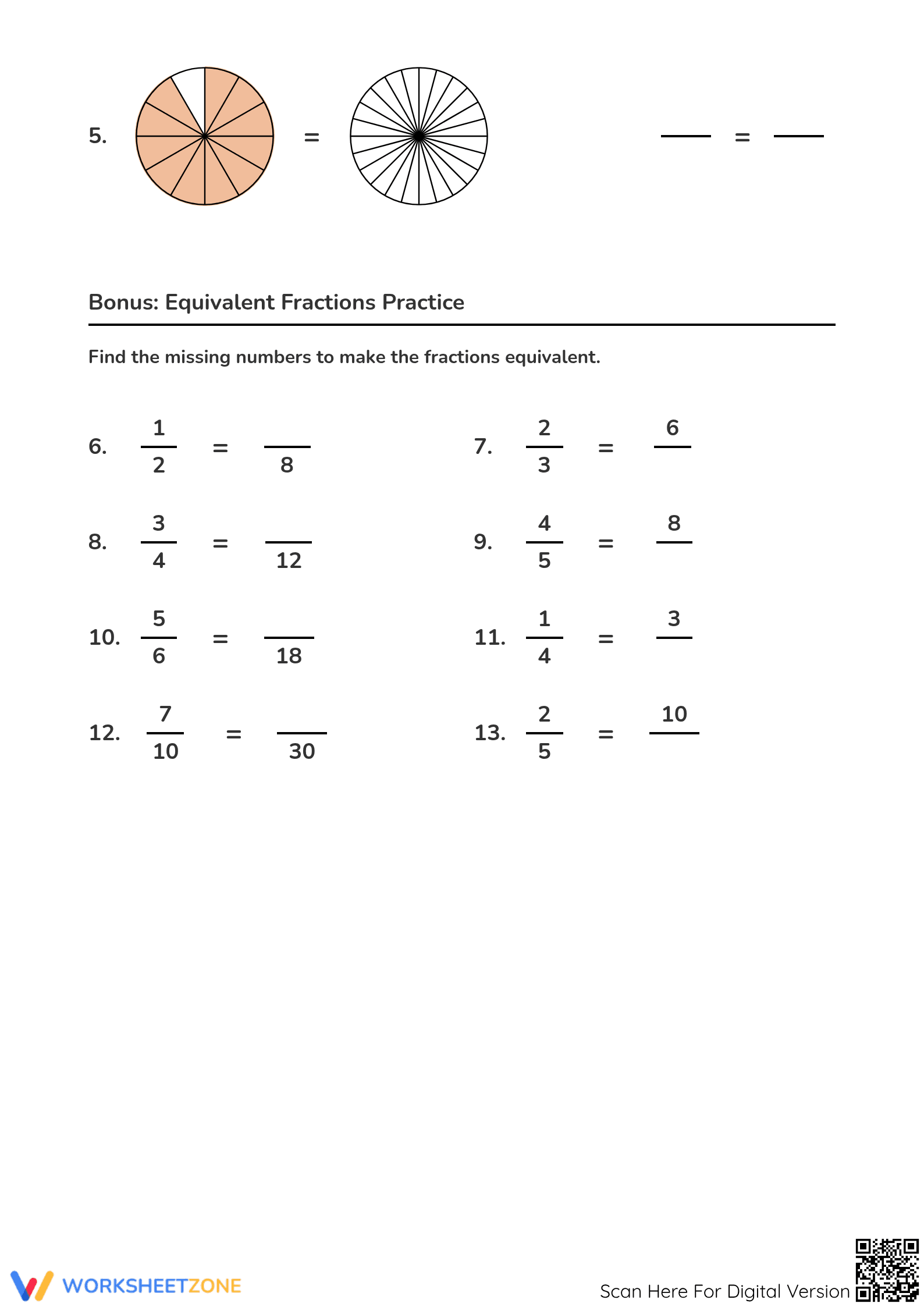
This two-page PDF contains 13 targeted problems designed for Grade 4 learners. The first page features 5 circle models where students must shade the second model to match the first and write the resulting fractions. The second page includes a "Bonus" section with 8 numeric problems where students find missing numerators or denominators to create equivalent pairs. A full answer key is provided for quick grading.
Skill Progression
- Guided Practice: The first 5 problems use circular area models to provide a concrete visual representation of fraction equivalence.
- Supported Practice: Students transition to identifying fractions based on their shading, connecting the visual model to the numeric symbol.
- Independent Practice: The final 8 problems remove visual aids, requiring students to use multiplication or division to determine the missing numeric value.
This progression follows the gradual-release model of instruction, moving from visual scaffolds to independent numeric application.
Standards Alignment
The primary focus is CCSS.MATH.CONTENT.4.NF.A.1, which requires students to explain why a fraction a/b is equivalent to a fraction (n × a)/(n × b) by using visual fraction models, with attention to how the number and size of the parts differ even though the two fractions themselves are the same size. This standard code can be copied directly into lesson plans, IEP goals, or district curriculum mapping tools.
How to Use It
Deploy this worksheet after a direct instruction lesson on fractions to gauge student understanding. It serves as an excellent formative-assessment tool; teachers should observe if students are correctly identifying the total number of segments in the second models. Expected completion time is roughly 25 minutes, making it ideal for a quiet independent work block or a homework assignment.
Who It's For
This resource is tailored for Grade 4 students but is highly effective for Grade 5 review or Grade 3 advanced learners. It pairs naturally with physical fraction tiles or a digital interactive whiteboard lesson on equivalent parts.
According to the RAND AIRS 2024 report on mathematics instructional materials, the use of visual area models is a critical precursor to fluency with abstract rational number operations. Fisher & Frey (2014) emphasize that the gradual release of responsibility from visual scaffolds to numeric fluency helps students build a robust mental map of equivalence. This worksheet directly supports CCSS.MATH.CONTENT.4.NF.A.1 by requiring students to demonstrate the plain-English skill of explaining why fractions are equivalent by using visual fraction models. By integrating both shading tasks and numeric completion, the resource addresses the NAEP recommendation for balanced instructional tasks that emphasize conceptual understanding alongside procedural skill. Teachers can utilize these 13 problems to collect evidence of student progress toward mastery of proportional reasoning. This approach ensures that learners do not merely memorize algorithms but understand the spatial relationships inherent in fraction equivalence.


