


























Views
Downloads


Equivalent Fractions Printable Worksheet | Grade 3-5 Math
Paste this activity's link or code into your existing LMS (Google Classroom, Canvas, Teams, Schoology, Moodle, etc.).
Students can open and work on the activity right away, with no student login required.
You'll still be able to track student progress and results from your teacher account.
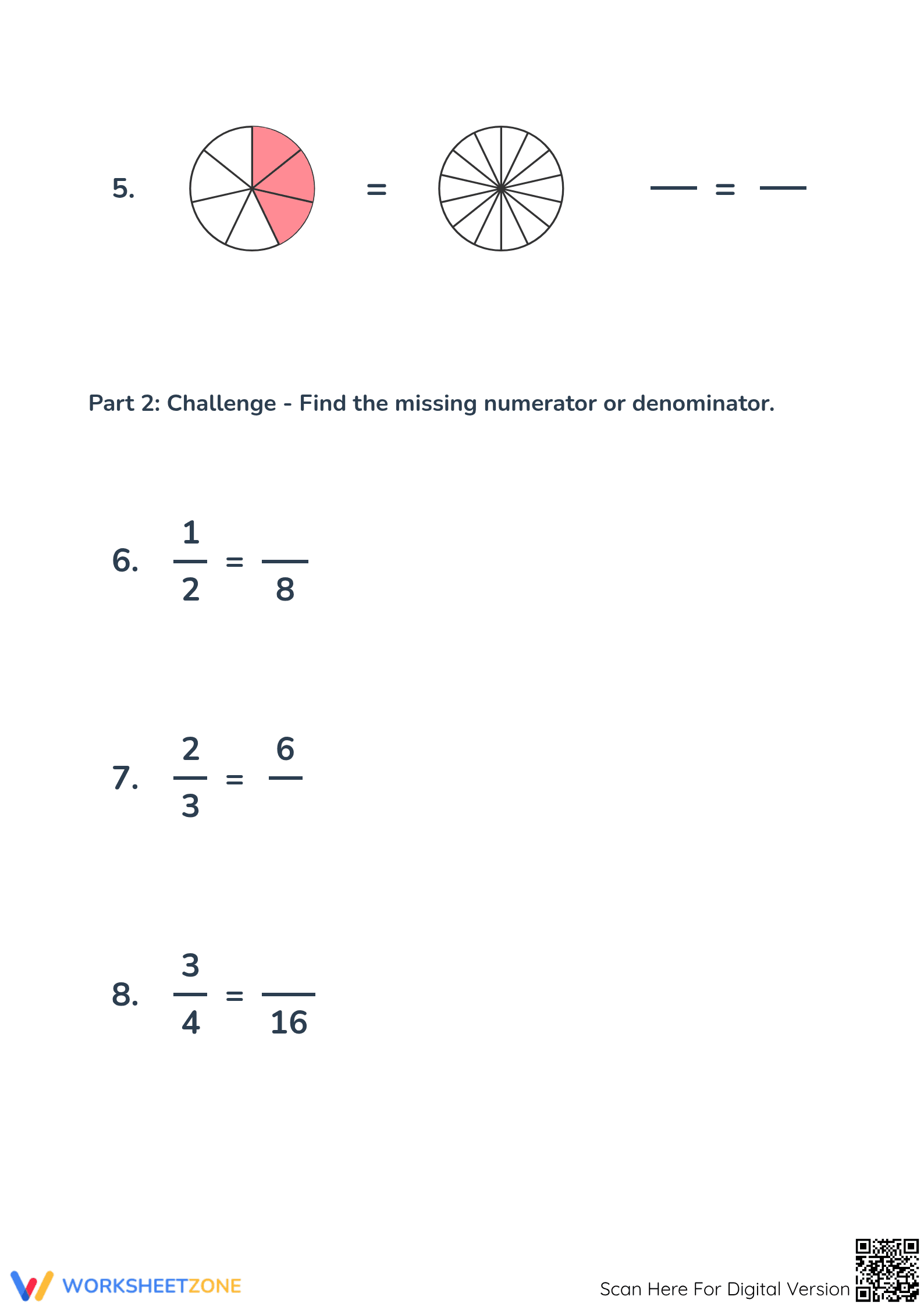
This equivalent fractions worksheet provides a structured approach for students to master the concept of fractional equality. By bridging visual models and numerical expressions, the resource ensures learners develop a concrete understanding of how different fractions represent the same part of a whole.
At a Glance
- Grade: 3–5 · Subject: Math
- Standard:
CCSS.MATH.CONTENT.3.NF.A.3— Explain equivalence of fractions and compare fractions by reasoning about their size- Skill Focus: Equivalent Fractions & Visual Modeling
- Format: 2 pages · 8 problems · Answer key included · PDF
- Best For: Individual practice or formative assessment
- Time: 15–25 minutes
The two-page PDF contains two distinct segments. Part 1 features circle models where students shade sections to create equivalent pairs, translating visual symmetry into notation. Part 2 introduces a challenge section, requiring students to solve for missing numerators or denominators without visual aids, promoting the transition toward algebraic reasoning and multiplication-based equivalence.
Implementing this resource requires minimal effort. Step 1: Print the two-page document. Step 2: Distribute to students for independent work. Step 3: Review using the included answer key to identify misconceptions. The total teacher prep time is under two minutes, making it an ideal choice for sub plans or quick lesson adjustments.
This resource aligns with CCSS.MATH.CONTENT.3.NF.A.3, requiring students to explain equivalence of fractions by reasoning about their size. It targets sub-standard 3.NF.A.3.A, focusing on understanding two fractions as equivalent if they are the same size. This standard code can be copied directly into lesson plans, IEP goals, or district curriculum mapping tools.
Use this worksheet as a check for understanding after introducing fractions. Observe how students partition blank models; if they struggle with precision, more work with physical tiles is needed. The worksheet is also effective for homework to reinforce instruction, with an expected completion time of 20 minutes for most elementary learners.
This resource is tailored for Grade 3 and 4 students starting non-unit fractions. It provides scaffolds for struggling learners through visual models while offering a challenge for those ready for numerical work. Pair this with an anchor chart showing common equivalents to provide students with a constant reference during independent practice.
Research from the RAND AIRS 2024 report emphasizes that visual-to-symbolic transitions are critical for long-term retention of rational number concepts in elementary mathematics. This worksheet facilitates that exact transition by requiring students to manually shade area models before calculating numerical equivalents. By explicitly linking the physical representation of a fraction to its symbolic form, students are less likely to view numerators and denominators as unrelated whole numbers. Instead, they develop a cohesive understanding of the relationship between parts and wholes as defined by the CCSS.MATH.CONTENT.3.NF.A.3 standard. Educational analysis suggests that students who engage with multiple representations of equivalent fractions demonstrate higher proficiency in later middle-school topics, such as adding unlike denominators and algebraic ratios. This printable resource provides a low-stakes environment for students to test their hypotheses about fraction size and equality, ensuring a robust foundation for more complex mathematical operations in subsequent grade levels.


