


























Views
Downloads

Essential Equivalent Fractions Test | Grade 4 Aligned
Paste this activity's link or code into your existing LMS (Google Classroom, Canvas, Teams, Schoology, Moodle, etc.).
Students can open and work on the activity right away, with no student login required.
You'll still be able to track student progress and results from your teacher account.
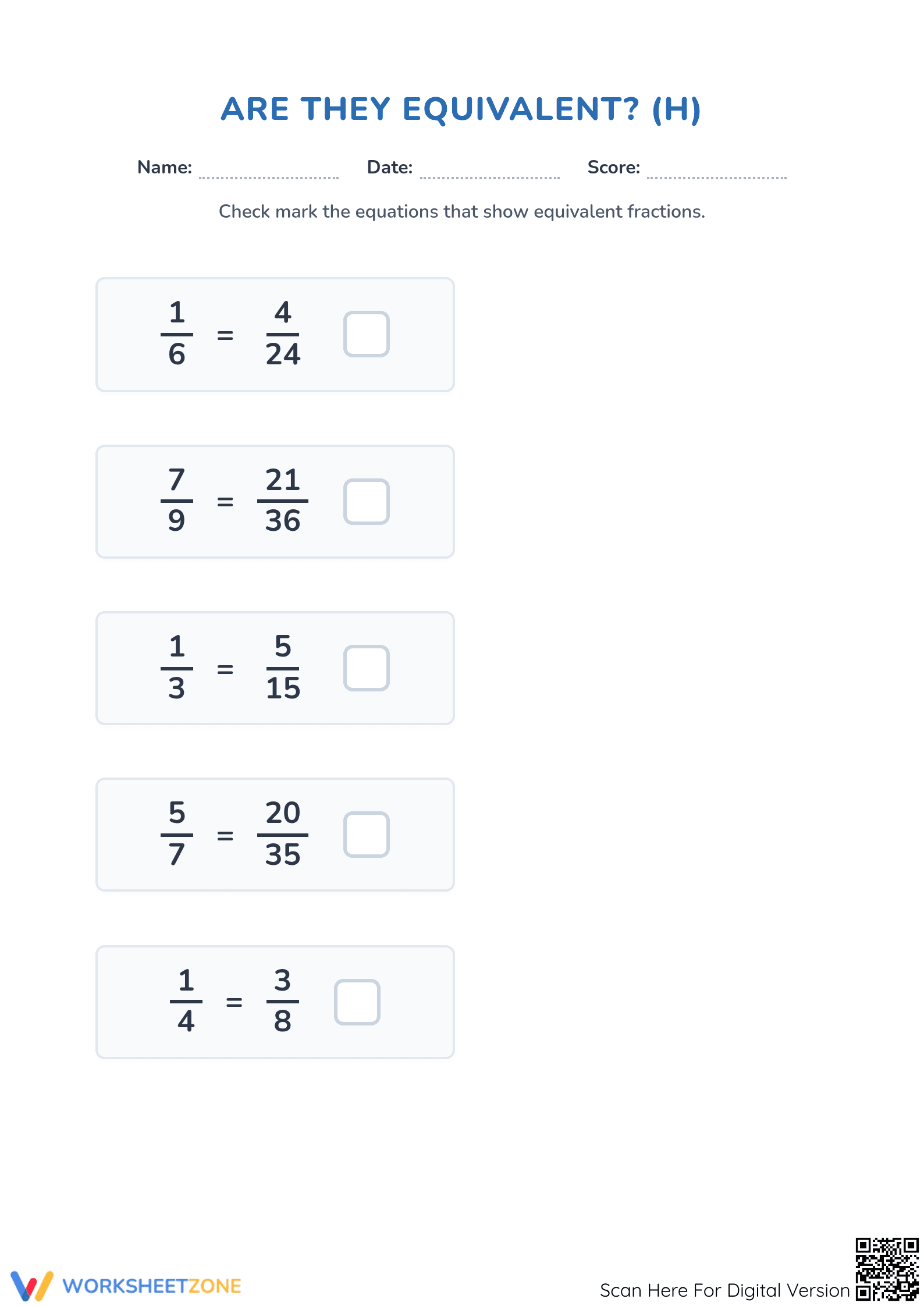
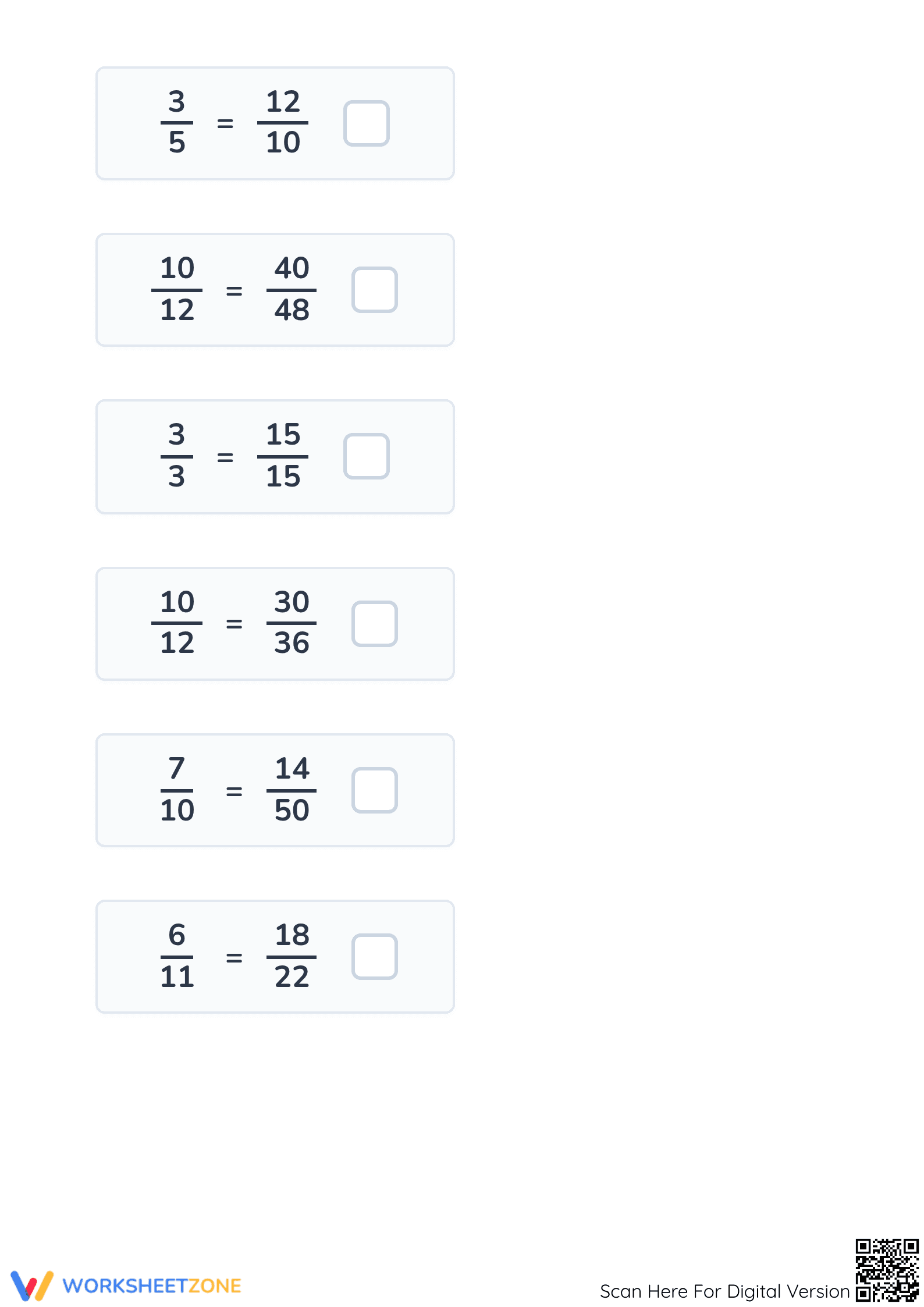
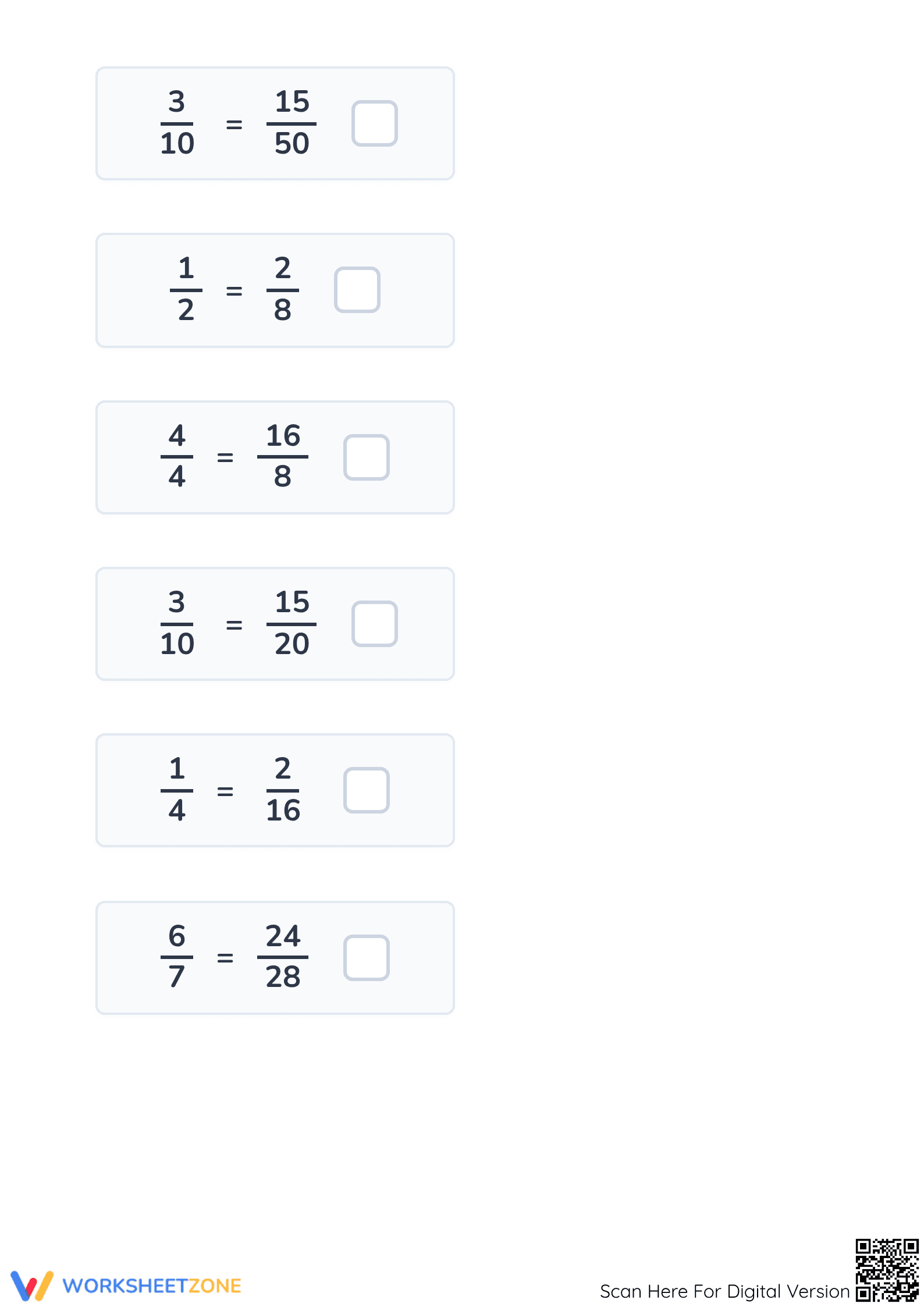
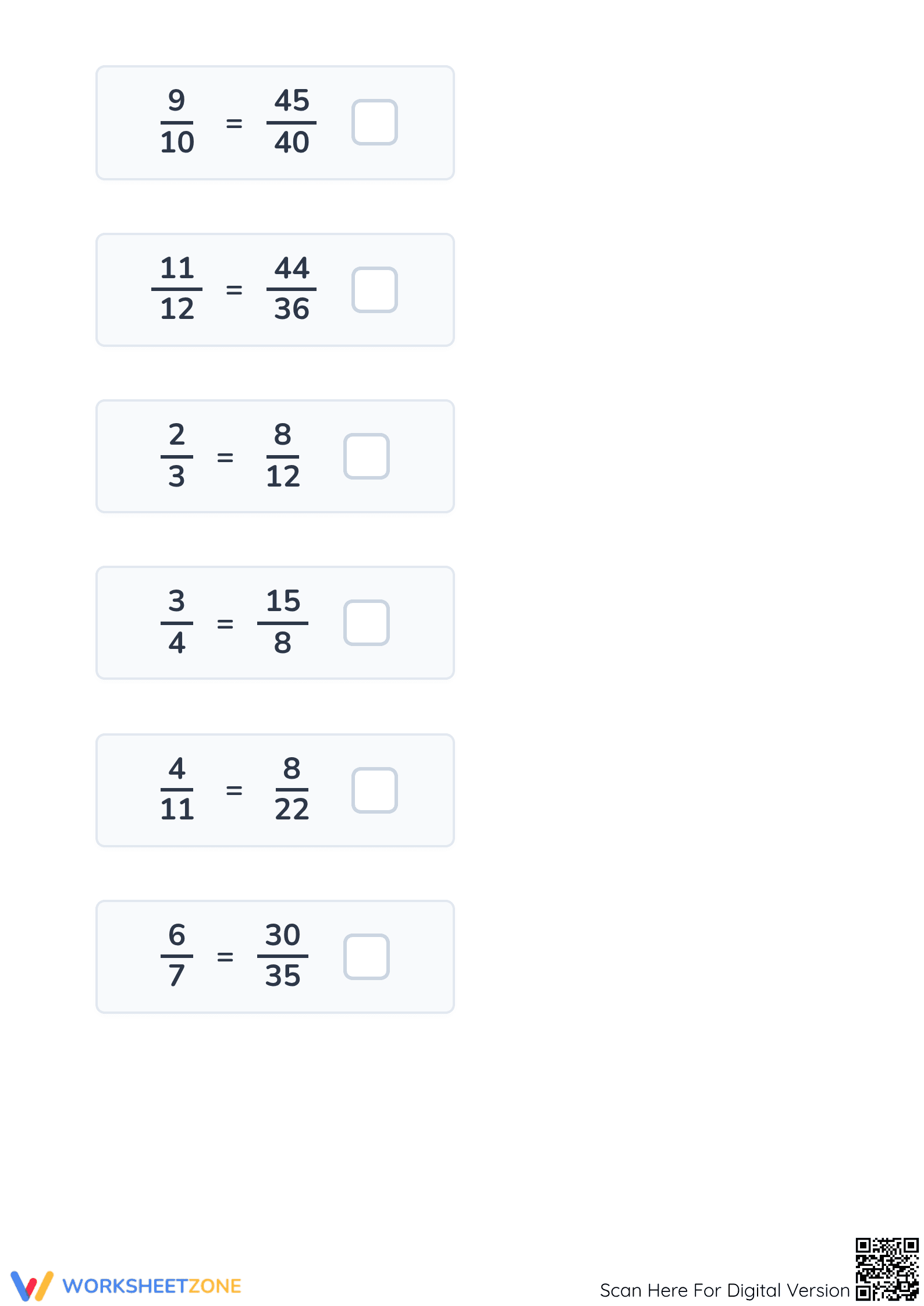
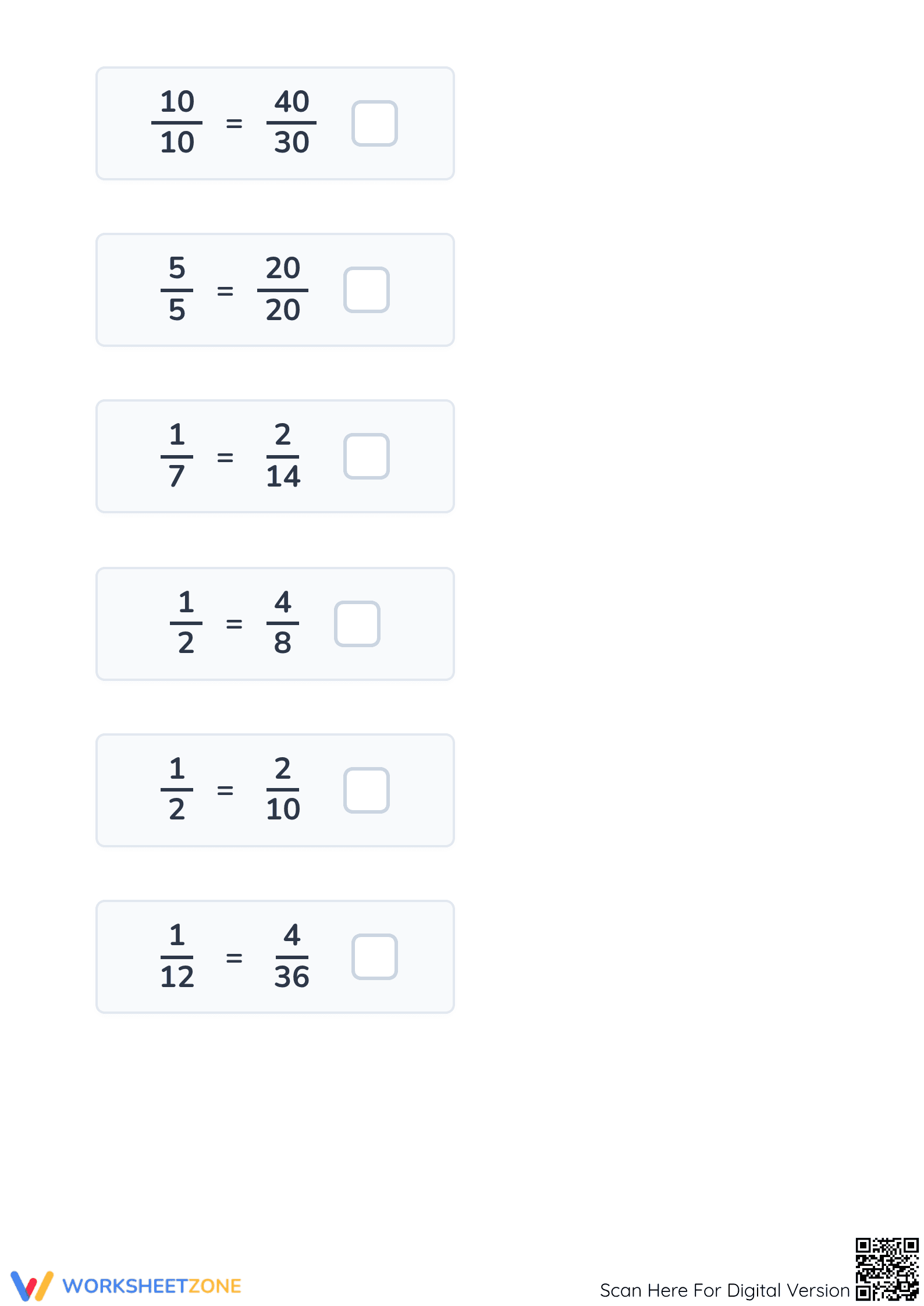
This comprehensive equivalent fractions assessment helps Grade 4 students master identifying equal ratios. By checking equations for accuracy, learners build the numerical fluency required for advanced fraction operations. This 5-page resource provides clear evidence of understanding, making it an essential tool for verifying conceptual mastery before moving to complex addition or subtraction tasks.
At a Glance
- Grade: 4 · Subject: Math
- Standard:
CCSS.MATH.CONTENT.4.NF.A.1— Explain why fractions are equivalent by using visual models or numerical multiplication- Skill Focus: Identifying and verifying equivalent fractions
- Format: 5 pages · 30 problems · Answer key included · PDF
- Best For: Formative assessment and progress monitoring
- Time: 25–35 minutes
This packet contains five worksheets, each featuring six fraction equations for evaluation. The distraction-free layout provides space for students to use cross-multiplication or division to verify scaling factors. A complete answer key is included for all 30 problems, ensuring efficient grading and immediate feedback for learners as they work through the set.
Mastery Evidence
Tasks are mapped to the progression of fraction mastery. Each equation tests if a/b equals (n x a)/(n x b), assessing the standard's core requirement. Teachers use the "Check mark" format to score performance, entering data into gradebooks to track accuracy across the 30-item set. This data clarifies which students require targeted reteaching on specific scaling factors.
Standards Alignment
Focus is `CCSS.MATH.CONTENT.4.NF.A.1`: explain why fraction a/b is equivalent to (n x a)/(n x b) using models or numerical logic. This resource targets the numerical application of this principle. Both standard codes can be copied directly into lesson plans, IEP goals, or district curriculum mapping tools for administrative documentation.
How to Use It
Use as a post-instruction assessment after visual model practice. Observe if students write scaling factors; this provides a formative tip regarding procedural fluency versus mental math reliance. Students typically complete the 30-problem set within 25 to 35 minutes, though this varies based on their multiplication table recall.
Who It's For
Designed for Grade 4, this also serves as intervention for older students struggling with common denominators. It pairs with a fraction tiles anchor chart or a lesson on the identity property. The repetitive tasks provide the practice needed for students receiving Tier 2 support or IEP accommodations.
According to the RAND AIRS 2024 report, high-quality mathematics instructional materials must balance procedural fluency with conceptual understanding to ensure long-term retention of rational number concepts. This assessment aligns with that finding by requiring students to verify numerical equivalence, a prerequisite for the more complex fraction arithmetic introduced in later grades. Research by Fisher & Frey (2014) emphasizes that "checking for understanding" through targeted tasks like these allows teachers to identify specific misconceptions before they become calcified. By isolating the verification of CCSS.MATH.CONTENT.4.NF.A.1, this tool provides high-signal data for data-driven instruction. Educators who utilize structured practice sets see a measurable improvement in student confidence when approaching multi-step word problems involving fractions. This resource ensures that the foundational logic of multiplying by a form of one is solidified through 30 targeted trials, matching the rigor expected in modern state assessments.


