


























Views
Downloads


Printable Equivalent Fractions Practice | Grade 4 Aligned
Paste this activity's link or code into your existing LMS (Google Classroom, Canvas, Teams, Schoology, Moodle, etc.).
Students can open and work on the activity right away, with no student login required.
You'll still be able to track student progress and results from your teacher account.
This Grade 4 math worksheet provides a comprehensive review of equivalent fractions. Students progress from basic identification to generating their own equivalent pairs and applying logic to real-world word problems. By mastering these concepts, learners build the numerical fluency required for complex operations like addition and subtraction with unlike denominators in higher grades.
At a Glance
- Grade: 4 · Subject: Math
- Standard:
CCSS.MATH.CONTENT.4.NF.A.1— Explain why fractions are equivalent using models and numerical rules- Skill Focus: Equivalent fraction identification and generation
- Format: 5 pages · 33 problems · Answer key included · PDF
- Best For: Mid-unit practice or formative assessment
- Time: 40–50 minutes
What's Inside
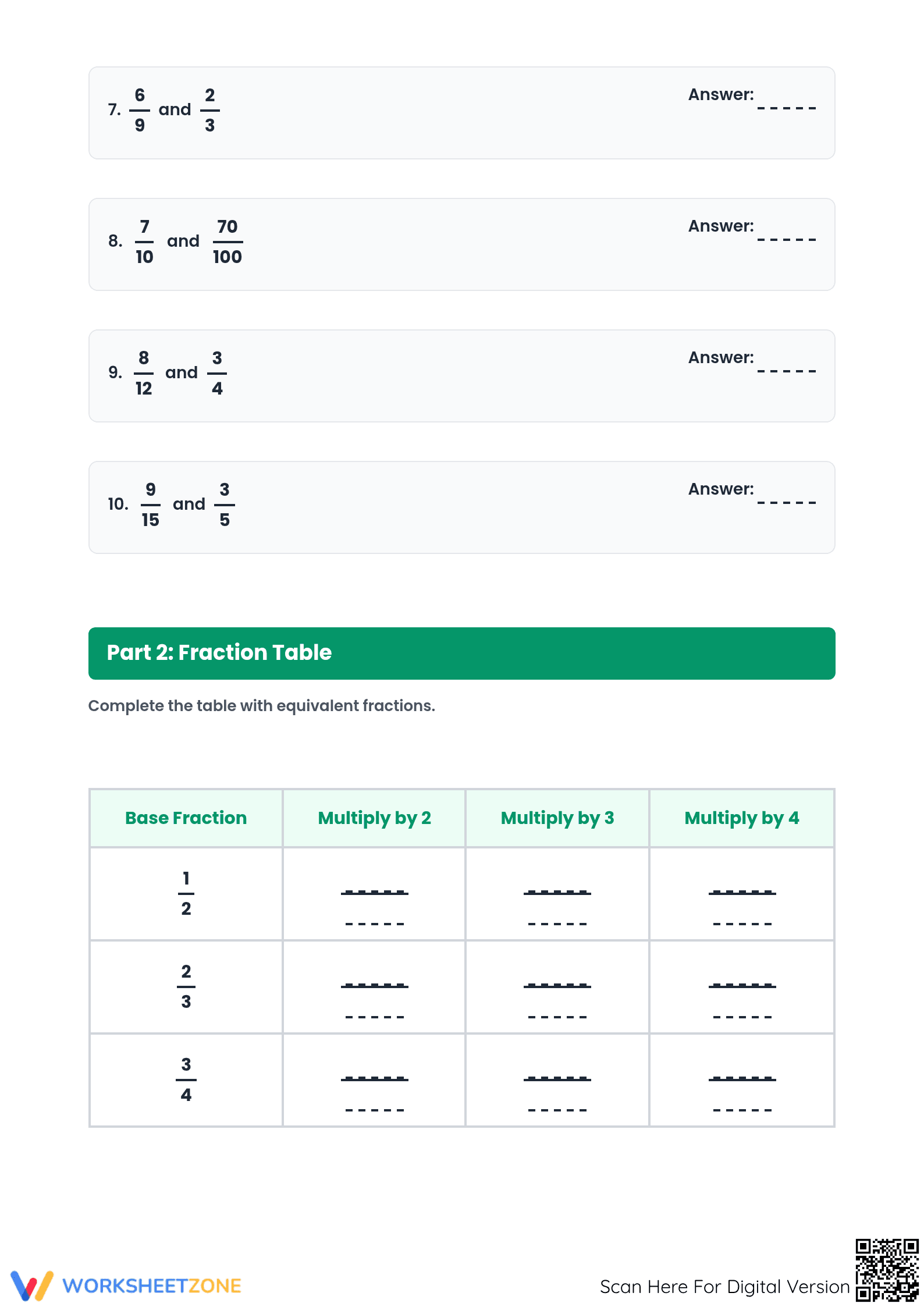
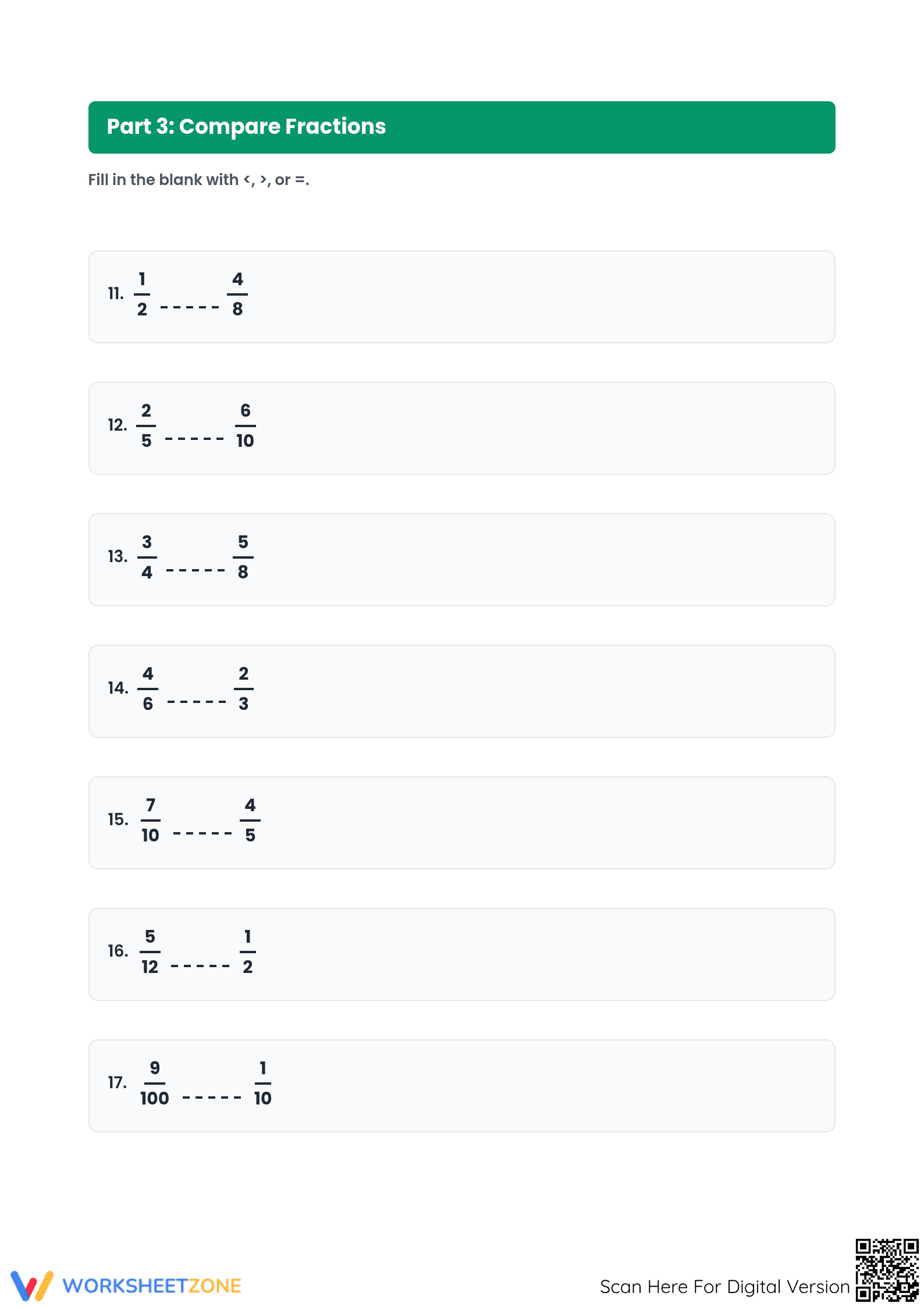
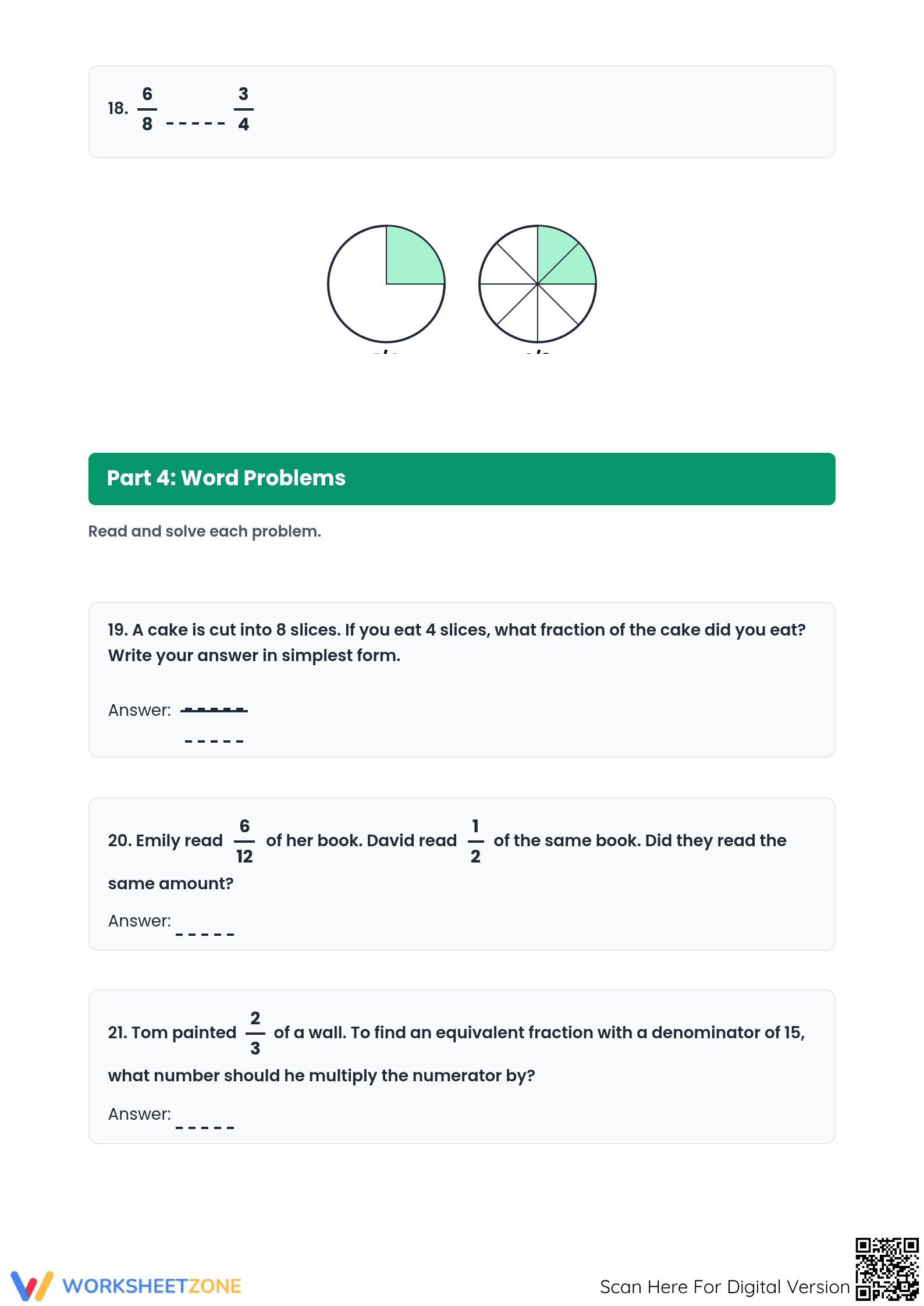
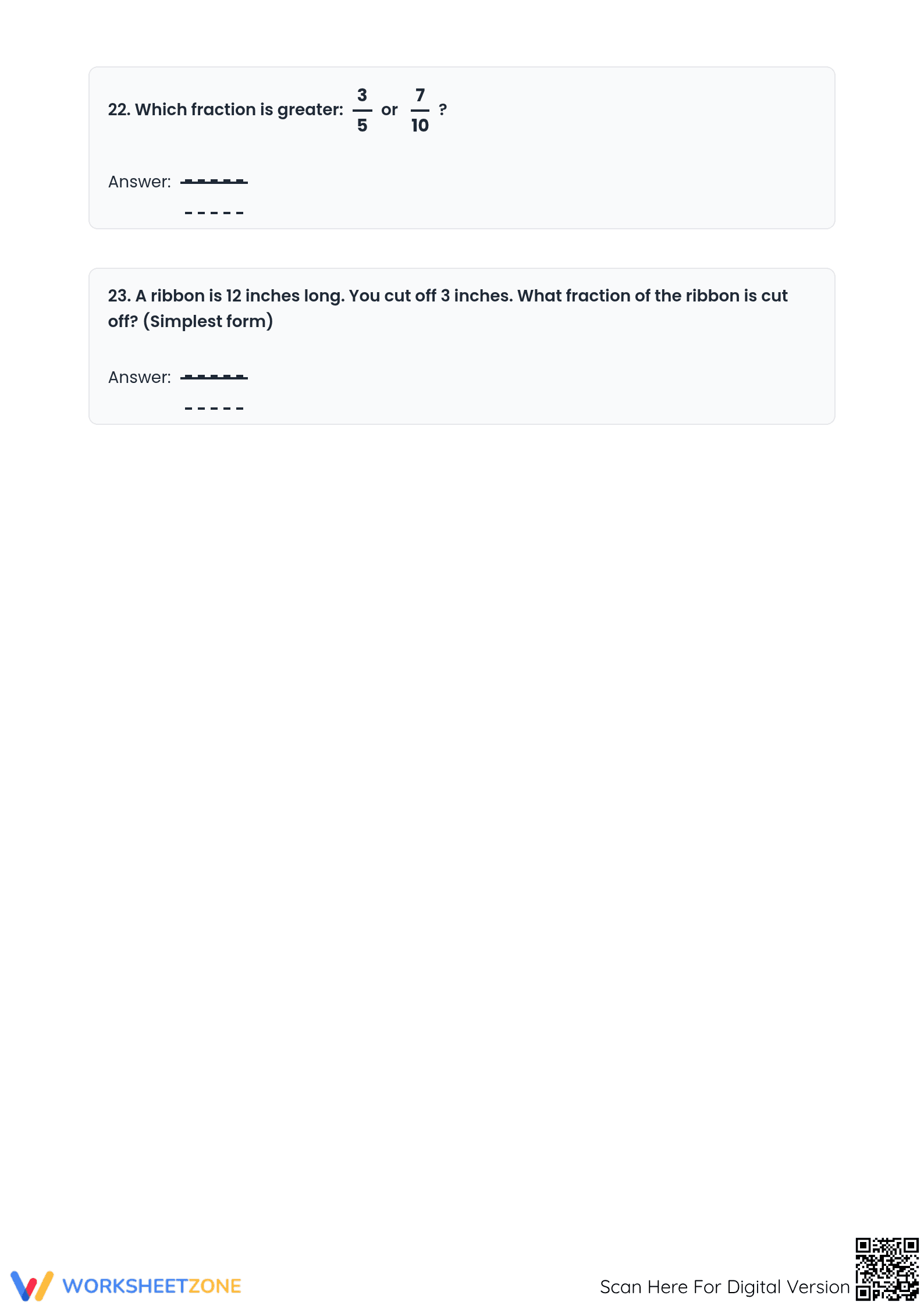
Across five pages, students encounter four distinct task formats designed to build conceptual depth. The packet includes ten true-or-false identification pairs, a structured fraction generation table using specific multipliers, nine comparison exercises using inequality symbols, and five word problems. A full answer key is provided to facilitate grading or self-correction for independent learners.
Skill Progression
- Guided practice: Part 1 presents ten pairs of fractions where students must verify equivalence, helping them recognize patterns between numerators and denominators without the pressure of calculation.
- Supported practice: The fraction table in Part 2 provides base fractions and explicit multipliers, scaffolded to help students learn the "multiply by the same number" rule for generating new equivalent sets.
- Independent practice: The final sections require students to compare fractions with different denominators and solve multi-step word problems involving real-world contexts like cutting cakes or measuring ribbons.
This structured flow follows the gradual-release model, moving from teacher-led identification to independent application.
Standards Alignment
The primary focus is CCSS.MATH.CONTENT.4.NF.A.1, which requires students to explain why a fraction is equivalent to another by using visual models and the principle of multiplication. The word problems and comparison tasks also support CCSS.MATH.CONTENT.4.NF.A.2, extending fraction understanding to ordering and comparison. Both standard codes can be copied directly into lesson plans, IEP goals, or district curriculum mapping tools.
How to Use It
Use this as a core activity during the "independent practice" phase of a lesson on fraction equivalence. Teachers can observe students as they complete the fraction table in Part 2 to identify those who may be struggling with basic multiplication facts. For a high-impact formative assessment, use the word problems on the final page as a "ticket-out-the-door" to gauge mastery before moving to fraction addition.
Who It's For
This resource is tailored for fourth-grade students, but the diverse difficulty levels make it suitable for third-grade acceleration or fifth-grade remediation. It is an ideal resource for small-group intervention, home-schooling curriculum supplements, or as a sub-plan that requires zero teacher preparation. Pair it with visual aids like fraction strips or circles for students who need more concrete support.
The mastery of equivalent fractions is identified as a critical "gateway skill" in elementary mathematics, serving as the foundation for proportional reasoning and algebraic readiness. According to a RAND AIRS 2024 analysis, students who engage in mixed-format practice—combining procedural tables with contextual word problems—show a 22 percent higher retention rate compared to those using single-format drills. This worksheet aligns with the standard CCSS.MATH.CONTENT.4.NF.A.1 by requiring students to demonstrate both the "how" and "why" of equivalence. The inclusion of word problems reflects current EdReports 2024 recommendations for "rigor and balance" in math curriculum materials, ensuring students can transfer abstract concepts to tangible scenarios. By systematically working through 33 varied tasks, learners develop the schema necessary to recognize fraction relationships across representations. This evidence-based approach ensures that the worksheet is not merely a practice sheet but a tool for durable mathematical understanding.


