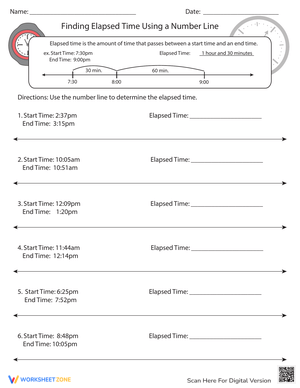
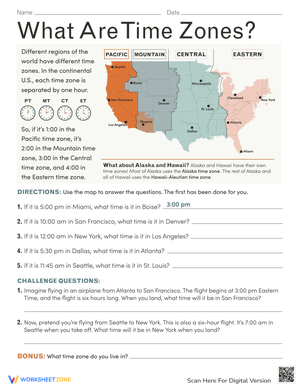
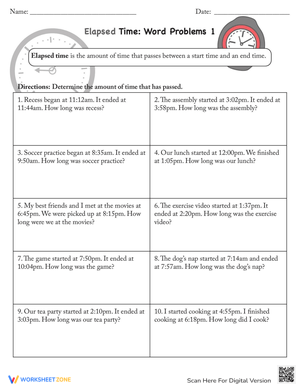
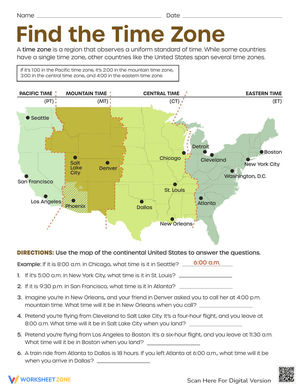
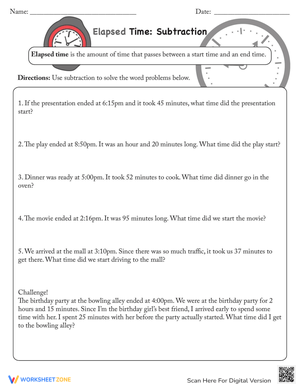
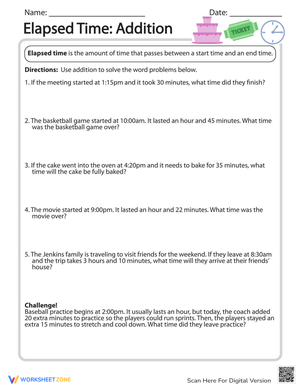
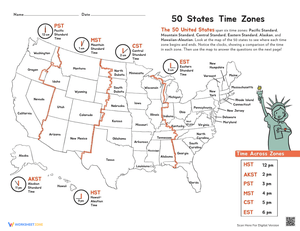
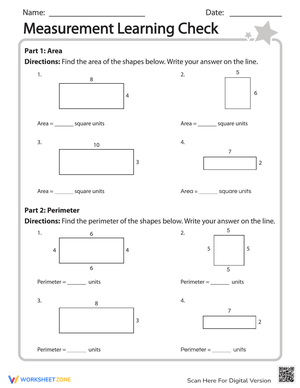
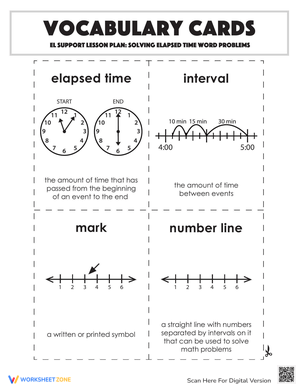
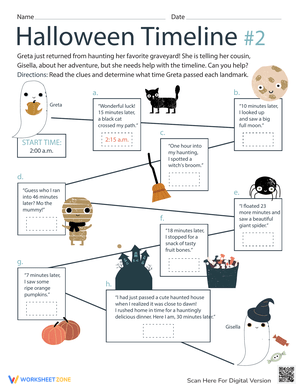
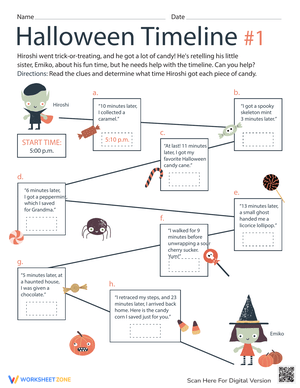
These word problems worksheets for 3rd grade target elapsed time across three distinct problem types: determining end time, working backward to find start time, and calculating duration when both endpoints are known. Each worksheet builds in open workspace so students can draw number line jumps without hunting for blank paper. Problems use contexts third graders actually recognize — soccer practice, school lunch, a trip to the library — which keeps the reading load manageable while the math stays rigorous.
What Students Work Through
Third grade is the year elapsed time stops being a footnote and becomes its own mathematical skill. Telling time to the nearest minute is now assumed; students must now measure the gap between two clock readings, which requires a different kind of reasoning. Each worksheet targets one or two of the following:
- Reading a start time and duration to find the end time
- Reading an end time and duration to work backward to the start time
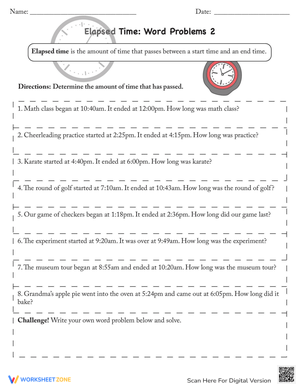
- Reading a start time and end time to calculate total minutes elapsed
- Applying open number line strategies to record jumps in whole hours, then remaining minutes
- Solving multi-step problems where an activity spans more than one hour boundary
The last skill is the one that separates students who understand time from students who have memorized a procedure. When the interval crosses an hour mark — 10:47 to 12:15, for example — there is no shortcut. Students who skip the number line stall or guess; the workspace on each worksheet nudges them toward a recorded strategy before they resort to that.
Standard Alignment
CCSS.MATH.CONTENT.3.MD.A.1 requires students to tell and write time to the nearest minute and solve word problems involving addition and subtraction of time intervals in minutes, explicitly citing number line diagrams as a representational approach. In classroom terms, that standard means students need experience with all three unknowns — end time, start time, and duration — not just the common "what time does it end?" variety. These word problems worksheets for 3rd grade distribute all three problem types across the set so students build genuine flexibility rather than comfort with a single procedure.
3.MD.A.1 typically lands late in most district pacing guides — late winter or early spring, after students have solid fluency with addition and subtraction within 1,000. That placement matters because elapsed time problems demand accurate arithmetic at the minute-counting stage. A student who miscalculates 47 + 13 will have the right strategy and the wrong answer every time. Pairing this practice with a quick fluency check during the unit helps teachers catch that particular interference early.
Common Errors Worth Catching Before They Take Hold
The most predictable mistake is treating minutes like base-10 digits. A student who needs to add 25 minutes to 3:47 will often write 3:72 PM — the hour looks right, the minute arithmetic feels correct, but the answer is impossible on any clock. Students who draw their number line jumps catch this error themselves because 3:72 simply cannot appear on a drawn timeline. Students who skip the drawing and compute mentally write it down confidently and move on.
A second pattern surfaces when the problem asks for start time rather than end time. Students who have internalized "start plus duration equals end" as a forward-only rule will add the duration to the given endpoint, arriving at a time that is later than the one they were handed. Annotating the unknown before starting — circling the word "start" or "end" directly in the problem — breaks that autopilot for most students. Watch separately for AM/PM confusion on any problem where the interval crosses noon: a third grader who correctly solves 10:30 AM plus 90 minutes will sometimes write 12:00 AM instead of 12:00 PM, an error easy to miss in a stack of papers because the time itself looks plausible.
Fitting These Worksheets Into Your Lesson Planning
The most reliable spot in the weekly schedule is the 8–10 minutes after morning meeting, when students are seated and the transition into math has not fully happened yet. One worksheet per day during the elapsed time unit keeps practice tight and lets you circulate before launching direct instruction. Problems that took students 12 minutes on Monday typically take 5 by Thursday — that shift is visible to them, which matters for motivation in a unit that can feel grinding at the start.
For small group instruction, pull students who stall on intervals that cross the hour mark. These word problems worksheets for 3rd grade work well in that setting because the workspace is already structured: ask students to narrate each jump aloud while drawing — "I'm jumping 15 minutes to get to 11:00, then 15 more to get to 11:15" — and you will immediately hear who is tracking what each jump represents versus who is making marks to look like they have a strategy. The set also laminate well; a few copies with dry-erase markers give you repeatable practice across multiple class sessions without reprinting.
Adjusting the Work for Mixed-Ability Classrooms
For students who are still shaky on minute arithmetic, simplify the numbers before simplifying the problem type. Cover the original start time, write in a clean hour — 2:00 instead of 2:17 — and let them work through the same problem structure with friendlier numbers. Once they navigate the number line reliably on whole-hour anchors, reintroduce the original times. This keeps the problem type consistent with what the rest of the class is doing, which matters for students who are sensitive about receiving visibly different work.
Students ready to move past the standard can work the word problems worksheets for 3rd grade content with one added constraint: solve each problem using two different representations and confirm the answers match. Comparing an open number line solution to a T-chart and explaining why both should agree pushes toward the flexible thinking that 4th grade measurement work will require. It also reliably identifies students who have learned one strategy so rigidly that they cannot transfer the concept to a different visual format — useful diagnostic information heading into the next unit.
Frequently Asked Questions
Why do third graders find elapsed time harder than other time topics?
Two things land at once: the base-60 system and multi-step tracking. Students have spent two years doing arithmetic in base-10, so the moment 47 + 25 stops producing a useful result without conversion, the ground shifts. At the same time, elapsed time problems require holding at least two pieces of information simultaneously — the current landmark time and how far remains to the next one — which stretches working memory for students who are still building fluency. Most other Grade 3 measurement work does not combine a non-base-10 structure with that kind of cognitive load at the same time.
How do I support students who get stuck on the reading before they reach the math?
Teach three annotation moves: underline the start time, circle the end time or duration, and put a box around what the problem is asking them to find. These three marks take less than a minute and direct attention to the actual numbers before students try to hold the whole problem in their heads. For students who find the word problems genuinely difficult to decode, reading the problem aloud while the student annotates removes the decoding load without removing the math task — the arithmetic reasoning stays intact.
Can these worksheets generate useful formative assessment data?
The number line workspace is the reason the answer is yes. A completed number line shows exactly where a student's reasoning broke down — whether they stopped before crossing the hour, whether their jump sizes are arbitrary, whether they are working forward when the problem calls for working backward. That visual record gives more diagnostic information than a circled final answer, and it makes student-teacher conferences during the unit far more specific than a score alone would allow.













 Interactive Worksheet Maker
 Quiz Maker
 Word Search Maker
 Crossword Puzzle Maker
 Word Scramble Generator
 Sentence Scramble Generator
 Handwriting Worksheet Generator
 Name Tracing Generator
 Fill In The Blank Generator