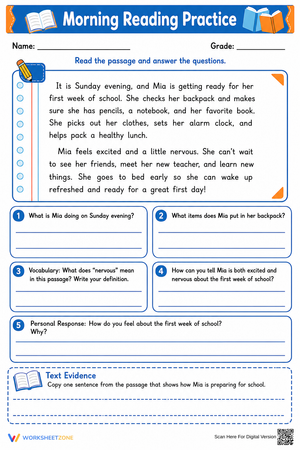
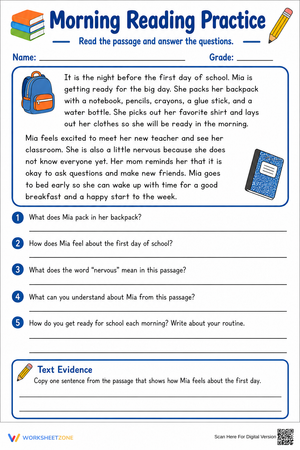
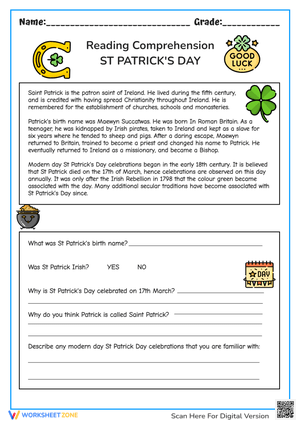
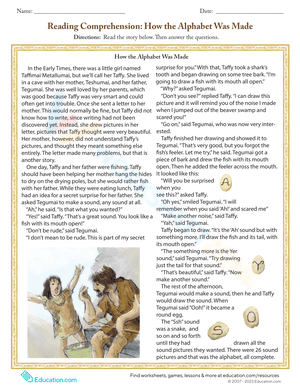
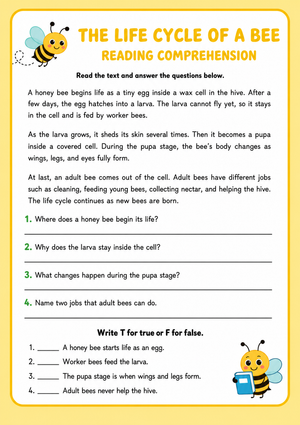
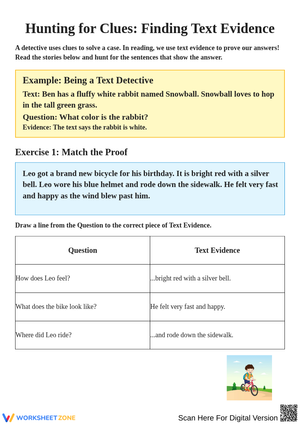
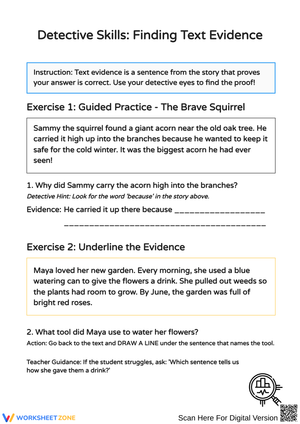
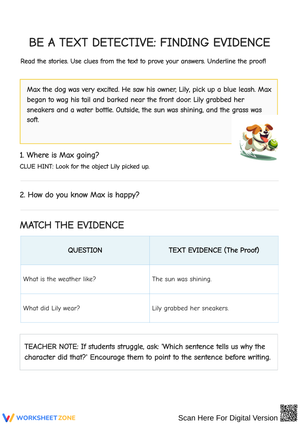
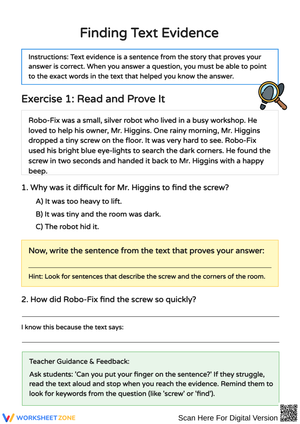
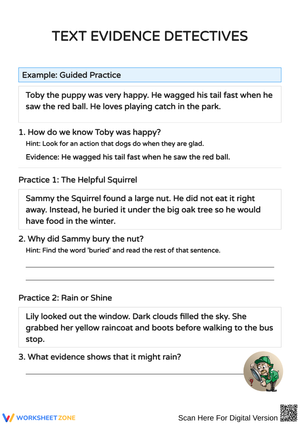
These 3rd grade finding text evidence printable worksheets give students structured practice in one of the trickiest moves in early reading comprehension: going back into a text after reading, locating the exact sentence that answers a question, and presenting it as proof rather than paraphrase. The set covers both fiction and informational passages, with response formats that range from color-coded underlining tasks to full RACE-strategy written responses.
Skills Covered Across the Set
At their core, what 3rd grade finding text evidence printable worksheets do well is force students to treat the text as a searchable document rather than something they've already half-processed. Third graders tend to answer comprehension questions from a blurry mental summary of what they just read; the discipline of returning to the page, finding a specific line—not a general area—has to be built deliberately and practiced often. Each worksheet targets one or more of the following:
- Underlining the single sentence that answers a question, not the surrounding paragraph
- Copying a direct quote and using quotation marks correctly
- Paraphrasing a text detail without adding interpretation or shifting the meaning
- Using sentence stems—The text states..., According to the passage..., The author explains...—to introduce cited evidence before writing it
- Distinguishing between a personal inference and something the author stated directly
- Locating evidence across both narrative text (character motivation, dialogue, event sequence) and informational text (facts, definitions, cause-and-effect relationships)
The RACE Framework as a Repeatable Routine
Several worksheets in the set are built around the RACE strategy: Restate, Answer, Cite, Explain. The Cite step is where the work actually lives for most third graders. It requires them to stop, go back into the passage, evaluate which sentence answers the question most directly, and record it—either as a direct quote or a paraphrase. Students who write their response as one undivided paragraph almost always bury their evidence so thoroughly it reads like an opinion. The dedicated citation box on a RACE worksheet makes that omission impossible to hide from the teacher or from the student reviewing their own work.
The color-coding worksheets serve as a lower-stakes entry point into the same skill. Each comprehension question is paired with a color; students use that crayon or marker to underline the matching sentence in the passage. Because there's no writing demand, this format lets students focus entirely on selection—finding the right line—without simultaneously figuring out how to phrase a response. That narrowing of the cognitive task makes color-coding effective early in the year or with students who shut down when facing a blank response area.
Where the Work Breaks Down: Patterns to Watch in Student Responses
The most persistent third-grade error in this skill is what might be called the whole-paragraph grab. A student who can't yet identify which sentence carries the answer will highlight every sentence in the vicinity just to be safe. This isn't carelessness—it's a genuine inability to discriminate between the answer-bearing sentence and its neighbors. Some worksheets address this directly by asking students to underline only one sentence and then cross out two nearby sentences that are related but don't answer the question. That crossing-out step forces the discrimination explicitly rather than assuming it will develop on its own.
A second pattern: students select evidence that is thematically close to the answer but doesn't actually say what the question asks. Ask a class to find evidence that the main character is nervous, and a reliable portion will underline "she walked slowly down the hallway"—a detail they've inferred nervousness from, not one that states it. Worksheets that ask students to write their evidence and explain the connection make this confusion visible. When a student writes "this shows she is nervous because it says she walked slowly," the teacher can see exactly where the reasoning needs to be corrected.
Building These Worksheets Into Your Weekly Lesson Plans
These 3rd grade finding text evidence printable worksheets fit into different spots in the day depending on the format. The shorter color-coding tasks work well in the first 8–10 minutes of a reading block—quick enough to focus attention without eating into instruction time. The RACE-format worksheets belong after whole-group modeling, during the independent practice window when students are putting the strategy to work on their own. A small-group approach that pays off: read a short passage together aloud, then have everyone point to their answer in the text before anyone says a word. That silent-pointing step ensures all students are actively searching rather than waiting for the fastest reader to locate it first.
Spacing matters more than volume here. Using the same passage twice—once for underlining, then a week later for a RACE written response—puts retrieval practice to work and shows students that finding evidence and writing about it are two distinct skills, each worth practicing separately. Two or three worksheets a week used consistently outperform a packet completed in one sitting and then set aside.
Standard Alignment
These worksheets address CCSS ELA-Literacy.RL.3.1 and RI.3.1. Both standards require students to ask and answer questions about a text by referring explicitly to what the text says—RL.3.1 for literature, RI.3.1 for informational text. On most state reading assessments in grades 3 through 5, the citing-evidence skill appears in short-answer and constructed-response items that ask students to support a claim with specific text details. The habits practiced here—returning to the text, selecting a specific line, introducing it with a citation stem—are exactly the behaviors those items reward. These skills also build directly toward RI.4.1 and RL.4.1, which raise the expectation to inferential evidence, making the citation habit at third grade foundational rather than optional.
How to Level These Worksheets Up or Down for Your Class
For students reading below grade level, the most practical adjustment is to pair a lower-Lexile passage with the same citation format. Decoding difficulty and evidence-location difficulty are separate problems; a student who can't decode the passage can't practice the citation skill. Keeping the response structure—the RACE organizer, the sentence stems, the underlining task—constant while adjusting the text complexity lets struggling readers work on the target skill without decoding barriers interfering.
Students who have the citation step down benefit from prompts that raise the analytical demand. Instead of "find evidence that shows the character is upset," they work with something like: "The author never directly says the character is upset. Find two separate details from the text that together suggest her feelings, and explain why one detail alone wouldn't be enough." That kind of compound evidence task mirrors what skilled readers do automatically and pushes students who need more challenge past the straightforward underline task.
For English Language Learners, the sentence stem frames already printed on many of these worksheets remove a significant barrier. Students don't need to construct an introduction phrase from scratch on top of finding and writing the evidence itself. Offering a small reference card with three or four stems alongside each worksheet keeps the language accessible without reducing the cognitive work of selecting and recording evidence.
Frequently Asked Questions
My students know they need to use evidence but keep copying the whole paragraph. How do I break that habit?
That whole-paragraph grab is the most common intermediate step—students who've learned to look back at the text but haven't yet learned to narrow their selection. The fix is making the boundary concrete and physical. Have students draw a box around only the sentence they're citing before they copy it; if the box spans more than one sentence, they haven't found their evidence yet. Several of these 3rd grade finding text evidence printable worksheets include a step that explicitly asks students to cross out nearby sentences that are related but don't answer the question—an addition that forces the narrowing decision every time rather than leaving it to chance.
What sentence stems work best at this grade level?
The most reliable starters for third graders are short and direct: The text states..., According to the passage..., The author wrote..., and In the text, it says.... These work because they create a clear seam between the student's own words and the cited material. Avoid stems so elaborate they become harder to use than simply writing the evidence outright. Once students can use one stem fluently, introduce a second—variety matters eventually, but consistency in the early months matters more.
Should third graders cite with direct quotes, paraphrase, or both?
Both, and the distinction is worth teaching explicitly. Direct quotes require quotation marks and exact copying; paraphrases require genuine restatement without changing the meaning. At this grade level, paraphrasing is harder—students tend to swap out one word while leaving the rest identical, which isn't actually paraphrasing. A reliable exercise: read one evidence sentence aloud, cover it, and have students tell a partner what it means in their own words before writing anything. The cover-and-retell step prevents the one-word-swap shortcut and forces actual comprehension of the evidence before it gets recorded.
How do I introduce this skill to students who have never been asked to cite evidence before?
Start concrete, not abstract. Tell students they're proving their answers the way a detective proves a case—with actual evidence from the scene, not with what they think probably happened. Then model finding evidence in a shared text, showing every step: read the question, go back in, scan for relevant language, point to the specific sentence before copying it. Don't introduce citation stems, RACE format, or any response structure on the same day you introduce the concept. First priority is getting students to understand why they're going back to the text at all. The format can follow once that fundamental habit is in place.












 Interactive Worksheet Maker
 Quiz Maker
 Word Search Maker
 Crossword Puzzle Maker
 Word Scramble Generator
 Sentence Scramble Generator
 Handwriting Worksheet Generator
 Name Tracing Generator
 Fill In The Blank Generator