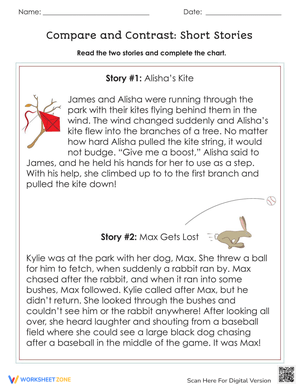
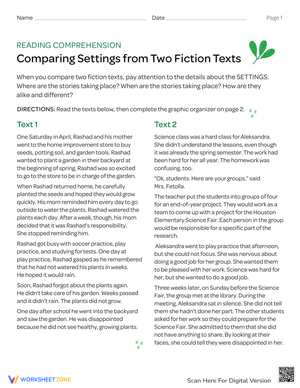
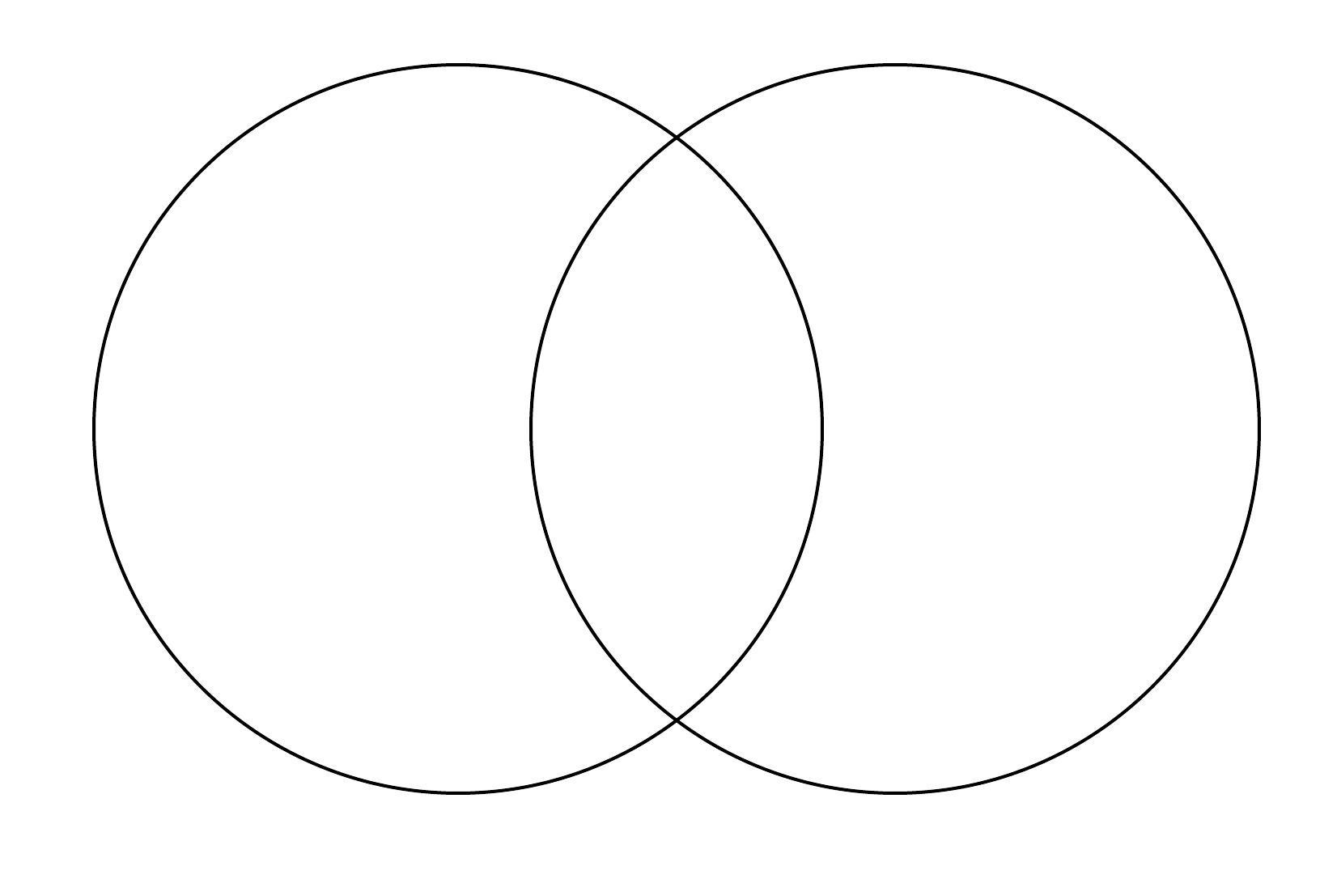
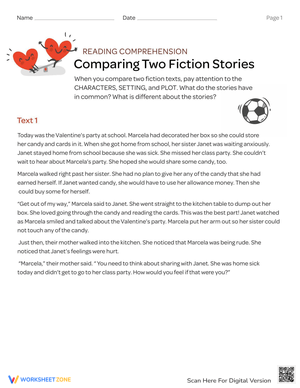
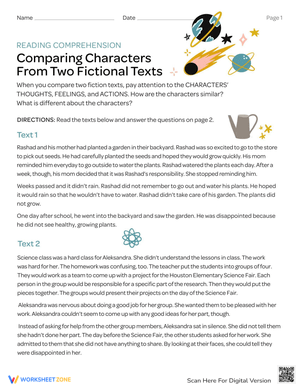
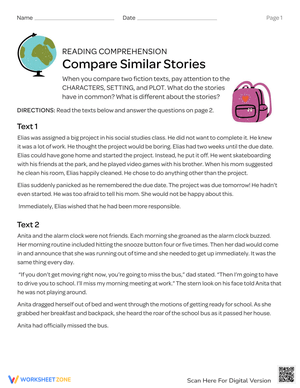
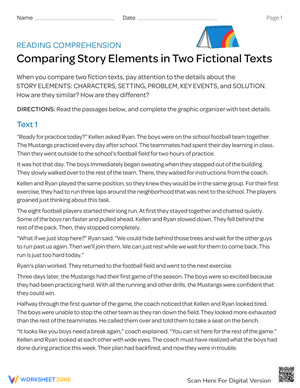
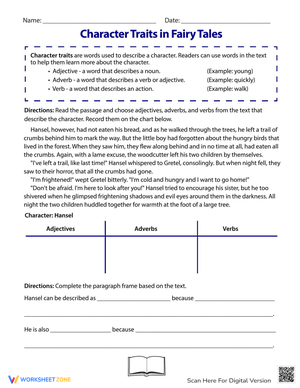
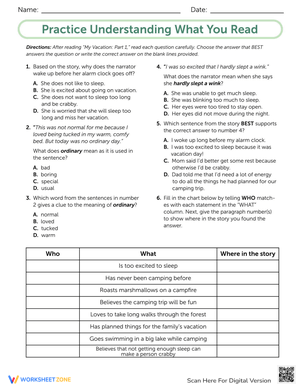
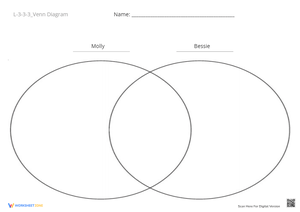
These compare and contrast characters printable worksheets for 3rd grade give teachers a direct path into one of the harder analytical moves eight- and nine-year-olds face: looking at two characters simultaneously and saying something specific and evidence-backed about both. The set includes Venn diagram formats, T-charts, and directed-prompt worksheets, giving real options depending on the text and where students are in the unit.
What the Worksheets Ask Students to Do
Third graders often enter the year able to name a character's surface traits — she's kind, he's brave — but struggle to anchor those labels to specific text moments. Each worksheet moves students through a three-step sequence: underline evidence in the passage, transfer observations to the graphic organizer, write one comparison sentence. The skills build across the full set:
- Distinguishing physical description from personality traits and knowing which category serves a character comparison
- Using specific dialogue and action details as evidence for internal characteristics like stubbornness or loyalty
- Writing comparison sentences with signal words — both, however, unlike, on the other hand
- Analyzing how two characters respond differently to the same conflict event
- Tracking change: a character who begins fearful and ends brave creates a different comparison problem than one who stays consistent throughout the story
The compare and contrast characters printable worksheets for 3rd grade in this set move deliberately from Venn diagrams to T-charts to directed prompts — from a familiar visual structure toward formats that require more extended written thinking with less visual support built in.
Where Students Go Off Track in Character Analysis
The most predictable error at this grade level isn't failing to notice differences — it's listing physical description instead of behavior. A student will write "Character A has brown hair and Character B wears glasses" on a T-chart rather than noting that one asks for help while the other refuses it. Every worksheet in the set prompts students toward traits tied to action, which redirects that instinct quickly.
A subtler problem appears with characters who seem nearly identical. When two characters both read as "nice," students often write the same trait in both columns and consider the task finished. The directed-prompt worksheets address this by asking students to name a specific moment when each character made a choice — even a small one — because choices reveal differences that surface description hides entirely. One character shares her lunch without being asked; the other shares only when nudged. A student who notices that distinction has crossed into real character analysis.
Third graders also conflate what a character does with what a character values. Recording that Character A runs toward the fire while Character B runs away is a useful start, but the comparison isn't finished until a student writes that one values bravery and one values self-preservation. The comparison sentence prompts on each worksheet make that bridge explicit rather than assumed.
Building These Worksheets Into Your Week
Before students open the organizer, try a two-highlighter read: one color for details about the first character, a second color for the second. When a detail fits both, students box it. That sorting step during reading transfers almost directly to the Venn diagram sections, which cuts down the mental overhead of working through the organizer itself. The whole move takes about five minutes and prevents ten minutes of confusion once the worksheet is open.
Venn diagram worksheets belong early in the unit. Most third graders have encountered that format since first grade, and the overlapping circles communicate the similarity-difference logic before a student reads a single word of the passage. Move to T-charts once students can consistently identify internal traits — T-charts require more writing and ask students to hold both characters in working memory without the visual anchor of overlapping circles. Use the directed-prompt worksheets as a formative check near the end of the unit, before any extended written response assignment.
One structure that holds up well in practice: read a picture book or short chapter together on day one and complete a Venn diagram worksheet as a class. On day two, send a second worksheet home with a shorter, easier passage for independent work. The deliberate difficulty mismatch is intentional — the take-home worksheet should let students practice the comparison thinking, not fight the reading.
Standard Alignment
The primary standard here is RL.3.3, which requires third graders to describe characters — traits, motivations, feelings — and explain how their actions drive the sequence of events. That standard sits at the center of the third-grade reading literature strand because it bridges the basic story recall students built in grades K-2 and the thematic analysis that begins in earnest in grades 4 and 5. The compare and contrast characters printable worksheets for 3rd grade in this set make RL.3.3 work concrete and documentable: a completed organizer shows immediately whether a student is describing surface traits or connecting traits to consequences.
The set also builds toward RL.3.9, which asks students to compare themes, settings, and plots across texts by the same author. Character comparison is the entry point for that work. Students who can articulate why two characters from different books by the same author face the same kind of internal conflict are already applying RL.3.9 thinking. These worksheets don't address RL.3.9 directly, but repeated practice with the comparison structure makes the cross-text version of that standard accessible by late in the year.
Adapting the Set for Different Learners
For students still building reading fluency, run the worksheets with passages read aloud in a small group rather than silently. The organizer stays exactly the same; what changes is who does the reading. Students who struggle with decoding often have sharp analytical instincts once word-level work is removed from the equation, and a completed T-chart from a read-aloud session is more useful formative data than a blank one left unfinished at a literacy center.
Students who finish early benefit from a follow-up question not printed on the worksheet: ask them to write one sentence predicting how each character would respond to a new situation the story never shows. That extension requires generalizing from the traits they identified — exactly the move that leads into theme analysis later in the year. It keeps early finishers doing real reading work instead of waiting.
For students who have already mastered the internal-versus-external trait distinction, swap the provided passage for a chapter from the class novel and assign two minor characters rather than the protagonist and antagonist. Minor characters are harder because the text gives fewer explicit clues — students must infer more from less, which is the right challenge level for a reader who has outpaced the standard worksheet task.
Frequently Asked Questions
Which organizer format should I introduce first?
Start with the Venn diagram. Most third graders have seen it since first or second grade, and the overlapping circles communicate the comparison structure before students have written a single word. Once students can consistently place traits in the correct section — not just label them, but write evidence-based phrases — move to the T-chart, which demands more written explanation per entry and offers less visual support.
How do I steer students away from listing only physical traits?
Ask one redirecting question before they write anything: "What does this character do when something goes wrong?" Physical traits are visible in illustrations; behavioral and emotional traits show up in the hard moments of a story. If students anchor their first observation in a specific plot event rather than a picture, they almost always land on something worth putting in the organizer.
Can these worksheets work with texts students are reading independently?
Yes, but only when the independent reading text is at or below the student's reading level. When a student is working hard to decode, very little mental energy remains for comparison analysis. The compare and contrast characters printable worksheets for 3rd grade in this set include short embedded passages for exactly this reason — removing the variable of text difficulty lets teachers assess the comparison skill directly, without decoding getting in the way of the data.
What is a realistic time frame for the first lesson using one of these worksheets?
Budget 40 minutes. Spend the first 8-10 minutes reading the passage together and modeling the two-highlighter sorting method. Then complete the organizer as a class with student input for roughly 15 minutes. Give the final 12-15 minutes for students to write their comparison sentence independently. That sequence — shared reading, collaborative organizer, independent writing — mirrors the gradual release pattern most third graders need before tackling the full task on their own.












 Interactive Worksheet Maker
 Quiz Maker
 Word Search Maker
 Crossword Puzzle Maker
 Word Scramble Generator
 Sentence Scramble Generator
 Handwriting Worksheet Generator
 Name Tracing Generator
 Fill In The Blank Generator