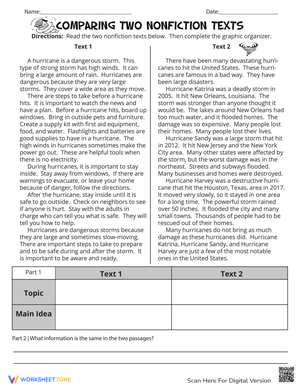
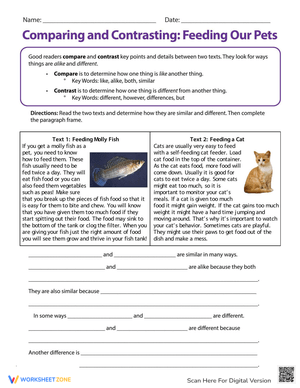
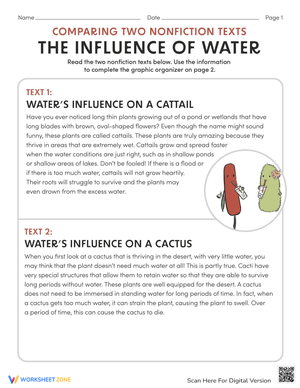
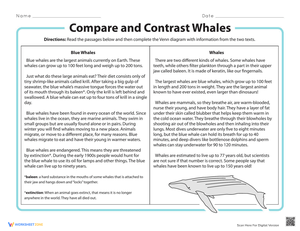
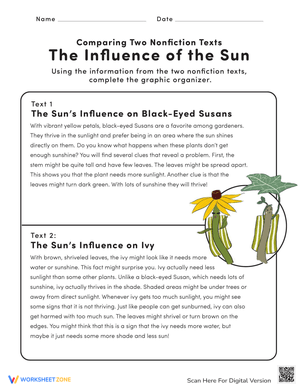
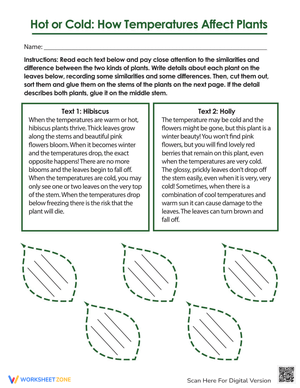
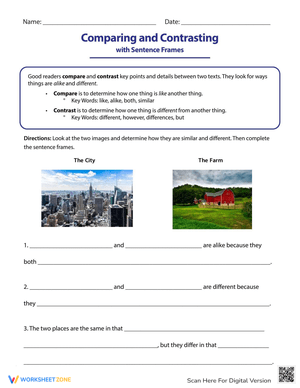
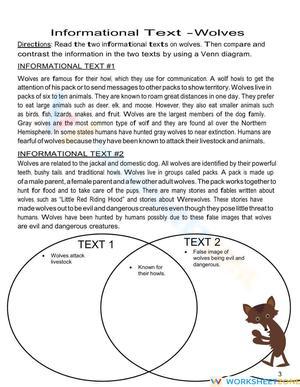
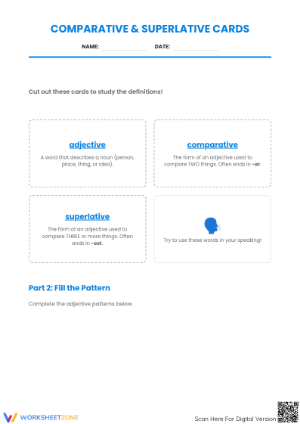
These compare and contrast in nonfiction pdf worksheets for 3rd grade pair two short informational passages on the same topic, then ask students to organize what they find using a graphic organizer and respond in writing. Topics across the set span animal biology, weather events, and paired biographies — the kind of content that keeps third graders invested enough to read carefully rather than skim for answers.
The Specific Skills Targeted
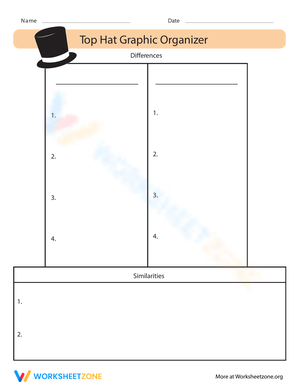
Each worksheet asks students to do three connected things: read two nonfiction passages, sort their key details into a Venn diagram or T-chart, and write a short paragraph explaining both a similarity and a difference. That sequence matters. Students who skip the organizer and go straight to writing almost always produce vague comparisons that swap details between texts. Building the sorting step into each worksheet keeps the process visible and correctable before it reaches the response prompt.
Beyond the organizer work, students mark signal words directly in the passages — underlining words like both, similarly, and also in one color, then contrast markers like however, unlike, and whereas in another. This annotation step trains students to slow down at the sentences that carry the most comparative weight, which is exactly where a lot of third graders rush past on a first read.
Smart Ways to Work These Worksheets Into Your Week
The most reliable entry point is a Monday or Tuesday whole-group lesson where you model the first comparison using a projected version of the organizer. Read both passages aloud, then think aloud as you place details — demonstrating that you return to the text rather than trust memory. Third graders consistently overestimate how much they retained from a first read; watching you look back sets a norm before they practice independently. Later in the week, compare and contrast in nonfiction pdf worksheets for 3rd grade work well as guided reading station materials, where a small group works through paired passages while you listen to their sorting decisions in real time. That small-group format surfaces reasoning you would never catch from a completed worksheet alone.
The set also fits into the fifteen minutes before a specials transition — too short for a full lesson, but long enough for students to reread one passage and add details they missed on their first pass. Using a completed organizer as a re-entry point during those windows builds the rereading habit without making it a separate instructional event.
Mistakes Students Make That These Worksheets Help You Catch
The most predictable error in third grade is what teachers sometimes call the "same topic" trap: students identify that both texts discuss the same subject and treat that recognition as the comparison itself. A student reading two passages about the water cycle will write "Both texts talk about water" and consider the task complete. Each worksheet counters this by requiring specific details — not broad subjects — in the organizer before any writing happens. When the Venn diagram asks for three facts per section, "talks about water" does not fit; students have to go back and find something that actually belongs in a circle.
A second error shows up in T-chart work: students place a detail from the first passage into the second column because they stopped tracking which text they were in. This happens most often with students who read both passages straight through before touching the organizer. Asking students to write the source number — Text 1 or Text 2 — next to each entry as they go catches this drift before it carries into the written response.
Standard Alignment
The worksheets align directly to RI.3.9 — Compare and contrast the most important points and key details presented in two texts on the same topic. That standard sits at the end of the Reading Informational Text strand for third grade deliberately; it assumes students can already identify key details in a single text (RI.3.1) and understand how authors structure information (RI.3.8). Teachers who find students struggling with RI.3.9 often discover the real gap is in RI.3.1 — the ability to distinguish a key detail from background information. The paired-passage format exposes this gap quickly, because a student who cannot identify the most important point in one text has nothing reliable to compare against in the second.
Adjusting the Set for a Range of Learners
For students still building fluency with informational text, the most effective adjustment is reducing reading volume before introducing the comparison task. Covering the second half of a passage with a sticky note, or printing a trimmed version, lets the student compare shorter texts while working through the full organizer and response sequence. The skill practice stays intact; only the reading load changes. Compare and contrast in nonfiction pdf worksheets for 3rd grade print cleanly at standard size, so trimmed versions are easy to prepare without reformatting the layout.
For students who finish early and need more challenge, the written response prompt is the strongest lever. Instead of asking for one similarity and one difference, ask those students to explain why the two authors might have chosen different details — introducing author's purpose without requiring a separate lesson. Most third graders can engage with the idea that two writers about the same animal had different goals, even before they encounter that concept formally.
Frequently Asked Questions
Do students need to read both passages before filling out the organizer?
Students do better when they read the first passage, complete their column of the organizer, and then move to the second passage. Reading both texts straight through before touching the graphic organizer leads to cross-contamination — details from the second text end up attributed to the first, and the writing reflects that confusion. One passage at a time, handled in sequence, produces cleaner analysis and fewer corrections on the organizer itself.
Can these worksheets serve as a summative assessment for RI.3.9?
A completed worksheet tells you whether a student can identify key details, sort them accurately between two texts, and express the relationship in writing — which maps directly onto what RI.3.9 requires. For summative use, evaluate the completed organizer alongside the written response: the organizer shows sorting process, the paragraph shows whether the student can articulate what the sorting means. Compare and contrast in nonfiction pdf worksheets for 3rd grade also function as formative tools earlier in a unit, where a completed organizer becomes a conference talking point rather than a final grade.
Are Venn diagrams or T-charts more effective for this skill at this grade level?
Both are worth using, and the choice depends on the passages. Venn diagrams work well when the two texts share a meaningful amount of overlapping information — as often happens with two biographies of the same historical figure. T-charts are stronger when the comparison is categorical: two different animals sorted by habitat, diet, and physical features, for example. Some students find the T-chart less ambiguous because every detail has a clear column, while the Venn diagram's center section can be hard to fill without a concrete discussion of what "shared information" actually means. Having both formats available across the set gives teachers the flexibility to match the organizer to the content rather than default to one every time.












 Interactive Worksheet Maker
 Quiz Maker
 Word Search Maker
 Crossword Puzzle Maker
 Word Scramble Generator
 Sentence Scramble Generator
 Handwriting Worksheet Generator
 Name Tracing Generator
 Fill In The Blank Generator