


























Views
Downloads
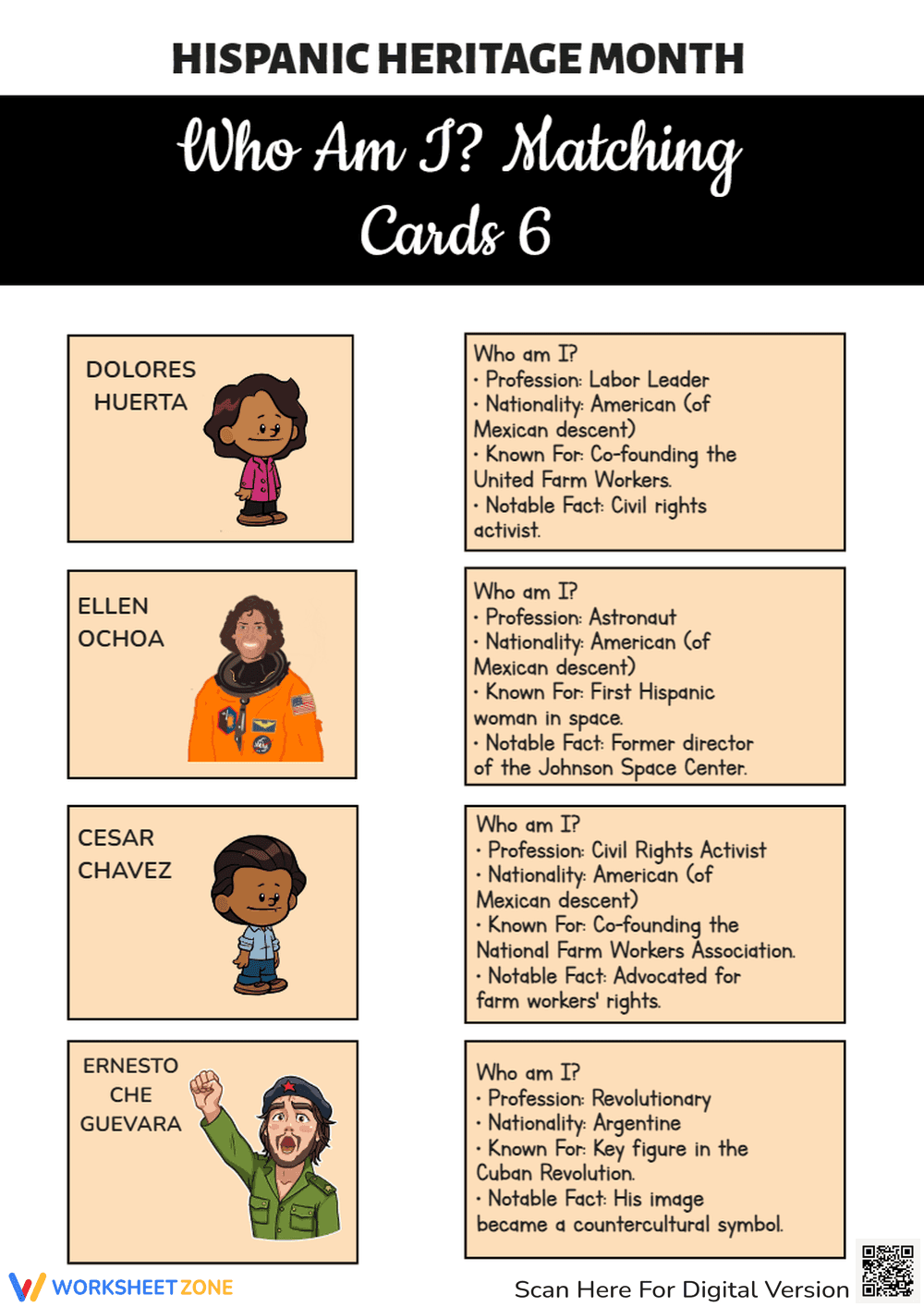

Essential Hispanic Heritage Month Matching Cards | Grade 1-3
Paste this activity's link or code into your existing LMS (Google Classroom, Canvas, Teams, Schoology, Moodle, etc.).
Students can open and work on the activity right away, with no student login required.
You'll still be able to track student progress and results from your teacher account.
This Hispanic Heritage Month matching worksheet helps elementary students identify influential leaders through a Who Am I? format. By connecting names and portraits to specific historical contributions, learners build foundational knowledge of civil rights, science, and global history. It provides a clear, visual way to celebrate cultural heritage while practicing reading comprehension.
At a Glance
- Grade: 1-3 · Subject: Social Studies
- Standard:
CCSS.ELA-LITERACY.RI.2.3— Describe the connection between a series of historical events or individuals- Skill Focus: Biography Matching
- Format: 1 page · 4 problems · Answer key included · PDF
- Best For: Social Studies Centers or Morning Work
- Time: 10–15 minutes
This single-page PDF features four distinct matching sets designed for early elementary learners. Each set includes a labeled portrait of a significant figure—Dolores Huerta, Ellen Ochoa, Cesar Chavez, and Ernesto Che Guevara—and a corresponding fact box. The fact boxes detail professions, nationalities, and notable achievements, such as co-founding the United Farm Workers or becoming the first Hispanic woman in space, providing a structured way to digest biographical information.
Zero-Prep Workflow
- Print: Select the single-page PDF and print enough copies for your small groups or individual students in approximately 30 seconds.
- Distribute: Hand out the sheets as a cut-and-paste activity or keep them whole for a drawing-line match with zero teacher setup required.
- Review: Use the included answer key to quickly verify student connections during a whole-class wrap-up or formative check in under 1 minute.
Total teacher preparation time is under two minutes, making this an ideal resource for substitute folders or last-minute cultural celebrations.
The primary standard addressed is CCSS.ELA-LITERACY.RI.2.3, which requires students to describe the connection between a series of historical events, scientific ideas, or individuals in a text. This worksheet specifically addresses the individuals aspect of the standard by requiring students to link specific biographical facts to the correct historical figure. Both standard codes can be copied directly into lesson plans, IEP goals, or district curriculum mapping tools.
Use this as a formative assessment after a read-aloud about Hispanic leaders. Observe if students can distinguish between the different types of activism, such as labor rights versus revolutionary movements, to gauge their understanding of historical context. It also works well as a quiet-time activity during Hispanic Heritage Month celebrations. Expected completion typically takes 10 to 15 minutes depending on student reading levels.
This resource is designed for Grade 1, 2, and 3 students. It is particularly effective for visual learners and English Language Learners (ELLs) who benefit from the pairing of portraits with descriptive text. For a complete instructional unit, pair this with a biography picture book or an anchor chart featuring these four leaders to provide additional context before the matching task.
According to the RAND AIRS 2024 report on elementary social studies, the integration of biographical matching tasks significantly improves student retention of historical facts compared to passive reading alone. This worksheet targets CCSS.ELA-LITERACY.RI.2.3 by asking students to connect individuals to their specific historical roles, such as labor leadership or space exploration. By focusing on the plain-English skill of identifying key figures and their contributions, the activity supports the development of chronological and thematic thinking in young learners. Research from Fisher & Frey (2014) suggests that visual scaffolds, like the portraits provided here, are essential for helping primary students build mental models of historical figures they have not personally encountered. This resource provides a structured, evidence-based approach to cultural education that fits easily into busy classroom schedules while meeting rigorous state and national literacy requirements.


