




























Views
Downloads
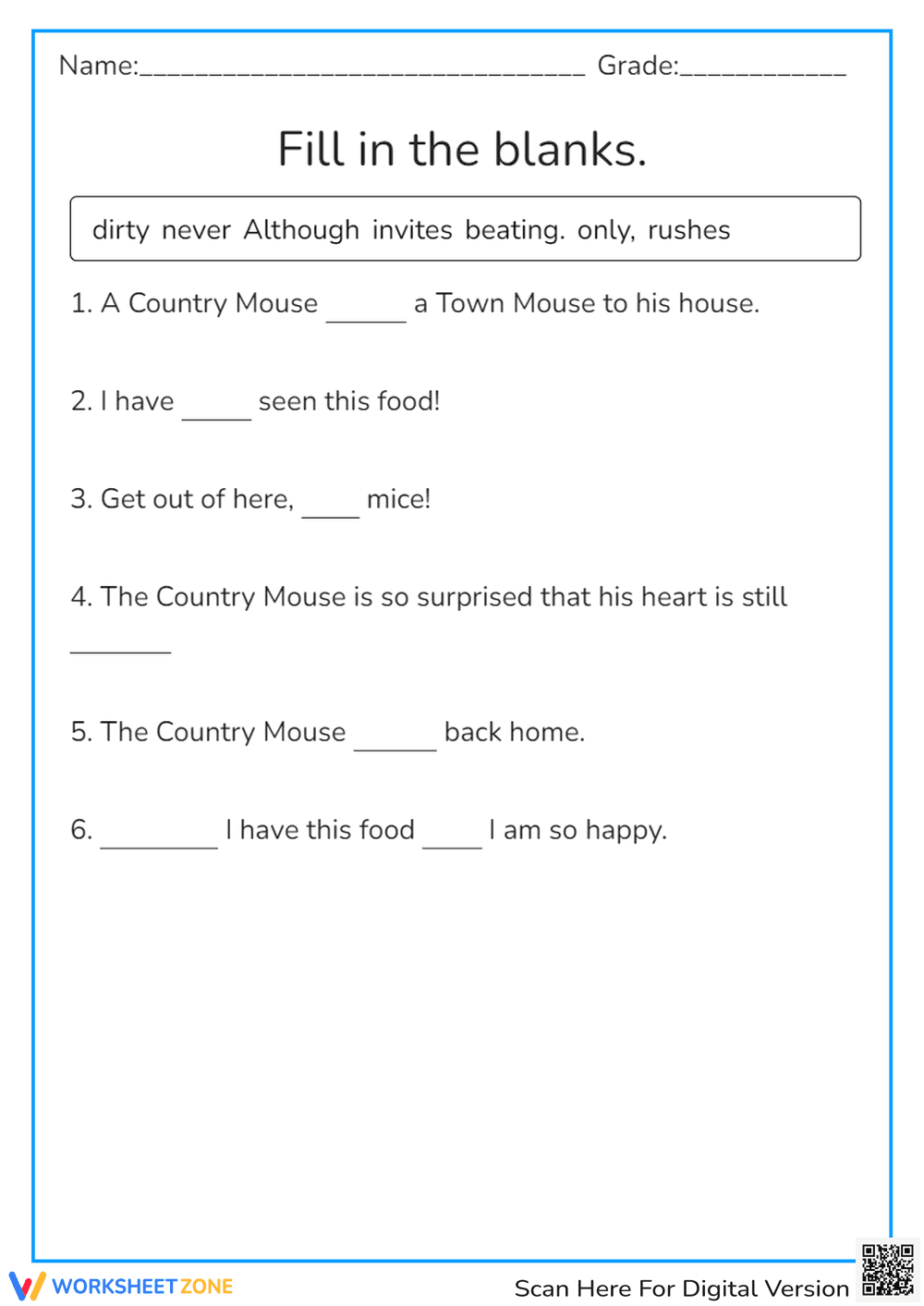

Essential Grade 3 Fill in the Blanks Worksheet

Paste this activity's link or code into your existing LMS (Google Classroom, Canvas, Teams, Schoology, Moodle, etc.).
Students can open and work on the activity right away, with no student login required.
You'll still be able to track student progress and results from your teacher account.
This Grade 3 vocabulary worksheet helps students master context clues through a focused fill-in-the-blanks exercise. By selecting the correct words from a provided word bank, learners improve their reading comprehension and sentence structure skills. This resource ensures students can accurately apply new vocabulary within the narrative context of a classic fable.
At a Glance
- Grade: 3 · Subject: ELA
- Standard:
CCSS.ELA-LITERACY.L.3.6— Acquire and use accurately grade-appropriate conversational and general academic words- Skill Focus: Context Clues & Vocabulary
- Format: 1 page · 6 problems · Answer key included · PDF
- Best For: Independent practice or quick formative assessment
- Time: 10–15 minutes
The worksheet features a clear, accessible layout designed for third-grade learners. It includes a word bank containing seven specific terms: dirty, never, Although, invites, beating, only, and rushes. Students must analyze six sentences based on "The Town Mouse and the Country Mouse" to determine where each word fits logically. The single-page PDF format includes a complete answer key for rapid grading.
Zero-Prep Workflow
This resource is designed for a zero-prep classroom workflow. First, print the single-page PDF (30 seconds). Next, distribute the sheets to students as a warm-up or exit ticket (30 seconds). Finally, review the answers as a whole group or use the included key for individual grading (1 minute). This efficiency allows for immediate instructional feedback.
Standards Alignment
This activity aligns with `CCSS.ELA-LITERACY.L.3.6`, which requires students to acquire and use accurately grade-appropriate conversational, general academic, and domain-specific words and phrases. It also supports supporting standards by focusing on determining the meaning of words in context. Both standard codes can be copied directly into lesson plans, IEP goals, or district curriculum mapping tools.
How to Use It
Use this worksheet during the "You Do" phase of a gradual release lesson on context clues. It serves as an excellent formative assessment to check if students can distinguish between different parts of speech, such as conjunctions like "although" and verbs like "invites." Expect students to complete the tasks in 10 to 15 minutes during independent work time.
Who It's For
This resource is perfect for general education third graders, English Language Learners (ELLs) needing sentence-level support, and students with IEPs focusing on vocabulary acquisition. It pairs naturally with a reading of Aesop’s fables or an anchor chart detailing how to look for clues in surrounding text to identify missing words.
According to the RAND AIRS 2024 report, structured vocabulary interventions that utilize cloze procedures significantly improve reading fluency and comprehension in elementary learners. This Grade 3 worksheet leverages that research by requiring students to engage with `CCSS.ELA-LITERACY.L.3.6` through active word selection. By analyzing the relationship between the word bank and the narrative sentences, students build the cognitive pathways necessary for long-term lexical retention. Fisher & Frey (2014) emphasize that providing a word bank scaffolds the task, allowing students to focus on the semantic fit rather than just recall. This 1-page resource provides 6 targeted opportunities for students to demonstrate mastery of academic language in a controlled setting. Educators can use the results to identify specific gaps in word usage or syntactic understanding, ensuring that every student receives the precise support needed to reach grade-level literacy benchmarks efficiently.


