These transition words worksheets for 3rd grade target the specific writing shift that happens around age eight — when students move from stringing sentences together to building paragraphs that hold a logical thread for the reader. The set covers sequence, addition, and cause-and-effect connectors through exercises that build toward students using these words independently, without a word bank in front of them.
The Specific Connectors Covered in Each Worksheet
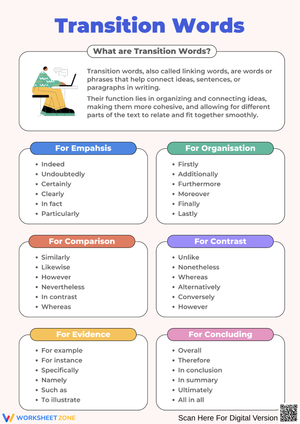
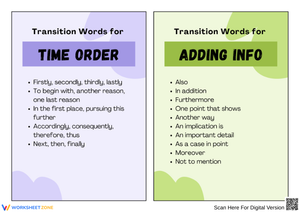
The resources divide linking words into three functional groups, which mirrors how most writing teachers introduce them: time order and sequence, addition and elaboration, and cause and effect. Keeping the categories distinct matters because students who encounter all the words in one undifferentiated list tend to grab whichever one feels comfortable — usually then or also — and never branch out.
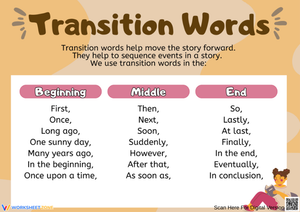
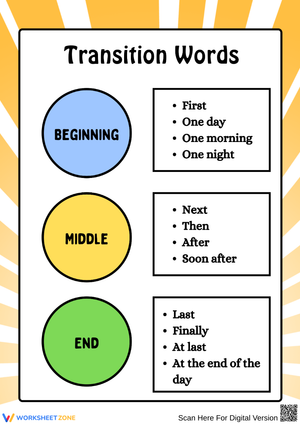
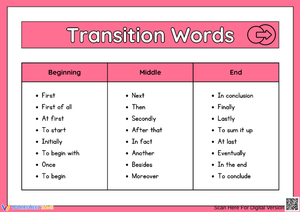
Sequence connectors — first, next, then, afterward, finally — are the entry point for most Grade 3 students because they map directly onto how children narrate events out loud. Addition connectors (also, another, in addition) get harder work in opinion writing, where students need to stack reasons without starting every sentence with "I think." Cause-and-effect connectors (because, so, therefore, as a result) carry the highest cognitive load because students must understand the logical relationship before they can select the right word — not just the chronological order of events.
Each worksheet focuses on one category at a time before the set introduces mixed exercises. The task formats across the worksheets include:
- filling in blanks using a word bank, where students must match the connector to the logic of the sentence
- choosing between two transition options and identifying why one fits better
- rewriting choppy sentence pairs as smoothly connected sentences
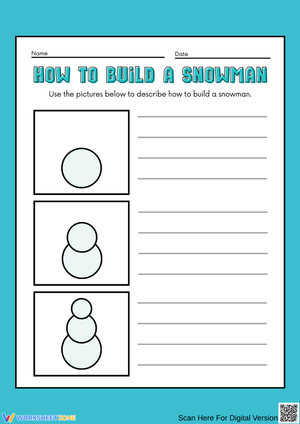
- composing original sentences using a specified transition word, with no options provided
Student Errors Worth Knowing Before You Teach This
The most common pattern is "then" overload. A student writes a narrative using then six or seven times across eight sentences because then is sequentially correct without ever being wrong enough to catch. What students miss is that "then" only tells the reader "this came next" — it carries no information about why or how events connect. Asking students to reread their own paragraph after swapping out even three of those instances usually produces an immediate improvement, and it builds editorial awareness that transfers to future drafts.
A subtler error surfaces in cause-and-effect writing. Students write "I like dogs because they are nice." The connector is placed correctly, but the reasoning stops at the weakest possible explanation. The transition is working; the thinking behind it is not. Several cause-and-effect exercises in the set ask students to complete the second clause themselves — which forces the reasoning, not just the connector placement.
Watch for students who drop "in addition" or "furthermore" into narrative writing where the register is completely wrong. When you see this, it signals the student learned the word in isolation rather than in context. They need examples of those phrases in actual informational paragraphs alongside examples of where they would feel out of place.
Standard Alignment
CCSS.ELA-LITERACY.W.3.1.C requires students to use linking words and phrases to connect opinions to reasons. In classroom terms, that means moving a student from "Dogs are better than cats. They are loyal. They protect you." to "Dogs are better than cats because they are loyal and will stand up for their family." The standard isn't asking students to identify transitions — it's asking them to use transitions to make an argument cohere.
The same skills appear across W.3.2, where transitions clarify how facts relate to each other in informational writing, and W.3.3, where sequence connectors organize narrative events. Because all three standards call on these words in different genres, transition instruction runs through the writing curriculum from September to June — not just through one unit.
How to Work These Worksheets Into Your Weekly Writing Instruction
The fill-in-the-blank exercises work well as a quick five-to-seven-minute warm-up at the start of a writing block, before students open their notebooks. The lower cognitive demand at that entry point gets students thinking about how ideas connect — which is exactly the mental posture you want them to carry into drafting.
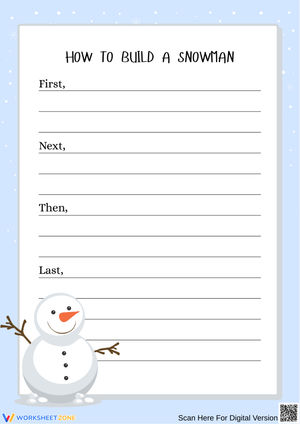
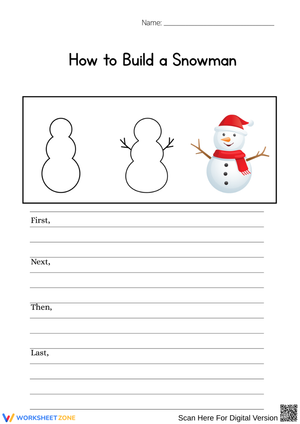
The rewriting tasks, where students receive choppy paragraphs and improve them using connectors, are better suited for partner work or small-group instruction. That format generates natural conversation: "Why did you pick therefore there instead of so?" is exactly the kind of thinking these exercises generate, and it rarely surfaces during silent independent practice. These transition words worksheets for 3rd grade also work well as Friday review after a week of paragraph-writing lessons — students can check whether they're applying classroom instruction in their own drafts before the week ends.
If you use writing workshop, the before-and-after rewriting exercises double as quick revision mentor texts. Showing students a choppy paragraph alongside its revised version takes about three minutes and makes the purpose of the practice concrete before students tackle it themselves.
Adjusting the Set for a Range of Writers in Your Class
For students still developing sentence-level fluency, the fill-in-the-blank exercises with a visible word bank are the right entry point. The decision is narrower — which of these words fits the logic of this sentence? — which lets them focus on understanding the relationship between ideas rather than retrieving vocabulary they haven't yet internalized. A category reference chart on their desk during the exercise isn't giving away the answer; it's the support structure they need to build the habit.
Writers ready to move beyond word banks benefit most from the open-ended rewriting exercises that provide no options. After completing a worksheet, ask these students to pull out their most recent writing draft, identify every transition word they used, and circle any word that appears more than twice — then swap at least one for a stronger alternative. That task takes ten minutes and is genuinely challenging for most Grade 3 students. It asks them to re-read as an editor rather than an author.
For students receiving writing intervention, the cause-and-effect exercises should follow direct instruction on what cause and effect means as a logical concept, not precede it. The connector vocabulary lands faster when students already hold a clear mental model of the relationship the word is naming.
Frequently Asked Questions
Which transition words should Grade 3 students know by the end of the year?
By the end of third grade, students should use sequence words (first, next, then, afterward, finally), addition connectors (also, another, in addition), and basic cause-and-effect words (because, so, as a result) with confidence across genres. Words like however, therefore, and furthermore are appropriate stretch vocabulary for students who are ready, but they are not the standard target for most third graders.
Can these worksheets support reading instruction, not just writing?
Yes, and deliberately so. Transition words function as logic signals during reading — however tells the reader a contrast is coming; therefore signals a conclusion. Teaching students to treat these words as traffic signs during reading builds text comprehension alongside writing fluency. The exercises that ask students to identify transitions in existing paragraphs work particularly well for this purpose. This use of transition words worksheets for 3rd grade in reading instruction shows up less often in lesson plans than pure writing practice, but the payoff in comprehension is measurable — students start anticipating the structure of an argument before they finish the paragraph.
How do I address the "and then" habit without discouraging students?
Frame it around craft, not correctness. "And then" isn't wrong — it's just the weakest available sequence word, and students can do better. One approach: ask the student to read two versions of a short paragraph aloud, one with five "and thens" and one with varied sequence connectors, and ask which sounds more like a published book. Most Grade 3 students will immediately prefer the second version, which shifts the motivation from rule-following to making their writing sound stronger.
What's the most effective way to use these as formative assessment?
The most revealing task isn't fill-in-the-blank — it's the open rewriting exercise. When a student rewrites a choppy paragraph using transitions of their own choice, you can see which categories they've internalized, which words they reach for under pressure, and whether they're applying logical thinking to their word selection or just filling in something that sounds approximately right. For tracking progress across the class, these transition words worksheets for 3rd grade are easy to scan in ten minutes at the end of a block and give clear, specific guidance on which students need additional work with cause-and-effect connectors in particular.












 Interactive Worksheet Maker
 Quiz Maker
 Word Search Maker
 Crossword Puzzle Maker
 Word Scramble Generator
 Sentence Scramble Generator
 Handwriting Worksheet Generator
 Name Tracing Generator
 Fill In The Blank Generator