


























Views
Downloads


Present Progressive Tense Worksheet | Grade 3 Essential
Paste this activity's link or code into your existing LMS (Google Classroom, Canvas, Teams, Schoology, Moodle, etc.).
Students can open and work on the activity right away, with no student login required.
You'll still be able to track student progress and results from your teacher account.
This Grade 3 ELA worksheet helps students distinguish between habitual actions and ongoing events by practicing the present progressive tense. By comparing simple present and present continuous forms, learners develop a stronger grasp of verb conjugation and temporal consistency in their writing. Students will successfully identify when to use auxiliary verbs with the -ing suffix.
At a Glance
- Grade: 3 · Subject: ELA
- Standard:
CCSS.ELA-LITERACY.L.3.1.E— Form and use simple verb tenses to describe actions and states- Skill Focus: Present Progressive vs. Simple Present
- Format: 3 pages · 10 problems · Answer key included · PDF
- Best For: Grammar centers and independent practice
- Time: 15–20 minutes
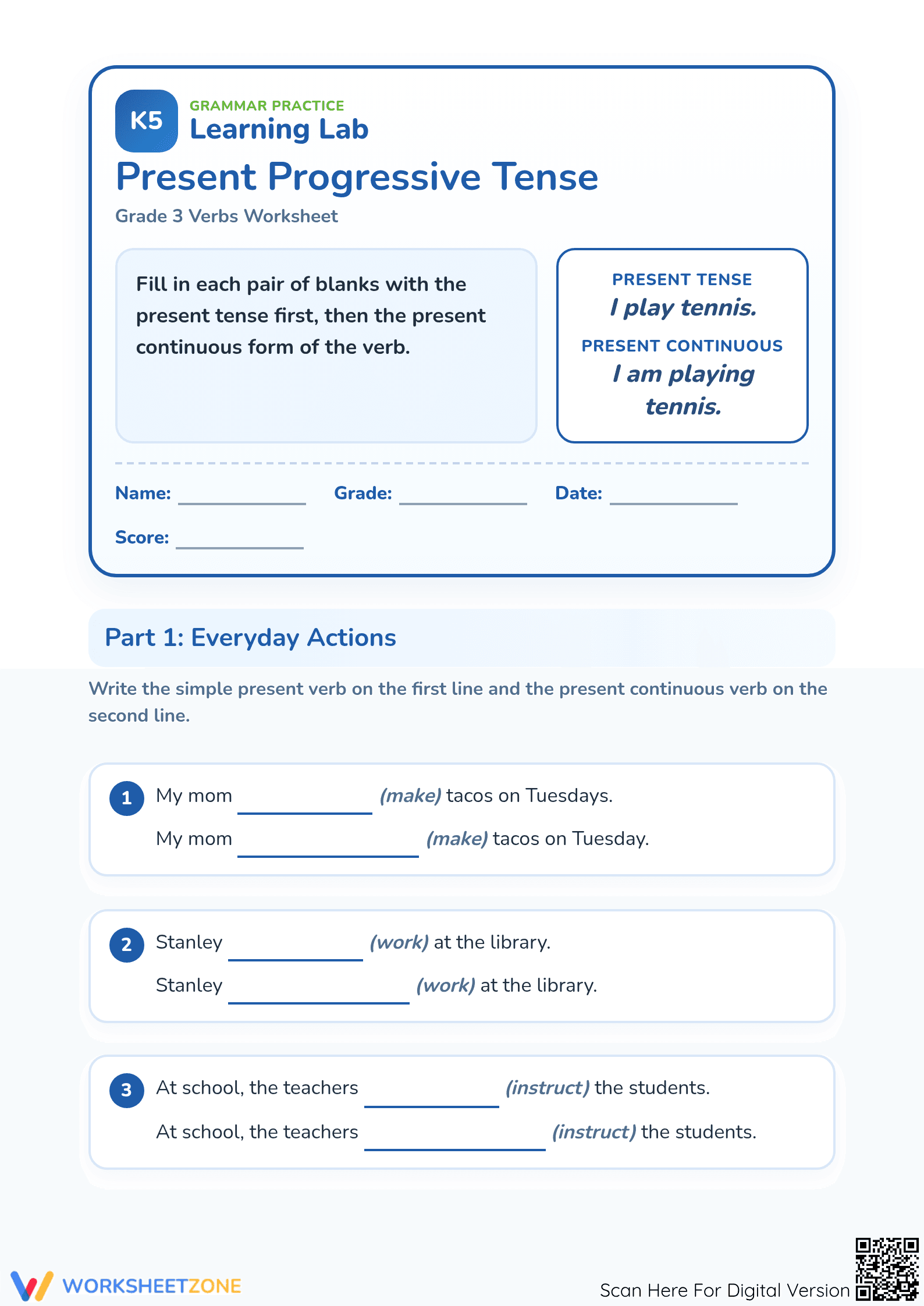
This comprehensive 3-page PDF features 10 structured exercises divided into two parts: "Everyday Actions" and "More Verb Practice." Each item provides a base verb in parentheses and two distinct sentence contexts. The first line requires the simple present form, while the second line requires the present progressive form. A full answer key is included to facilitate quick grading or student self-correction.
Skill Progression
- Guided Practice: The worksheet begins with a clear visual example comparing "I play" with "I am playing," establishing the pattern for the student before they begin the tasks.
- Supported Practice: In Part 1, students work through 5 items using common verbs like "make," "work," and "eat," where the context clues signal the correct tense choice.
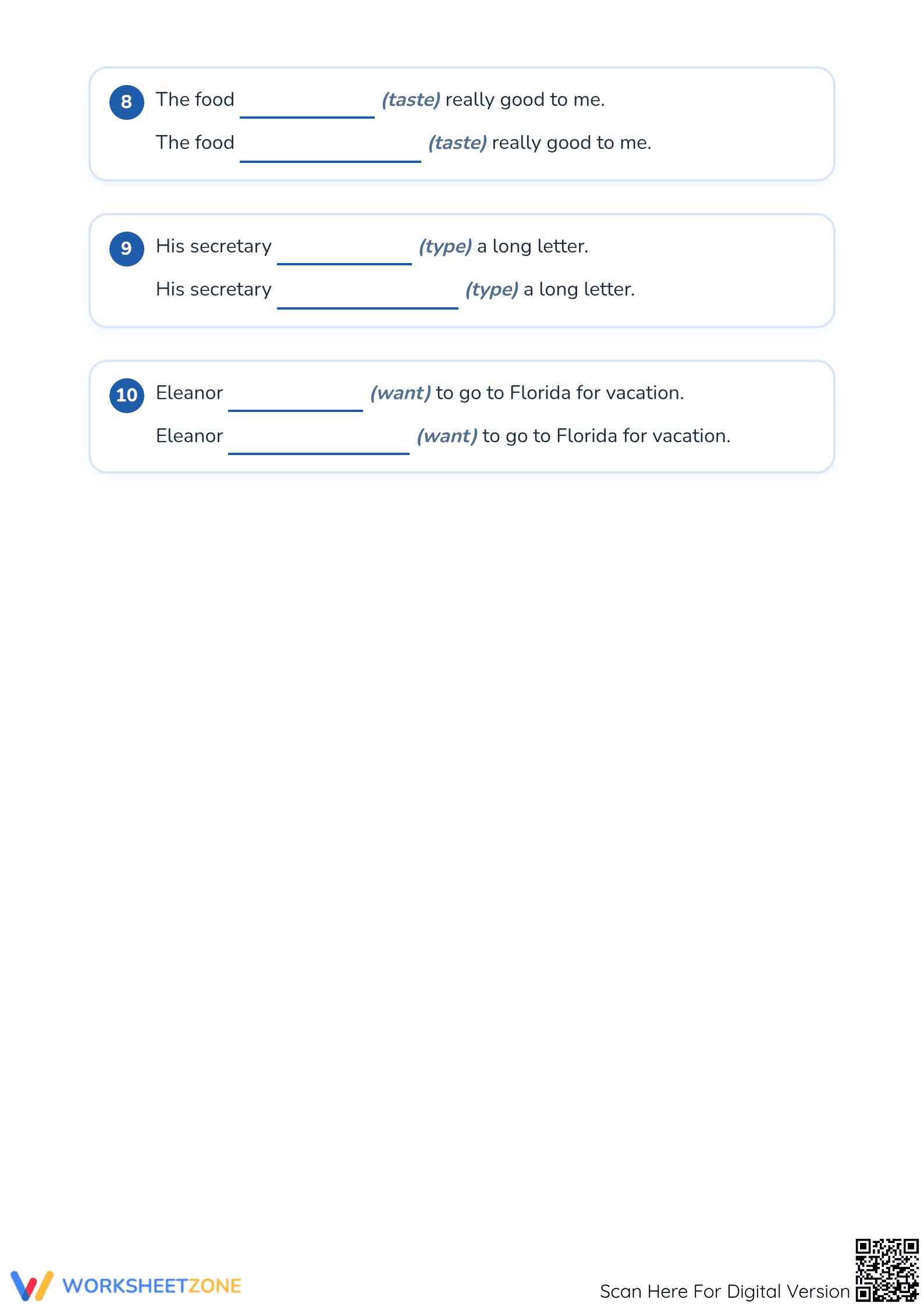
- Independent Practice: Part 2 challenges students with 5 additional items, requiring them to apply the conjugation rules to different subjects and verbs like "swim" and "taste" without repetitive prompts.
This gradual-release approach ensures students move from observing the rule to applying it across various sentence structures using an I Do, We Do, You Do framework.
Standards Alignment
The primary focus is `CCSS.ELA-LITERACY.L.3.1.E`, which requires students to form and use simple verb tenses. While the progressive tense is often introduced as a bridge to more complex grammar, this worksheet ensures students can differentiate between the simple present and the present continuous. Both standard codes can be copied directly into lesson plans, IEP goals, or district curriculum mapping tools.
How to Use It
Use this worksheet during the independent practice phase of a grammar lesson on verb tenses. It serves as an excellent formative assessment after a direct instruction session on the -ing suffix and auxiliary verbs. Teachers can observe students as they work to see if they remember to include the "to be" verb (am/is/are) in the progressive form. Expect completion in 15 to 20 minutes.
Who It's For
This resource is designed for third-grade students mastering basic grammar, but it also serves as a valuable intervention tool for fourth graders needing a refresher. It is particularly helpful for English Language Learners (ELLs) who often struggle with the distinction between habitual and current actions. Pair this with a verb tense anchor chart for maximum student support.
According to the RAND AIRS 2024 report on instructional materials, high-quality grammar resources must provide explicit contrast between similar linguistic structures to prevent fossilized errors. This worksheet addresses that need by placing simple present and present progressive forms in direct proximity, forcing students to evaluate the temporal context of each sentence. By requiring 10 distinct applications of the CCSS.ELA-LITERACY.L.3.1.E standard, the resource ensures that students move beyond rote memorization toward functional mastery of verb forms. Research from Fisher & Frey (2014) suggests that this type of structured comparison is essential for developing the metalinguistic awareness necessary for sophisticated writing. This 3-page printable provides the repetition required for cognitive retention while maintaining a clear, uncluttered layout that reduces cognitive load for Grade 3 learners.


