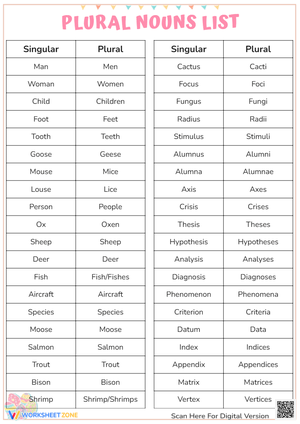
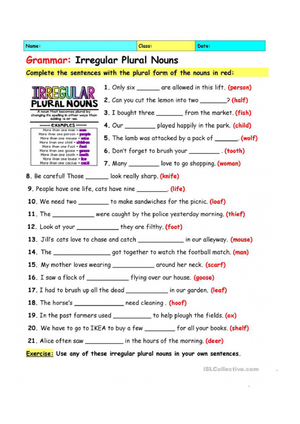
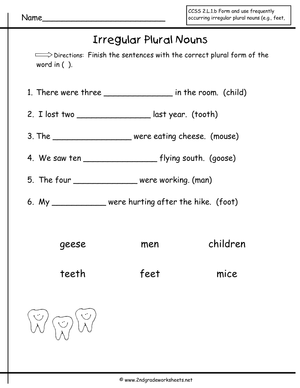
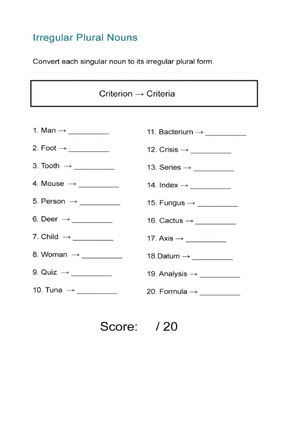
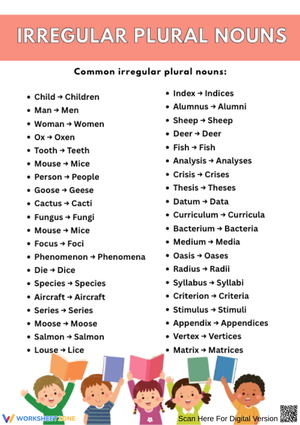
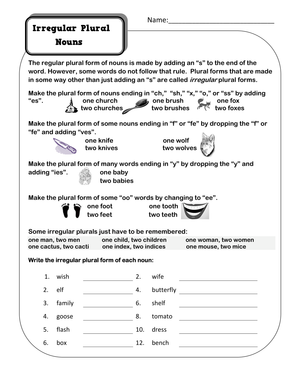
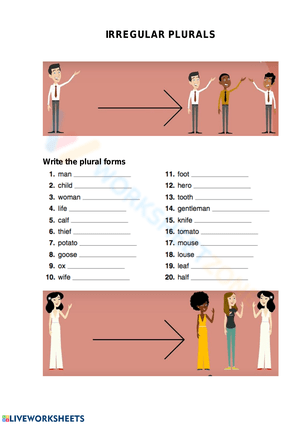
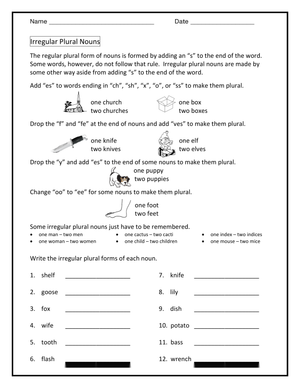
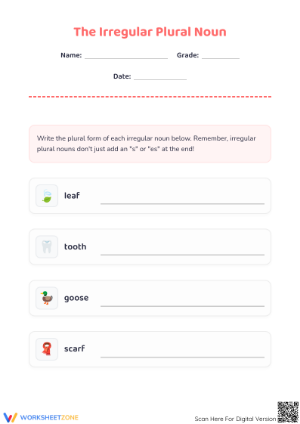
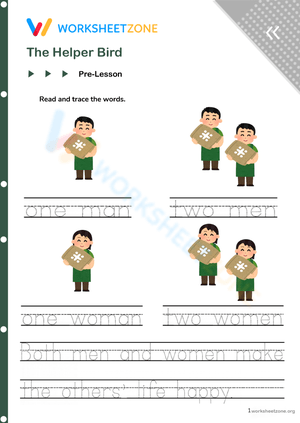
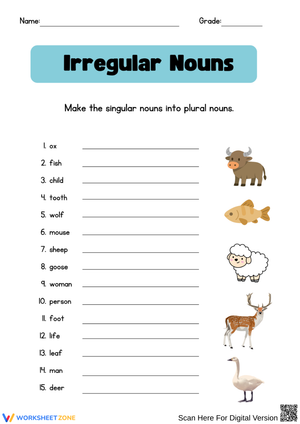
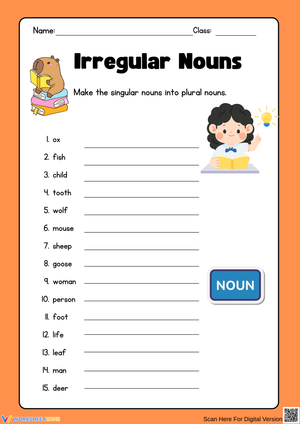
These irregular plural nouns printable worksheets for 3rd grade give teachers six print-ready grammar resources built around the noun pairs that produce the most consistent errors in Grade 3 writing: child/children, tooth/teeth, foot/feet, mouse/mice, man/men, and woman/women. The set moves from recognition tasks toward sentence-level application, so students progress from circling correct forms to writing them independently in context. Keeping the target word list short is deliberate — durable retention at this age comes from repeated encounters with the same pairs across different task types, not from one-time exposure to an exhaustive noun list.
What Each Worksheet Targets
The core challenge with irregular plurals is that students cannot apply a rule — they have to absorb individual pairs and recognize that some nouns shift internal vowels (foot/feet, tooth/teeth, man/men) while others restructure entirely (child/children). Each worksheet approaches that challenge from a different angle, building toward independent control of the forms:
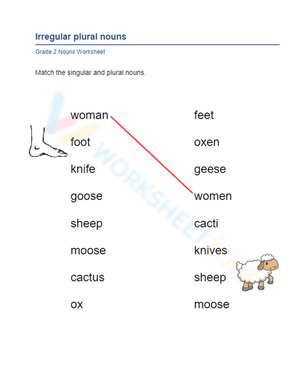
- Matching: Students draw lines connecting singular nouns to their irregular plural forms — initial recognition before any writing is required.
- Sorting: Students sort a mixed list into regular plurals and irregular plurals, reinforcing the distinction rather than drilling forms in isolation.
- Fill-in-the-blank: Students select or supply the correct plural to complete a sentence, requiring them to read the context before choosing a form.
- Error correction: Students read sentences containing forms like childs or tooths, identify the mistake, and rewrite the sentence correctly — the task that most closely mirrors real editing work.
- Sentence writing: Students write original sentences using a targeted irregular plural noun, the most demanding task in the set and the clearest evidence of whether a student controls the form independently.
Several worksheets also group noun pairs by the type of change students will notice. Placing man/men, foot/feet, and tooth/teeth together highlights the internal vowel shift; setting child/children apart draws attention to its structural difference. When students see that some words change in a similar way, the forms become easier to hold onto than if they appeared as an undifferentiated list.
Errors Students Make That These Worksheets Surface
The most predictable error at this level is confident overgeneralization. A student who has been praised for knowing "add -s to make a plural" will write mouses or tooths without hesitation — the error isn't carelessness, it's the wrong rule applied correctly. Error-correction worksheets work particularly well for this reason: reading a sentence like "Three childs sat on the steps" triggers an immediate auditory check that pure recognition tasks cannot replicate. Students hear that it sounds wrong before they can explain why, and that instinct is the beginning of grammatical control.
A second pattern is the transfer gap. A student who correctly marks children on a matching worksheet will write "The childs ran to the playground" forty minutes later during a writing block. That isn't inconsistency — it's what happens when composing demands most of the student's attention and grammar monitoring drops. Including sentence-writing tasks in the same set, rather than saving them for a later lesson, narrows that gap by requiring the student to hold the correct form while also constructing meaning.
Spelling is a third category worth watching. Students sometimes know the spoken form — they say "mice" without prompting — but write mices or, occasionally, muse. Asking students to underline the changed letters in the matching worksheet (the oo that becomes ee in tooth/teeth, for instance) draws attention to the letter-level shift before the writing tasks begin, which reduces spelling errors on subsequent worksheets.
Standard Alignment
These worksheets align to CCSS.ELA-LITERACY.L.3.1.b, which requires students to form and use irregular plural nouns. In classroom terms, this standard sits inside the Grade 3 Language strand alongside verb tense and subject-verb agreement — skills that all depend on students handling noun forms accurately in their own writing. Irregular plurals land at Grade 3 specifically because students at this stage are composing longer, more complex sentences and need to control noun forms across varied contexts, not just in isolated recognition tasks. Teachers in CCSS-aligned schools can drop these worksheets into a grammar unit as formative practice and pull them back out for spiral review without adjusting anything.
Building These Worksheets Into Your Weekly Grammar Routine
The sequence that works most reliably across a four-to-five day block starts with brief direct instruction: introduce six to eight target pairs on a class anchor chart, note which words shift a vowel and which change form entirely, and read them aloud together. Use the matching or sorting worksheet on day two as morning work — the low-stakes format lets students process the forms before the instructional day accelerates. Move to sentence completion by midweek, which requires students to read context cues before committing to a form. Reserve error correction for Thursday; identifying a mistake in someone else's writing is more cognitively demanding than choosing from a list, and students are usually ready for it by that point. End on Friday with the sentence-writing worksheet as an informal check — if a student writes the correct plural form without any visual prompt, the instruction has held.
These worksheets also fit the shorter grammar windows that appear throughout the day: the 10-to-12-minute slot before a specialist, an exit ticket at the end of the literacy block, or a center rotation. Because each worksheet targets the same noun pairs through a different task, teachers can run them across the week without the practice feeling repetitive to students.
Teachers who use irregular plural nouns printable worksheets for 3rd grade as intervention materials often reduce the target set to four pairs and add a word bank at the top. That adjustment keeps the grammatical focus intact while removing the recall demand for students who need more processing time with individual forms.
Differentiating the Set for a Range of Learners
For students still building confidence with basic plural formation, start with the matching worksheet only — three or four target pairs, with a reference box of correct forms visible at the top. The goal at that level is accurate recognition, not independent recall. Adding a small picture cue (one mouse next to three mice) reduces the working memory load and keeps the focus on the grammatical concept rather than a picture-word retrieval problem that has nothing to do with irregular plurals.
On-level students generally move through the full weekly sequence without adjustment. If a specific student controls recognition tasks but stalls at sentence writing, the intermediate step is sentence completion rather than jumping straight to original composition. A partially written sentence provides the context and most of the language; the student supplies only the correct noun form. That step-by-step support bridges the gap between passive recognition and independent production without skipping the work in between.
For students who have already internalized the core six pairs, the extension isn't a longer word list — it's a harder writing task. Ask those students to write a short paragraph, three to five sentences, that uses at least four of the target irregular plurals correctly. Reviewing that paragraph in a brief conference tells far more than a second matching worksheet, and it keeps the grammar anchored to authentic writing rather than treating the worksheets as an end in themselves.
Frequently Asked Questions
Which irregular plural nouns should I prioritize for Grade 3?
Start with the six pairs that appear most often in Grade 3 reading and student writing: child/children, man/men, woman/women, mouse/mice, tooth/teeth, and foot/feet. Less common forms like ox/oxen or goose/geese appear in some curricula but belong in instruction only after students have the highest-frequency pairs under control. A list students encounter regularly and use often produces more reliable retention than a longer, less familiar list.
Can I use these worksheets to assess students rather than just practice with them?
The error-correction and sentence-writing worksheets function well as formative checks. Error correction shows whether a student recognizes the correct form when prompted; sentence writing shows whether the student can produce it without a prompt. Neither replaces a formal assessment, but both give teachers specific, actionable information about individual students — information that a circled multiple-choice answer rarely provides.
How do these work for English language learners?
For ELL students, irregular plural nouns printable worksheets for 3rd grade work best when paired with explicit oral review before any written task is assigned. Read the target noun pairs aloud together, have students repeat them, and confirm that students can hear the difference between singular and plural before they write anything. Students whose home language marks plurality differently — or does not mark it morphologically at all — need that spoken grounding more than they need a longer written exercise, at least in the early stages of instruction.
Do the worksheets need to be used in a specific order?
Each worksheet stands alone, so teachers can assign individual worksheets based on where students are in the learning sequence rather than moving through the full set in order. That said, using all six across a single instructional unit produces the most durable results. That accumulated exposure across formats — recognition, then context, then composition — is what makes a complete set of irregular plural nouns printable worksheets for 3rd grade more effective than assigning any one worksheet repeatedly.












 Interactive Worksheet Maker
 Quiz Maker
 Word Search Maker
 Crossword Puzzle Maker
 Word Scramble Generator
 Sentence Scramble Generator
 Handwriting Worksheet Generator
 Name Tracing Generator
 Fill In The Blank Generator




 BACK TOSCHOOL