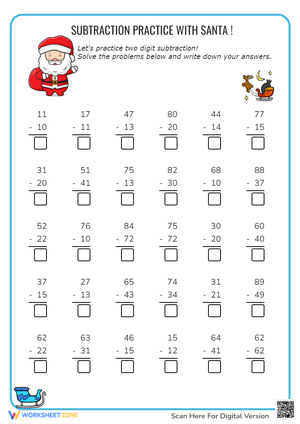
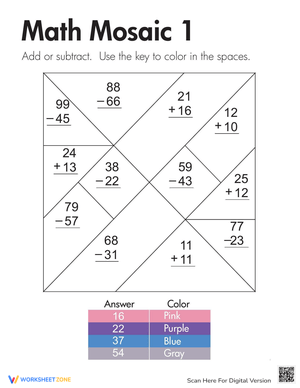
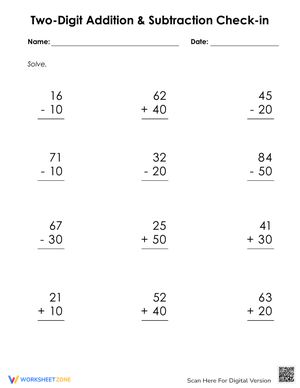
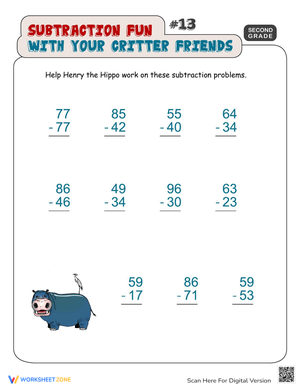
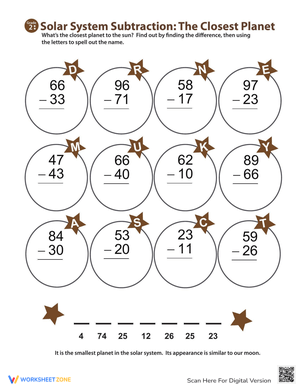
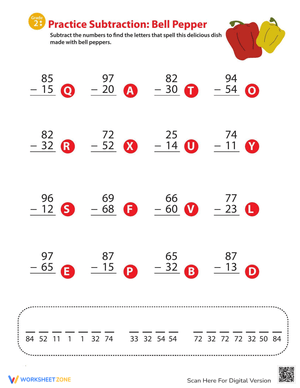
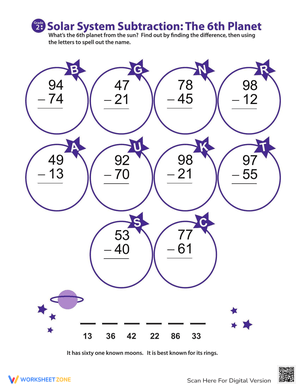
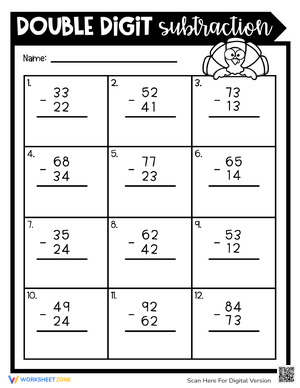
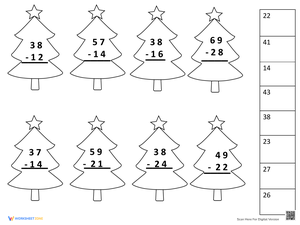
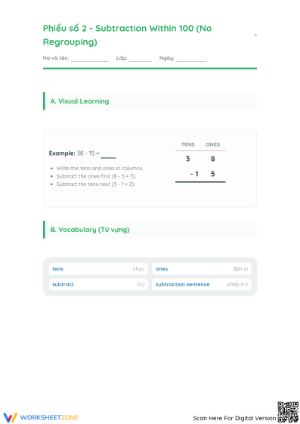
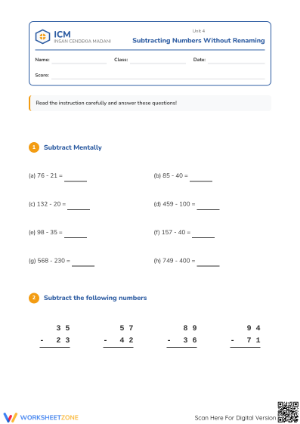
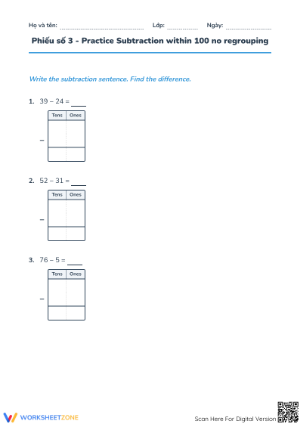
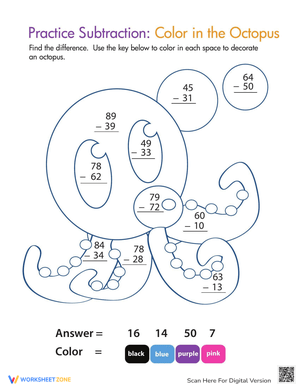
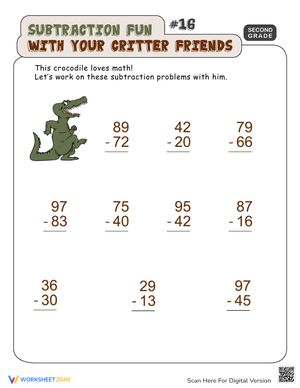
These 2nd grade two digit subtraction and no regrouping printable worksheets give teachers structured practice that keeps the focus where it belongs at this stage: on the place-value logic behind column subtraction. Students subtract ones from ones and tens from tens, with each top digit greater than or equal to the digit beneath it — no regrouping required. That constraint is pedagogically deliberate. It lets students establish the written column routine cleanly before the added complexity of borrowing enters the picture later in the year.
The Specific Skills These Worksheets Build
The core task across these worksheets is two-digit subtraction in vertical form. Students work column by column — ones first, then tens — with problems arranged so that every subtraction within a column produces a whole number answer without borrowing. The sequence aims at written fluency: not just correct answers, but accurate written procedures that transfer to harder work.
The habits these worksheets develop matter well beyond this unit:
- Vertical alignment: placing ones directly above ones and tens above tens before beginning to calculate
- Column-by-column solving: working down each column rather than across the full number, the way mental math strategies sometimes pull students
- Place-value reading: understanding that 64 is 6 tens and 4 ones, so subtracting 23 removes 2 tens and 3 ones as separate column operations
- Pre-solving setup checks: confirming alignment is correct before calculating anything
- Answer placement: writing digits in their correct column positions — an overlooked but common source of error in second grade
Several worksheets in the set extend beyond standard vertical problems. Some ask students to rewrite horizontal equations in vertical form before solving. Others include missing-number items or brief word problems that require writing the equation first and then solving. These formats add thinking demand without introducing regrouping as a variable.
Common Errors That Show Up in Student Work — and What to Do About Them
The most persistent error in this skill is misalignment. A student writing 73 minus 41 may stack the digits with the 1 directly under the 7 rather than under the 3, then subtract across mismatched columns. The subtraction itself is correct; the digit pairing is wrong. Because the student has performed valid computation on the wrong numbers, the error is easy to miss when checking quickly — and the student genuinely cannot see where the answer went wrong. Checking alignment before anything else during classroom circulation catches this before it compounds across an entire worksheet.
A subtler pattern is left-to-right column solving. Students work the tens column first, then the ones, mirroring the direction they read. On no-regrouping worksheets this actually produces a correct answer because each column operates independently. The problem is that this habit fails the moment regrouping enters the picture and column order suddenly matters. Teachers who notice and redirect this during no-regrouping practice prevent a harder reteach later in the year.
There is also a structural issue worth naming explicitly to students: every no-regrouping problem allows subtracting the smaller digit from the larger one in each column, which leads many students to internalize that as a universal rule. It works perfectly within this skill set. It becomes the source of the most common regrouping error later — where students flip column digits to avoid borrowing rather than regroup. A brief classroom conversation about why this rule works now but will not always apply sets up better habits before that transition arrives.
Where These Worksheets Fit in a Grade 2 Math Week
Monday morning work with a familiar no-regrouping format is a reliable way to open the math week. Students arrive with context from prior instruction, the format is predictable, and there is no startup confusion that eats into lesson time. Later in the week, a shorter six-problem worksheet functions as an exit ticket; a longer mixed-format one works for a small-group session where the teacher watches column setup and answer placement in real time.
One teaching sequence worth trying: project a sample worksheet, model two problems with a think-aloud focused on the pre-solving setup check, then release students to work independently on a parallel worksheet. After ten minutes, pull three student worksheets to the document camera and discuss alignment and answer placement without identifying whose work it is. That mid-lesson pause surfaces common errors before students have practiced them across the full problem set.
Partner work before independent practice is also effective. Partners check each other's column alignment — before solving, not after — and talk through any disagreement. Two to three minutes of this cuts down substantially on the alignment issues that would otherwise require individual reteaching during circulating time. For substitute days, the set gives visiting teachers a math task that students can complete without instruction on new procedures.
Standard Alignment
CCSS.MATH.CONTENT.2.NBT.B.5 calls for students to fluently add and subtract within 100 using strategies based on place value. Two-digit subtraction without regrouping sits in the early-to-middle part of this standard's instructional arc. Teachers typically introduce this skill after students demonstrate fluency with basic subtraction facts within 20 (2.OA.B.2) and can read, write, and represent two-digit numbers in terms of tens and ones.
The 2nd grade two digit subtraction and no regrouping printable worksheets in this set address 2.NBT.B.5 directly and prepare students for 2.NBT.B.7, which extends subtraction to within 1,000 and introduces regrouping. In classroom terms, the column procedure practiced here is not an isolated skill — it is the written structure that carries forward into every multi-digit subtraction problem students encounter through elementary school. Getting that structure reliable without the pressure of borrowing makes the transition to regrouping substantially less disorienting when it arrives.
Matching Each Worksheet to the Right Learner
The range of formats within these 2nd grade two digit subtraction and no regrouping printable worksheets makes differentiation manageable without preparing separate materials for each group. For students who need more structure, choose worksheets with generous spacing, ten problems or fewer, and clearly printed T and O column headers. Students who consistently mix columns benefit from a faint vertical line printed between the tens and ones places — most stop needing it within a week or two of consistent use.
On-level students handle standard vertical format without additional support. Adding two or three horizontal equations that they must rewrite before solving is enough variety to keep the work from becoming purely mechanical without shifting the skill target.
Students ready for extension work well with missing-number formats — problems such as blank minus 23 equals 41, where they determine the unknown top number. This requires inverse thinking and confirms whether students understand the addition-subtraction relationship, not just the column steps. Short word problems that ask students to write the equation themselves before solving add one more layer: the translation step makes the task more demanding while the no-regrouping constraint keeps the written procedure stable. One worksheet of this type per week keeps extension students working at the edge of their understanding while the rest of the class builds fluency on standard formats.
Frequently Asked Questions
What prior knowledge do students need before these worksheets are worth assigning?
Students should be able to identify the tens and ones value in any two-digit number, read and write two-digit numbers, and recall basic subtraction facts within 20 without counting back on their fingers for every problem. If a student is still laboring over 9 minus 4, the column method will overload working memory and the errors will trace back to fact recall rather than place value. Solid fact fluency lets students attend fully to the written procedure.
How many problems per session is appropriate for Grade 2?
Ten to fifteen problems is the right range for most independent practice sessions. Fewer than ten limits the repetition needed for fluency-building; more than twenty leads to the rushing that produces avoidable alignment and computation errors. For exit tickets or quick checks, five or six problems are enough to reveal whether students have the column method under control.
Should students work with base-ten blocks at the same time?
During initial instruction, yes — base-ten blocks or quick drawings help students see that subtracting 21 from 64 means removing 2 tens and 1 one separately, grounding the written columns in concrete meaning. Once that connection is established, students can work through these 2nd grade two digit subtraction and no regrouping printable worksheets without manipulatives. Requiring blocks after students have internalized the column method slows fluency-building without adding conceptual benefit.
How can I tell when a student is ready to move to subtraction with regrouping?
Consistent accuracy across formats — standard vertical problems, horizontal equations rewritten before solving, brief word problems — without visible checking or frequent self-correction is the clearest indicator. Students who move through fifteen no-regrouping problems correctly and finish well ahead of others have not just memorized the format; they have internalized the column structure. That is the right moment to introduce problems where the ones digit of the bottom number is greater than the ones digit of the top number, making regrouping necessary.













 Interactive Worksheet Maker
 Quiz Maker
 Word Search Maker
 Crossword Puzzle Maker
 Word Scramble Generator
 Sentence Scramble Generator
 Handwriting Worksheet Generator
 Name Tracing Generator
 Fill In The Blank Generator