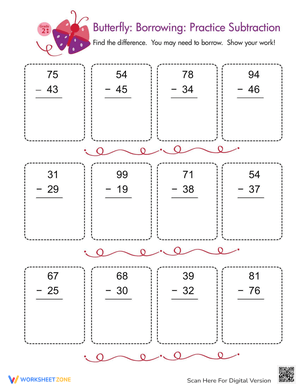
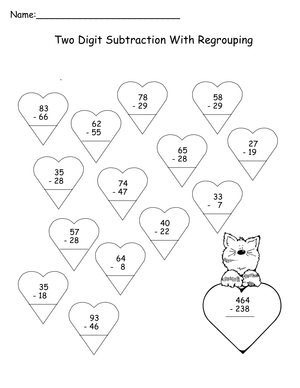
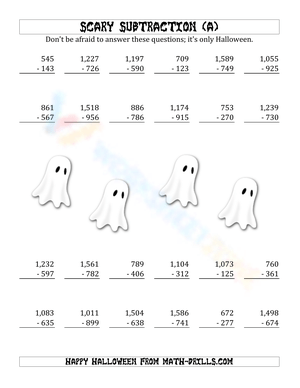
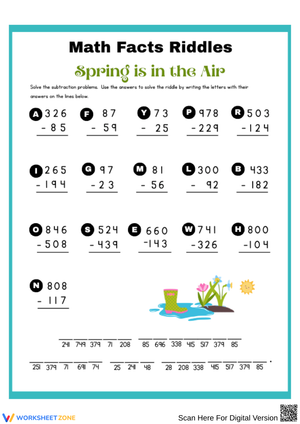
These 2nd grade subtraction with regrouping pdf worksheets give teachers targeted, print-and-go practice for one of the trickiest procedural hurdles in early elementary math — the moment students first have to reach across place values and trade a ten for ten ones. The set moves through two-digit subtraction problems systematically, from problems where only some require regrouping to mixed sets where students must inspect each problem before calculating, which is exactly where reasoning tends to break down if students have only memorized a series of steps.
Concepts in Each Worksheet
Each worksheet isolates a specific slice of the regrouping process rather than presenting every variation at once. The progression runs from problems that reliably trigger regrouping — where the ones digit in the minuend is less than the ones digit in the subtrahend — through to mixed sets that force students to decide whether regrouping is necessary before they begin. That decision step is a real thinking move, and it separates students who understand what a ten represents from students who are executing a memorized routine without number sense underneath it.
- Two-digit minus two-digit problems requiring regrouping, with column space above the tens and ones digits for students to record the cross-out and rewrite
- Mixed sets where only some problems require regrouping, so students have to check before calculating rather than regroup on autopilot
- Problems where the tens digit of the minuend is 1 — after regrouping, zero tens remain, and students consistently fail to record that zero in the tens place of the answer
- Word problem contexts framed around quantities second graders recognize: stickers, crayons, students on a field trip
- Place value chart formats that make the tens and ones columns explicit before students encounter the standard vertical algorithm
The vocabulary on every worksheet uses regroup and decompose a ten into ones — not borrow. That's deliberate. Borrowing implies the number comes back, which it doesn't. Students who internalize the word regrouping build a more accurate mental model of what the trade actually represents, and that model holds up when they encounter three-digit problems in third grade.
Frequent Student Errors Worth Watching For
The error that appears most reliably in second-grade work is what some teachers call bottom-up subtraction. A student looks at 52 minus 28, sees that 2 is less than 8, and subtracts 2 from 8 instead — writing 34 as the answer. It looks calculated. The student didn't skip a step; they subtracted in the wrong direction because they've internalized "subtract the smaller from the larger" as a rule that applies to individual digits rather than to the full numbers involved.
A color-coded routine interrupts this consistently. Before touching the ones column, the student circles the ones digit of the top number. If that digit is less than the ones digit of the bottom number, they draw an arrow — before writing anything — pointing to the tens column. Drawing the arrow turns regrouping into the first action rather than an afterthought. A second error appears at the tens column: students who correctly regroup the ones often forget to reduce the tens digit, leaving the original number sitting there while writing a correct ones digit below it. Modeling the cross-out-and-reduce step in a contrasting color during whole-group instruction makes it stick faster than restating the rule verbally.
How to Build These Worksheets Into Your Instructional Week
The most efficient use of this set is as a five-problem exit task at the close of the math block. Collected before students line up, it takes about six minutes to complete and another four to scan as a class stack. The data is immediate: you know by the time you leave for the day which students need to sit with you in a small group the following morning.
For gradual release during instruction, project one worksheet and work the first two problems aloud, narrating every decision: "I look at the ones column first. Six minus nine — I don't have enough ones. I need to regroup before I subtract." Then have students work a middle problem on their whiteboard while you circulate. Assign the remaining problems independently. That same worksheet becomes your formative record when you collect it — no separate assessment needed.
These resources also work well as Monday warm-ups after a weekend gap. Regrouping is exactly the kind of procedural knowledge that fades without repetition, and a short warm-up catches significant drift before it compounds across the week. The 2nd grade subtraction with regrouping pdf worksheets in this set are sized so that a five- or six-problem warm-up uses one worksheet without exhausting it, leaving the rest for math center rotation later in the week.
Standard Alignment
These worksheets directly address CCSS 2.NBT.B.5: "Fluently add and subtract within 100 using strategies based on place value, properties of operations, and/or the relationship between addition and subtraction." In classroom terms, this standard is the main throughline for second-grade math from roughly January through April — the one teachers return to repeatedly as students move from manipulatives to representational drawings to the standard algorithm. Regrouping problems are the most demanding element within 2.NBT.B.5, which is why practice targeting this specific skill, rather than general mixed addition-subtraction review, gives teachers the clearest picture of where each student actually stands in relation to the standard.
Adjusting the Worksheets for a Range of Learners
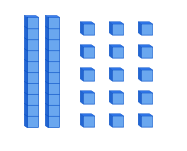
For students still developing place value understanding, pair worksheet practice with base-ten block manipulatives rather than requiring the standard algorithm cold. The student builds the top number with blocks, physically trades one ten-rod for ten unit cubes, and then records what happened on the worksheet. Used this way, the worksheet functions as a recording tool rather than an assessment — which reduces the cognitive demand on procedure enough that the concept has room to land. Once a student can narrate the trade aloud without looking at the blocks, the blocks come away.
Students who are accurate on standard regrouping problems benefit most from the mixed sets, where the challenge isn't the calculation itself but the inspection step that precedes it. Presenting a problem like 67 minus 23 alongside 53 minus 47 without visual cues forces students to slow down and check before computing — exactly the reasoning habit that matters when three-digit problems arrive in third grade. For students working above grade level, the word problem worksheets push toward applying regrouping inside a context, which requires an interpretive layer before any calculation begins. These 2nd grade subtraction with regrouping pdf worksheets cover enough problem variety that teachers at different points in the unit rarely need to reach for a separate resource.
Frequently Asked Questions
At what point in second grade should regrouping instruction begin?
Most teachers introduce subtraction with regrouping after students are solid on two-digit subtraction without regrouping — typically mid-to-late winter in a standard pacing guide. If students are still uncertain about place value concepts (identifying tens and ones, representing numbers with base-ten blocks), regrouping instruction will be harder than it needs to be. A quick place value check before the unit saves significant reteaching time later.
How do I use these worksheets with students who are still on single-digit subtraction?
Pull the place value chart format worksheets for those students and use them as a tool for building the underlying concept. A student who isn't yet working at two-digit subtraction can still practice decomposing a ten into ones on the chart without connecting it to the standard algorithm yet. That conceptual work is still productive — it just needs more time before the abstract procedure follows.
Do the worksheets include answer keys?
Yes. Each worksheet in the set includes a matching answer key. For teachers using these as formative assessments, the answer keys make it possible to sort a class stack of student work in about five minutes — enough time to identify which students need a pull-group before the next lesson.
Should these be sent home for homework, or kept for classroom practice?
Both work, but with one practical caveat: regrouping is the kind of skill where a student who learned the procedure incorrectly will practice the error at home without anyone to catch it. Sending these 2nd grade subtraction with regrouping pdf worksheets home before students have demonstrated accuracy in class risks hardening a wrong habit overnight. A more reliable sequence is to confirm accuracy with a short in-class check first, then use the remaining worksheets in the set as homework once students are executing the algorithm correctly.













 Interactive Worksheet Maker
 Quiz Maker
 Word Search Maker
 Crossword Puzzle Maker
 Word Scramble Generator
 Sentence Scramble Generator
 Handwriting Worksheet Generator
 Name Tracing Generator
 Fill In The Blank Generator