


























Views
Downloads

Number Patterns & Subtraction | Grade 2-3 Essential
Paste this activity's link or code into your existing LMS (Google Classroom, Canvas, Teams, Schoology, Moodle, etc.).
Students can open and work on the activity right away, with no student login required.
You'll still be able to track student progress and results from your teacher account.
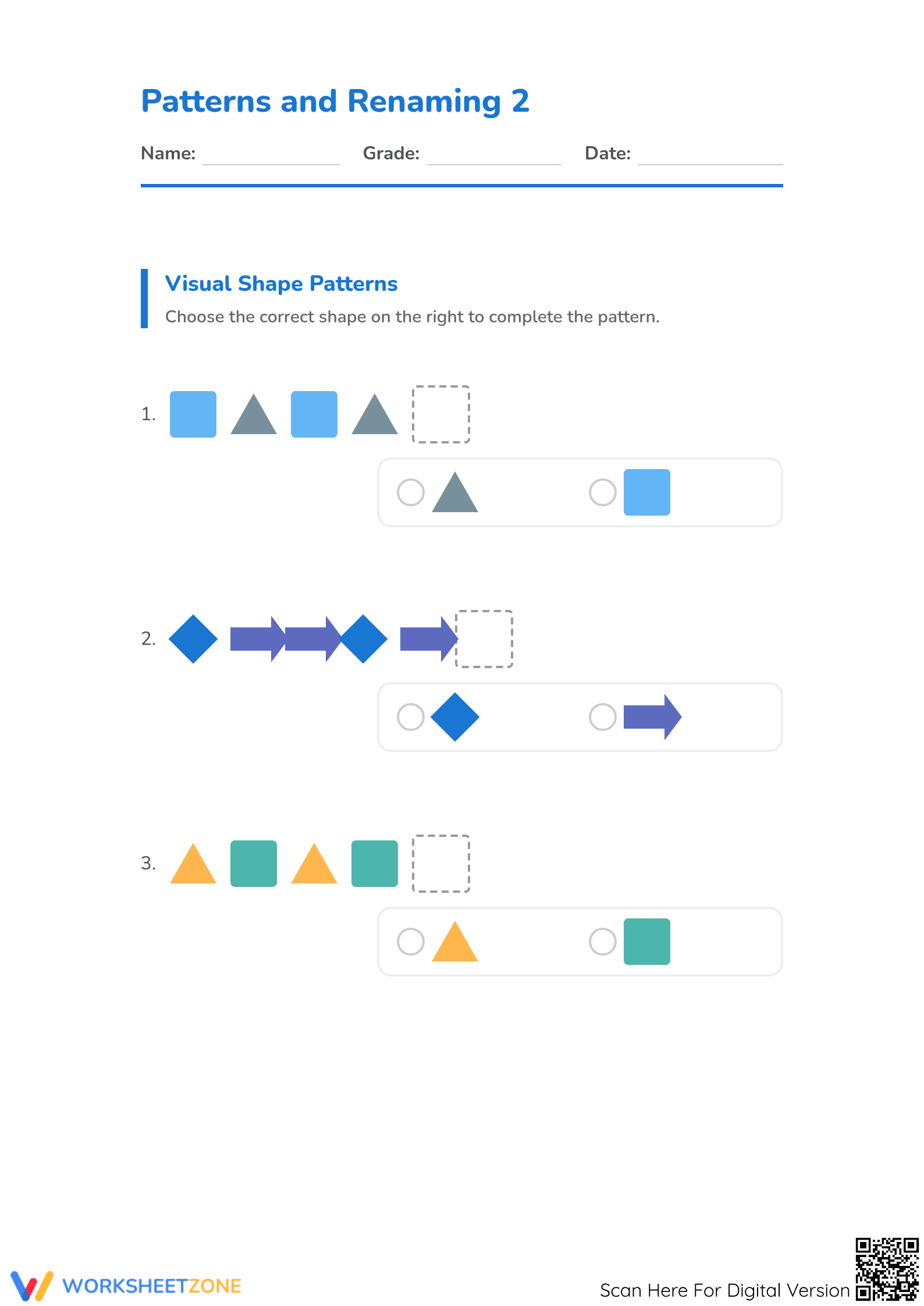
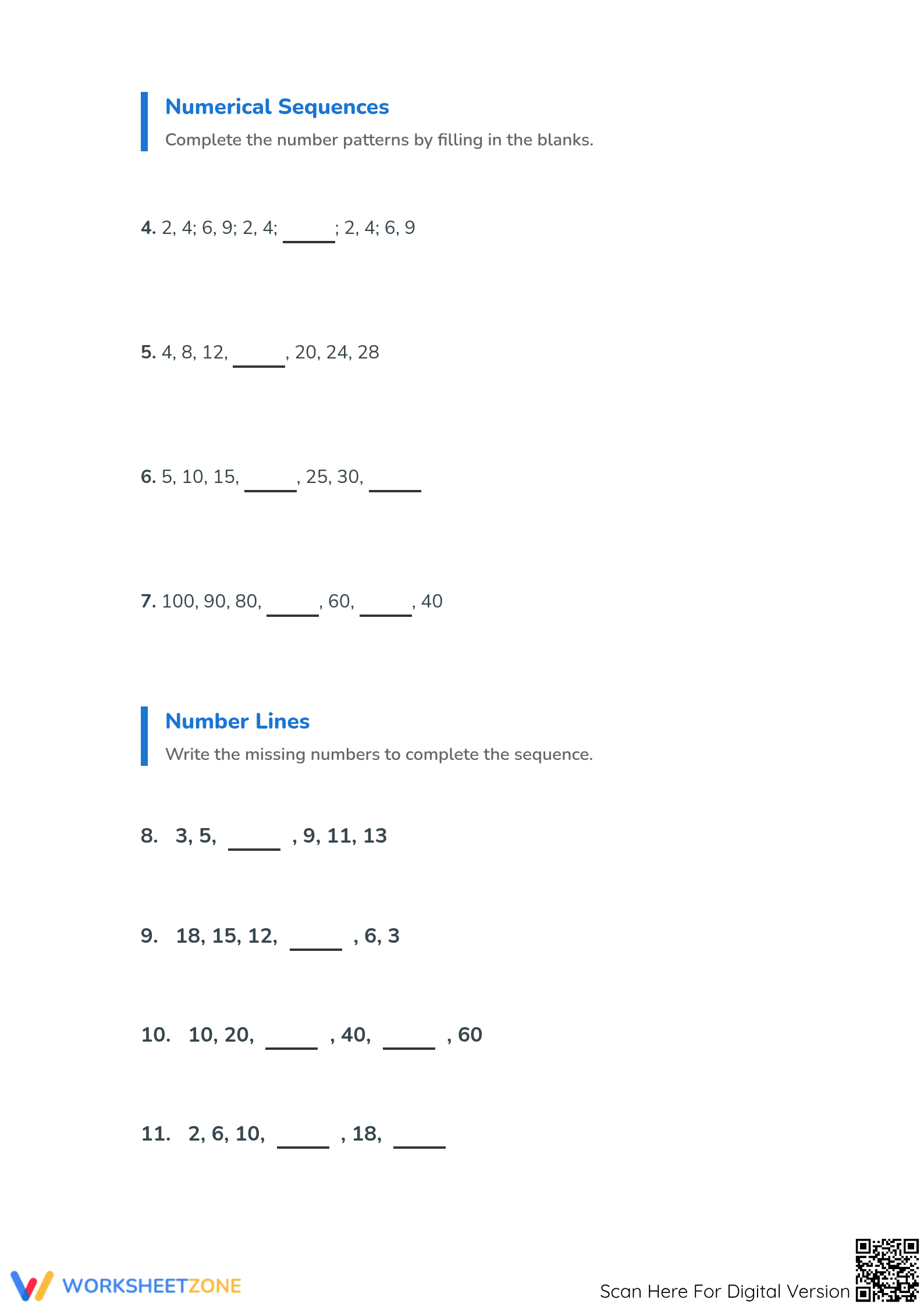
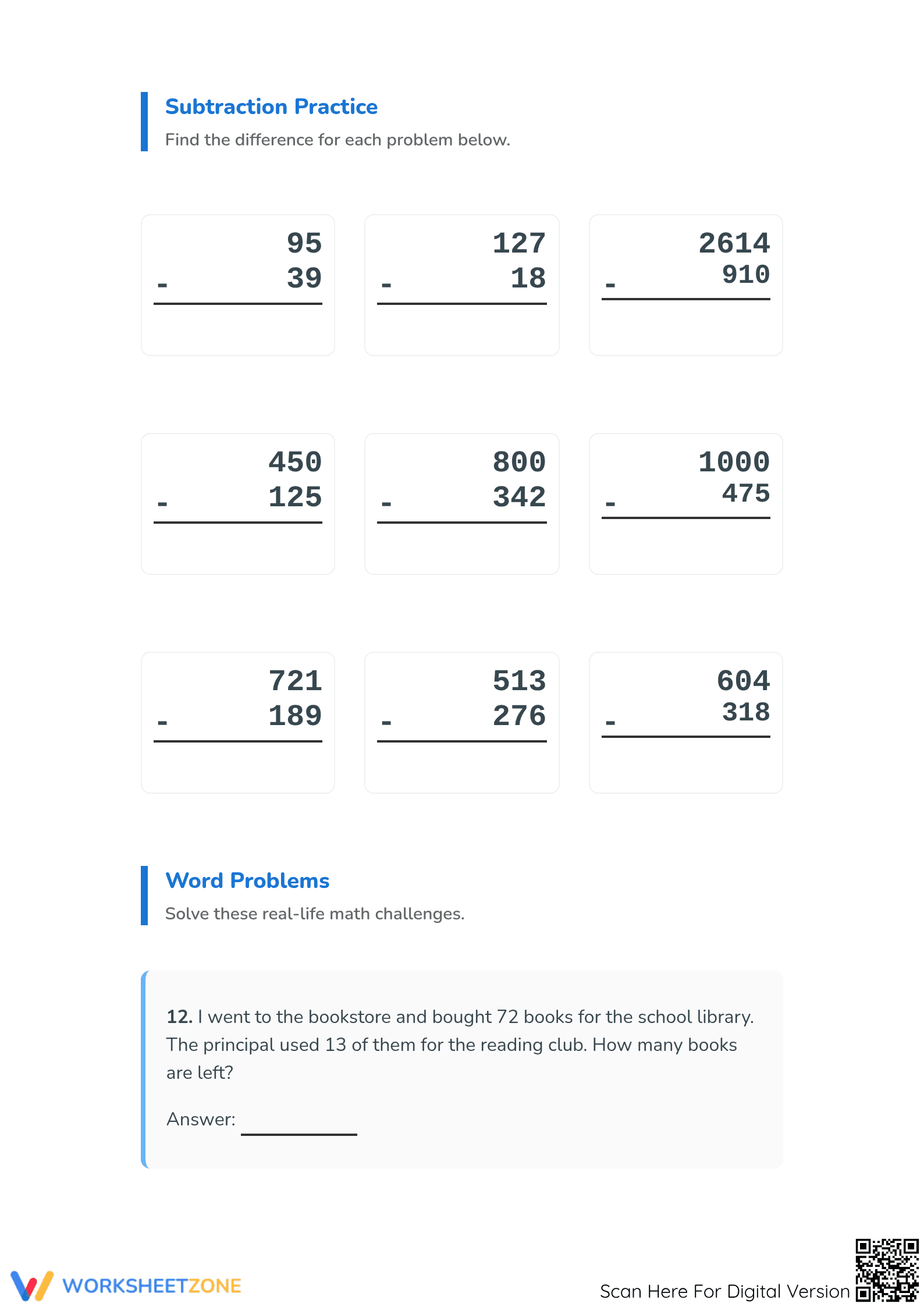
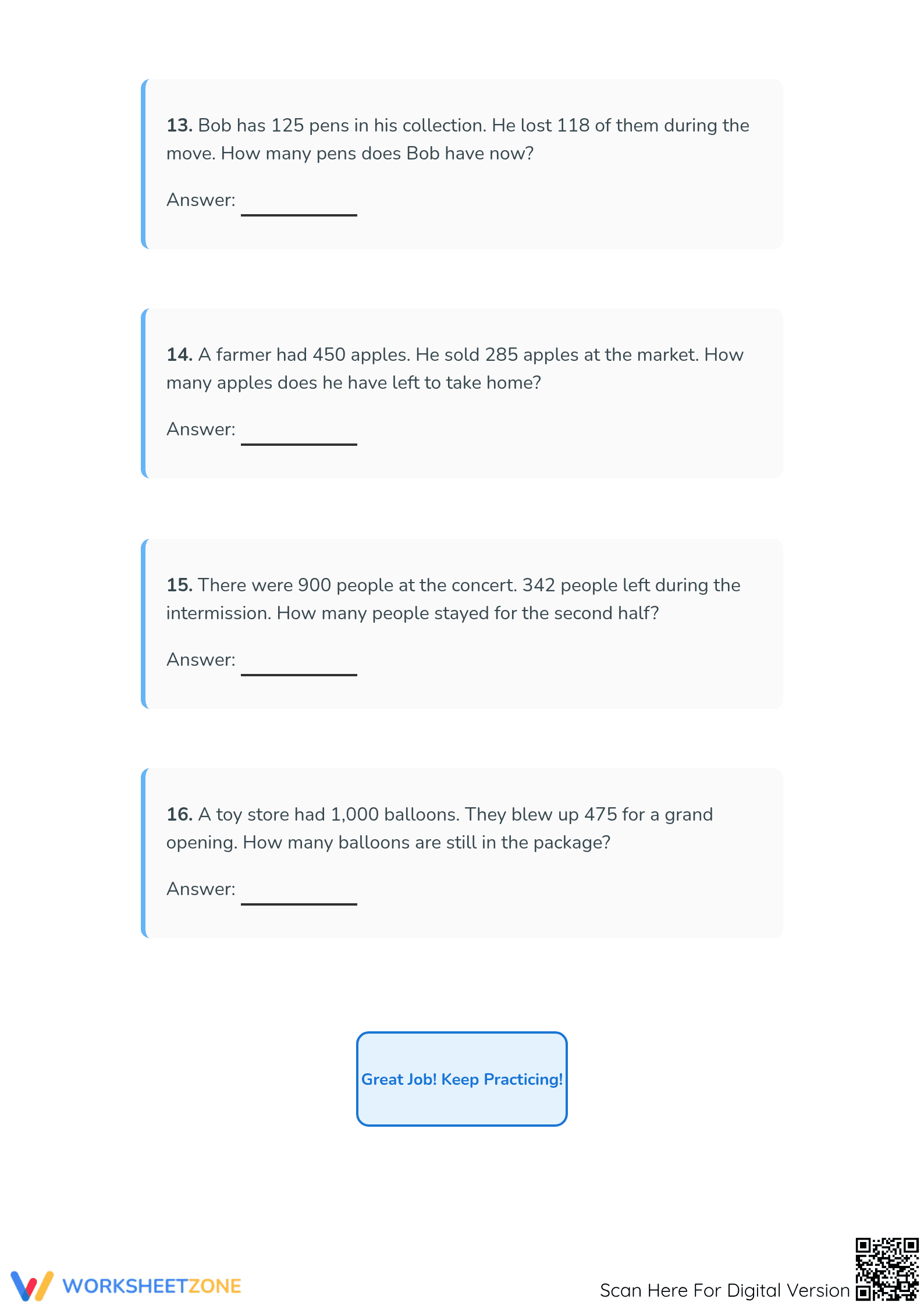
This Grade 2-3 Math worksheet focuses on two critical numeracy skills: identifying arithmetic patterns and mastering subtraction with renaming. Students complete logical number sequences before transitioning into multi-digit subtraction problems requiring regrouping. Practicing these dual skills develops the computational fluency and algebraic thinking necessary for advanced mathematical operations.
At a Glance
- Grade: 2 · 3 · Subject: Math
- Standard:
CCSS.MATH.CONTENT.2.NBT.B.7— Decompose tens or hundreds to subtract multi-digit numbers with precision- Skill Focus: Patterns and Subtraction with Renaming
- Format: 4 pages · 80 problems · Answer key included · PDF
- Best For: Daily math centers and computational fluency practice
- Time: 30–45 minutes
This four-page resource contains 80 targeted exercises building mastery through logic and repetition. Each page begins with "Complete the pattern" tasks to identify sequence rules, followed by fifteen "Subtract by renaming" problems. The vertical layout provides workspace for marking regrouping, and a complete answer key is provided for immediate grading or self-correction.
The worksheet uses a high-repetition model to move students toward procedural fluency.
- Guided Practice: Pattern-recognition tasks serve as a warm-up, grounding students in numerical relationships.
- Supported Practice: Vertical subtraction problems allow students to systematically apply regrouping steps for multi-digit values.
- Independent Practice: With 80 tasks, students have extensive opportunities to practice the renaming algorithm until the process becomes automatic.
This ensures students move beyond accidental success into reliable mastery through the gradual release of responsibility.
The primary focus is `CCSS.MATH.CONTENT.2.NBT.B.7`, requiring students to subtract within 1000 using strategies based on place value. It specifically addresses the decomposition of tens or hundreds during subtraction. This standard code can be copied directly into lesson plans, IEP goals, or district curriculum mapping tools to ensure instructional alignment with state and national frameworks.
This resource is best utilized during independent practice or as a math rotation station. Use the pattern section as a "bell ringer" to activate prior knowledge. During the activity, observe if students correctly cross out and rename the tens column; this provides a formative assessment of place-value understanding. Expected completion time is 30 to 45 minutes, making it suitable for a full math block.
Designed for Grade 2 and 3 students, this worksheet is ideal for learners ready to tackle decomposing numbers. It serves as an intervention tool for students needing RTI support or as a challenge for advanced learners. Pair this with a place-value anchor chart to provide a visual reference for the renaming process during early instructional stages.
Mastering subtraction with renaming is a pivotal skill representing the transition from simple counting to algorithmic thinking. Research from RAND AIRS (2024) indicates that students achieving fluency in decomposition strategies by Grade 3 show higher performance in complex arithmetic in later years. This worksheet addresses common struggles with regrouping by providing focused practice, which Fisher & Frey (2014) identify as essential for moving procedural knowledge into long-term memory. By aligning with CCSS.MATH.CONTENT.2.NBT.B.7, this resource ensures students engage with the fundamental place-value logic of the base-ten system rather than rote memorization. The inclusion of number pattern tasks strengthens algebraic reasoning, a key component of the NAEP framework for primary math proficiency. This dual-focus approach supports the development of "number sense" that is foundational for middle-school mathematics success.


