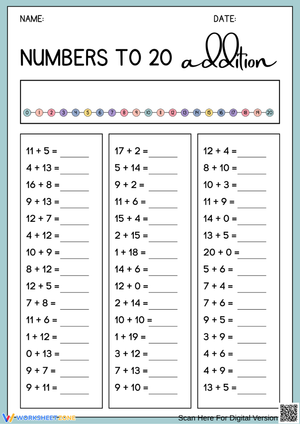
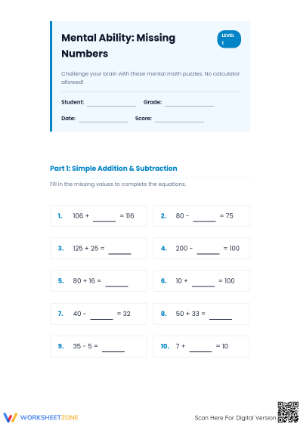
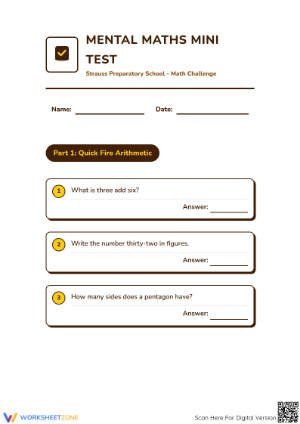
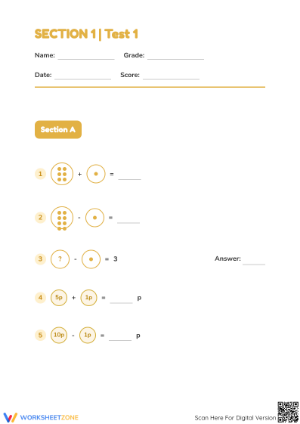
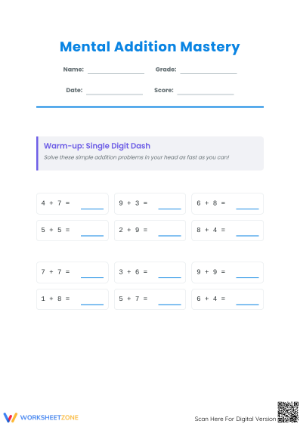
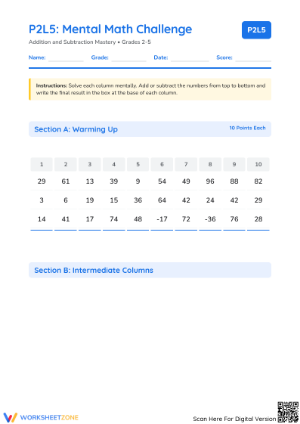
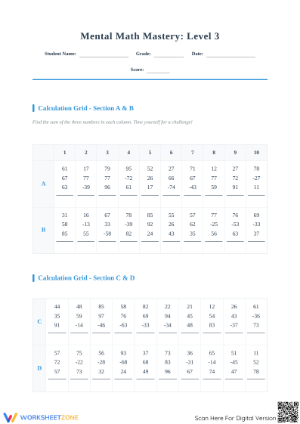
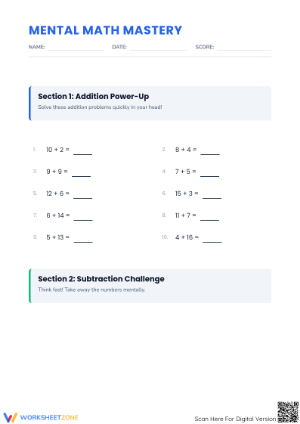
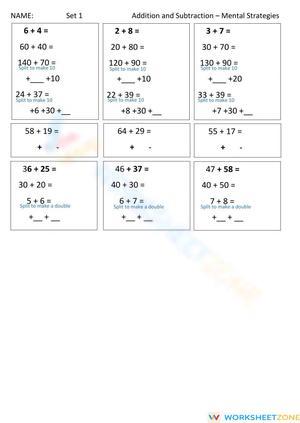
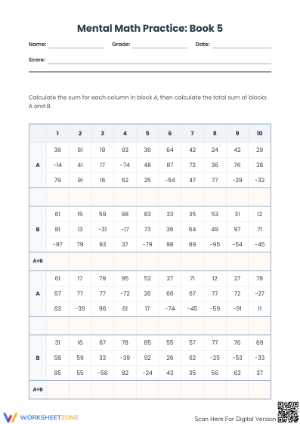
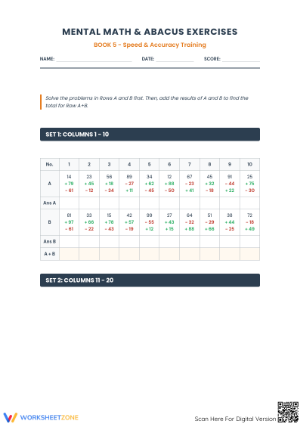
These 2nd grade mental math printable worksheets resources give teachers a ready-made practice system for the two skills that define second-grade number work: fluency with addition and subtraction within 20, and the ability to mentally add or subtract 10 or 100 from three-digit numbers. Each worksheet is short enough to fit inside a five-minute warm-up while surfacing exactly where a student's number sense breaks down. The set works with no advance prep beyond printing — a practical quality when planning time is already compressed.
The Skills These Worksheets Target
Second grade is the year students are expected to stop counting on their fingers. That transition — from tallying to trusting — is harder than it sounds, and it requires repeated, structured encounters with the same fact families across varied problem formats. Each worksheet addresses that need directly.
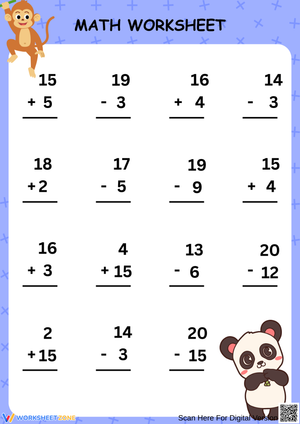
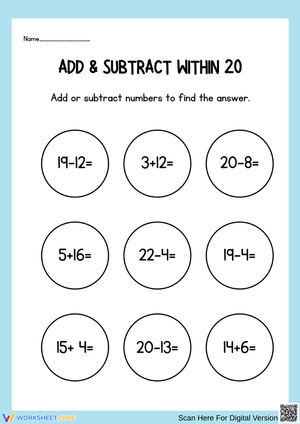
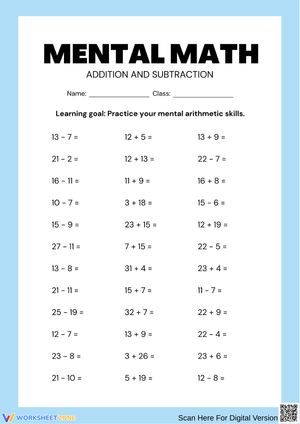
- Addition and subtraction within 20 — problems using strategies like making a ten, doubles, and doubles-plus-one. The emphasis is on strategy flexibility, not just answer recall.
- Missing addend problems — a format that pushes students to think about the relationship between addition and subtraction, rather than treating them as unrelated operations.
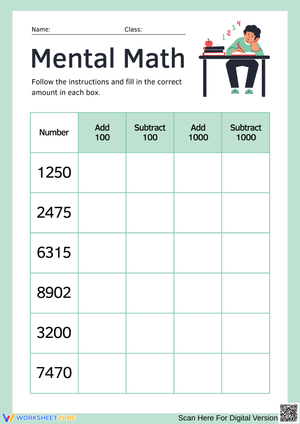
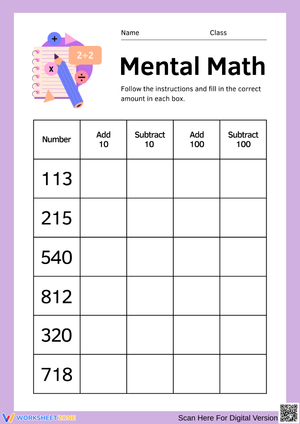
- Mental +10 / −10 and +100 / −100 — using three-digit numbers between 100 and 900, aligned to 2.NBT.B.8. These problems build place value intuition rather than reliance on the standard algorithm.
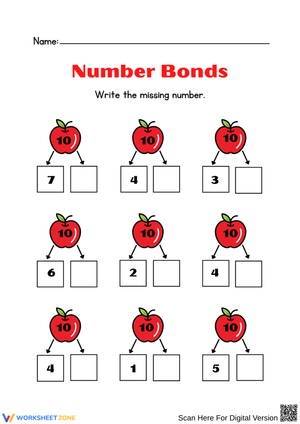
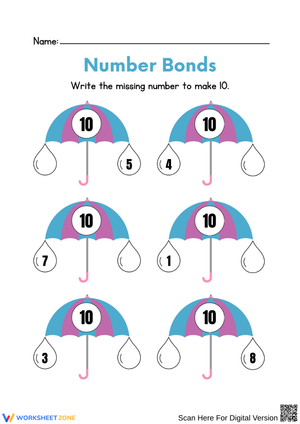
- Number bond completion — students break a number into two parts and record both representations, which deepens part-whole understanding in a way that bare addition drills don't.
Problem formats rotate across worksheets so students can't pattern-match their way through without actually thinking. That's a deliberate structural choice.
Mistakes Students Make That These Worksheets Surface
The most common error on within-20 problems isn't a wrong answer — it's a correct answer arrived at by the wrong method. A student who solves 8 + 5 by counting up from 8 will usually land on 13, but they haven't built the fluency the standard requires. Because these worksheets are untimed and strategy-neutral in format, you can observe how students work rather than just checking whether they're right. That observation tells you more than the final answer does.
The 2.NBT.B.8 problems reveal a consistent and specific error: students handle +10 and −10 correctly for most three-digit numbers, then hit a problem like 10 less than 300 and freeze. Their mental model of "the tens digit changes" doesn't account for what happens when that digit is zero. They know 340 − 10 = 330, but 300 − 10 produces a blank or a guess like 200. This signals a gap in place value understanding that repetition alone won't close — it needs direct discussion.
On missing addend problems, students who are strong at straight addition will solve __ + 6 = 13 correctly in their head, then write 6 in the blank because it was the last number they read. That's a reading comprehension issue layered onto a math one, and it shows up in student work regularly enough that it's worth anticipating before you return the first set of worksheets.
Standard Alignment
2.OA.B.2 requires students to fluently add and subtract within 20 using mental strategies. The within-20 problems across the set directly address this standard, with problem types chosen to push students past finger-counting toward genuine recall and flexible thinking.
2.NBT.B.8 asks students to mentally add or subtract 10 or 100 to or from numbers between 100 and 900. Every worksheet targeting this standard stays within that range and avoids numbers that require carrying or regrouping across place values, keeping the cognitive load on the mental operation itself rather than on number-reading. Instructionally, this standard sits at the intersection of addition fluency and place value — it's a natural second-semester focus once students have solid footing with within-20 facts.
How to Build These Worksheets Into Your Lesson Plans
The most effective use pattern is a Monday-through-Friday warm-up sequence where each 2nd grade mental math printable worksheets worksheet opens the math block. Mondays work well for within-20 fact families — students are re-engaging after the weekend and the familiar format eases them back in. Wednesday or Thursday suits the +10 / +100 place value problems, which require sharper sustained focus and land better mid-week. Fridays can carry a mixed-format review worksheet, which also serves as an informal weekly formative check without requiring any additional assessment prep.
These worksheets also work in math centers as a two-student oral-practice activity: one student reads the problem aloud, the other answers without looking at the paper, and they trade roles at the halfway point. The student reading has to track accuracy, which means they're doing math too. It produces more genuine engagement than most students working silently at their own pace.
Adjusting the Worksheets for a Range of Learners
For students still relying on finger-counting or tally marks, pair a worksheet with a visible 0–20 number line taped to their desk. The goal isn't to remove tools abruptly — it's to give students a reference they can gradually stop using as patterns become automatic. The worksheet itself doesn't change; the support structure alongside it does.
Students who have within-20 facts secured can move directly to the +10 / −10 / +100 / −100 worksheets and be further challenged by requiring two-strategy justification: solve the problem one way, then explain a second method in writing. This works naturally with the 2nd grade mental math printable worksheets format because the problems are short enough to revisit in the same sitting without adding much time. For the highest-performing students, you can layer challenges by writing a sticky note attached to their worksheet: "Start with 7 + 6, then add 100 to your answer." No new materials, no separate assignment, and it meaningfully extends the work they're already doing.
Frequently Asked Questions
How many problems does each worksheet include?
Problem counts vary across the set — most worksheets include between 10 and 20 problems, kept short so they fit a five-minute warm-up without spilling into the main lesson. A smaller problem count also reduces the fatigue that causes students to shut down and guess on the final third of a longer drill.
Are timed drills included, or are these open-ended?
The worksheets are open-ended by format — no timers are built in. Teachers who want to use 2nd grade mental math printable worksheets resources for timed practice can add a personal-best challenge, but the format doesn't pressure students by default. Research on math anxiety in early elementary consistently shows that timed pressure produces avoidance rather than fluency in students who haven't yet reached automaticity — and second grade is exactly the stage where that anxiety takes root.
Can these worksheets go home as homework?
Yes — the problems require no classroom tools or manipulatives, so students can complete them independently at home. A brief note to families explaining the two core strategies (making a ten, and the +10 / +100 pattern) helps parents give useful support rather than defaulting to counting up alongside their child.













 Interactive Worksheet Maker
 Quiz Maker
 Word Search Maker
 Crossword Puzzle Maker
 Word Scramble Generator
 Sentence Scramble Generator
 Handwriting Worksheet Generator
 Name Tracing Generator
 Fill In The Blank Generator