


























Views
Downloads
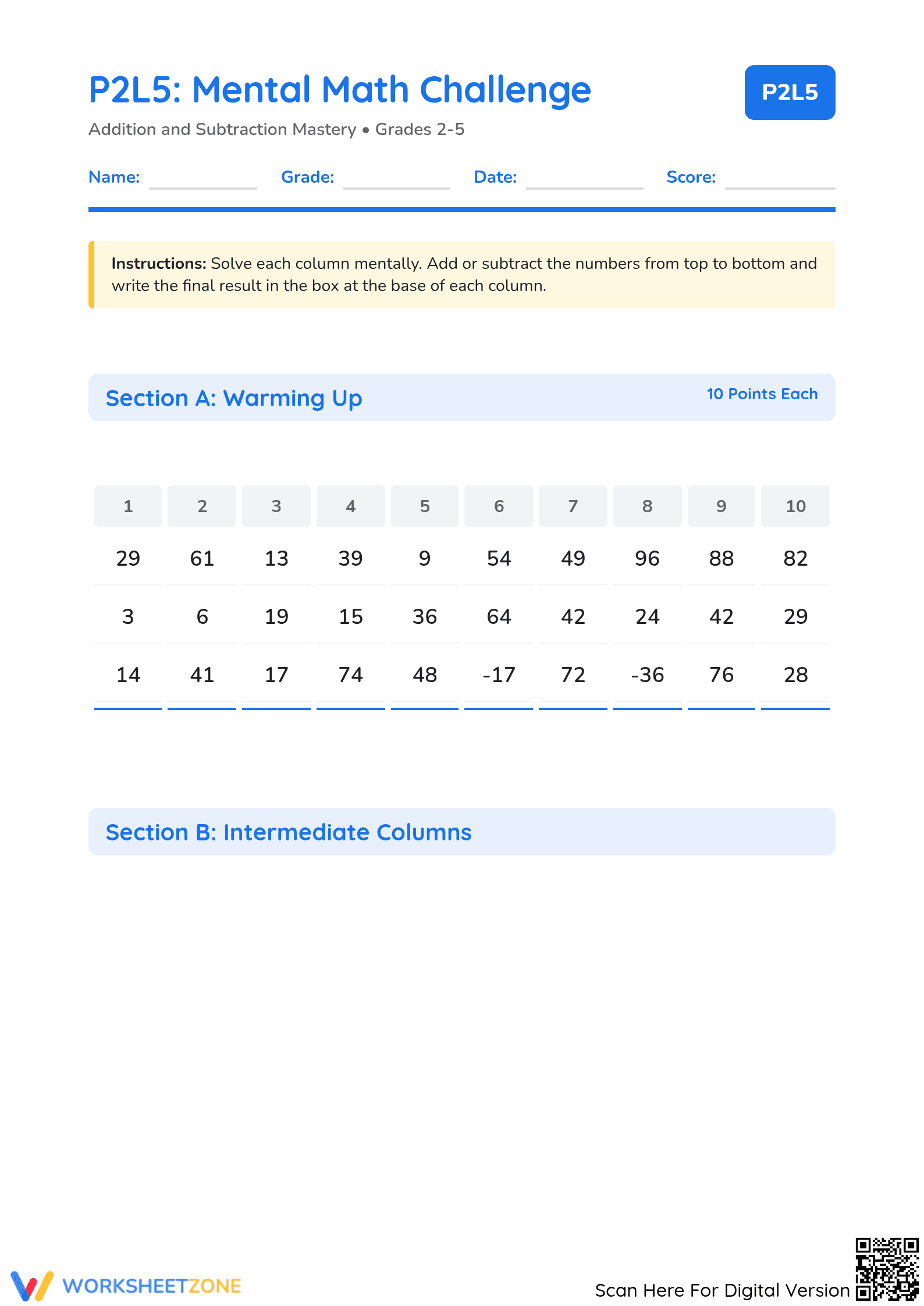



Essential Mental Math Challenge | Grades 2-5 Math Practice
Paste this activity's link or code into your existing LMS (Google Classroom, Canvas, Teams, Schoology, Moodle, etc.).
Students can open and work on the activity right away, with no student login required.
You'll still be able to track student progress and results from your teacher account.
This comprehensive Mental Math Challenge helps students in Grades 2 through 5 master addition and subtraction fluency. By solving columnar problems mentally, learners develop strong number sense and computational speed. This resource provides structured practice that transitions from basic warming up to advanced concentration tasks, ensuring students build the mental agility required for complex mathematics.
At a Glance
- Grade: 2–5 · Subject: Math
- Standard:
CCSS.MATH.CONTENT.4.NBT.B.4— Add and subtract multi-digit numbers mentally to build computational speed and accuracy- Skill Focus: Mental Addition and Subtraction
- Format: 3 pages · 40 problems · Answer key included · PDF
- Best For: Daily warm-ups and fluency drills
- Time: 15–20 minutes
What's Inside
This 3-page worksheet set includes four distinct sections: Warming Up, Intermediate Columns, Advanced Speed Test, and Concentration Challenge. Each section contains 10 vertical columns of numbers for students to process mentally. The difficulty increases as sections introduce more numbers per column and include negative values to simulate subtraction. A full answer key is included for rapid grading or self-correction.
Zero-Prep Workflow
This resource is designed for immediate classroom integration. First, print the multi-page set for your students, which takes less than one minute. Second, distribute the sheets as a morning warm-up or a timed challenge to engage the whole class instantly. Finally, use the provided answer key to review results in under two minutes, providing students with immediate feedback on their computational accuracy.
Standards Alignment
The primary focus is CCSS.MATH.CONTENT.4.NBT.B.4, which requires students to fluently add and subtract multi-digit whole numbers. The resource also supports CCSS.MATH.CONTENT.3.NBT.A.2 by reinforcing fluency within 1000. Both standard codes can be copied directly into lesson plans, IEP goals, or district curriculum mapping tools.
How to Use It
Use this worksheet as a "Bell Ringer" at the start of math class to focus student attention and activate prior knowledge. Alternatively, assign individual sections as a formative assessment to identify which students require additional scaffolding with mental regrouping. Teachers should observe student processing time to gauge computational automaticity during the Advanced Speed Test section.
Who It's For
This resource is ideal for elementary and middle school students working on core arithmetic skills, as well as those needing RTI Tier 2 support for fluency. It pairs naturally with number line activities or short mental math instructional videos. The varying difficulty levels make it accessible for diverse learners within a single classroom.
Mathematical fluency is more than just speed; it is the ability to use strategies flexibly and accurately. Research from EdReports (2024) emphasizes that mental math practice provides the cognitive foundation for higher-order problem solving by reducing the working memory load during complex tasks. This worksheet targets CCSS.MATH.CONTENT.4.NBT.B.4 by providing 40 high-repetition tasks that bridge the gap between rote memorization and algorithmic mastery. According to Fisher & Frey (2014), gradual release of responsibility is most effective when students engage in regular, low-stakes practice that builds confidence. By progressing through warming-up drills to advanced concentration challenges, students internalize the relationships between numbers. This PDF-ready resource ensures that Grade 2-5 educators can implement research-backed arithmetic drills without the burden of lesson preparation, directly supporting district-level goals for quantitative literacy and computational automaticity in diverse classroom settings.


