


























Views
Downloads


Complete 3.NBT.A.2 Worksheet: Mental Math — Grade 3
Paste this activity's link or code into your existing LMS (Google Classroom, Canvas, Teams, Schoology, Moodle, etc.).
Students can open and work on the activity right away, with no student login required.
You'll still be able to track student progress and results from your teacher account.
Comprehensive Mental Math Assessment for Grade 3
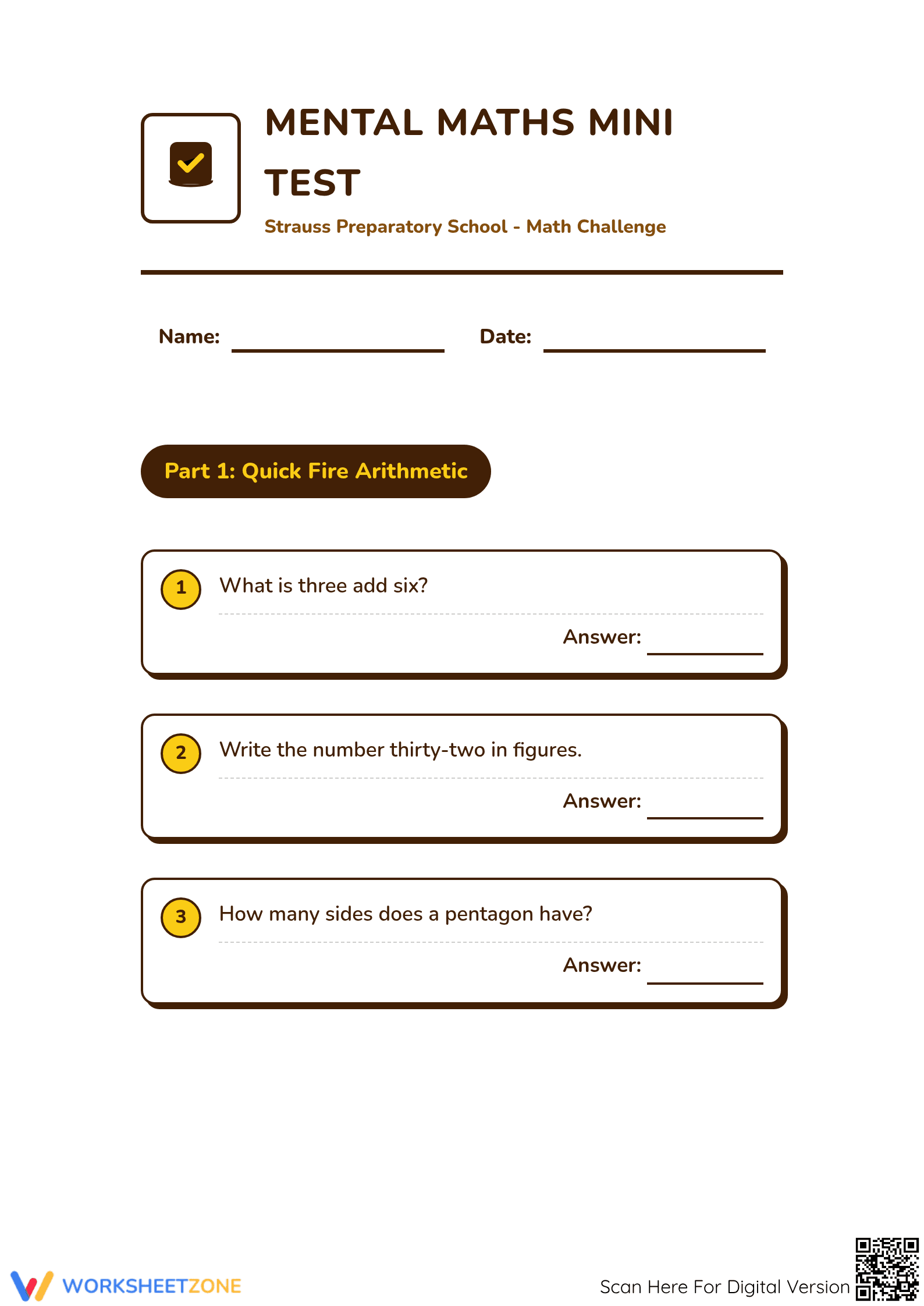
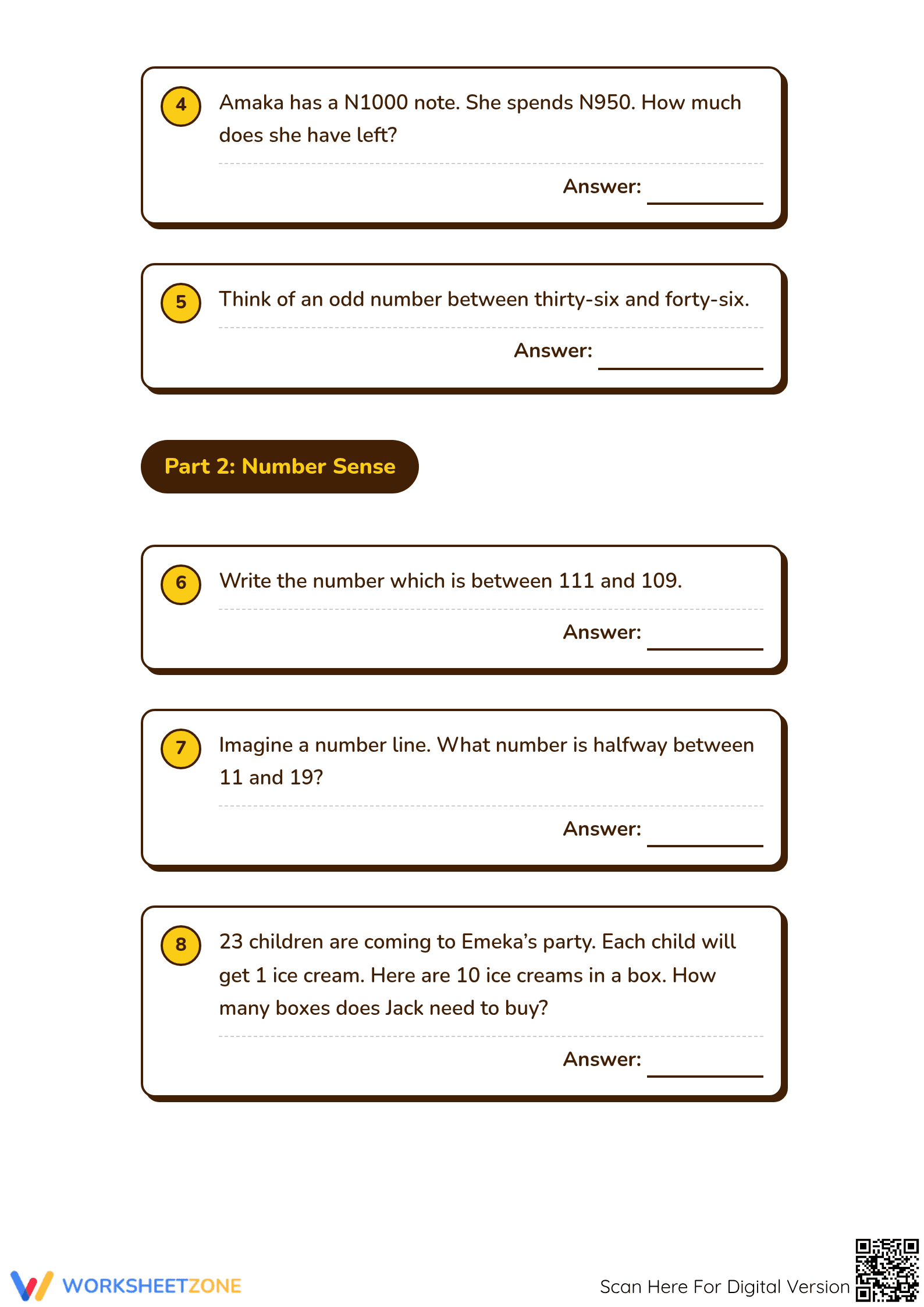
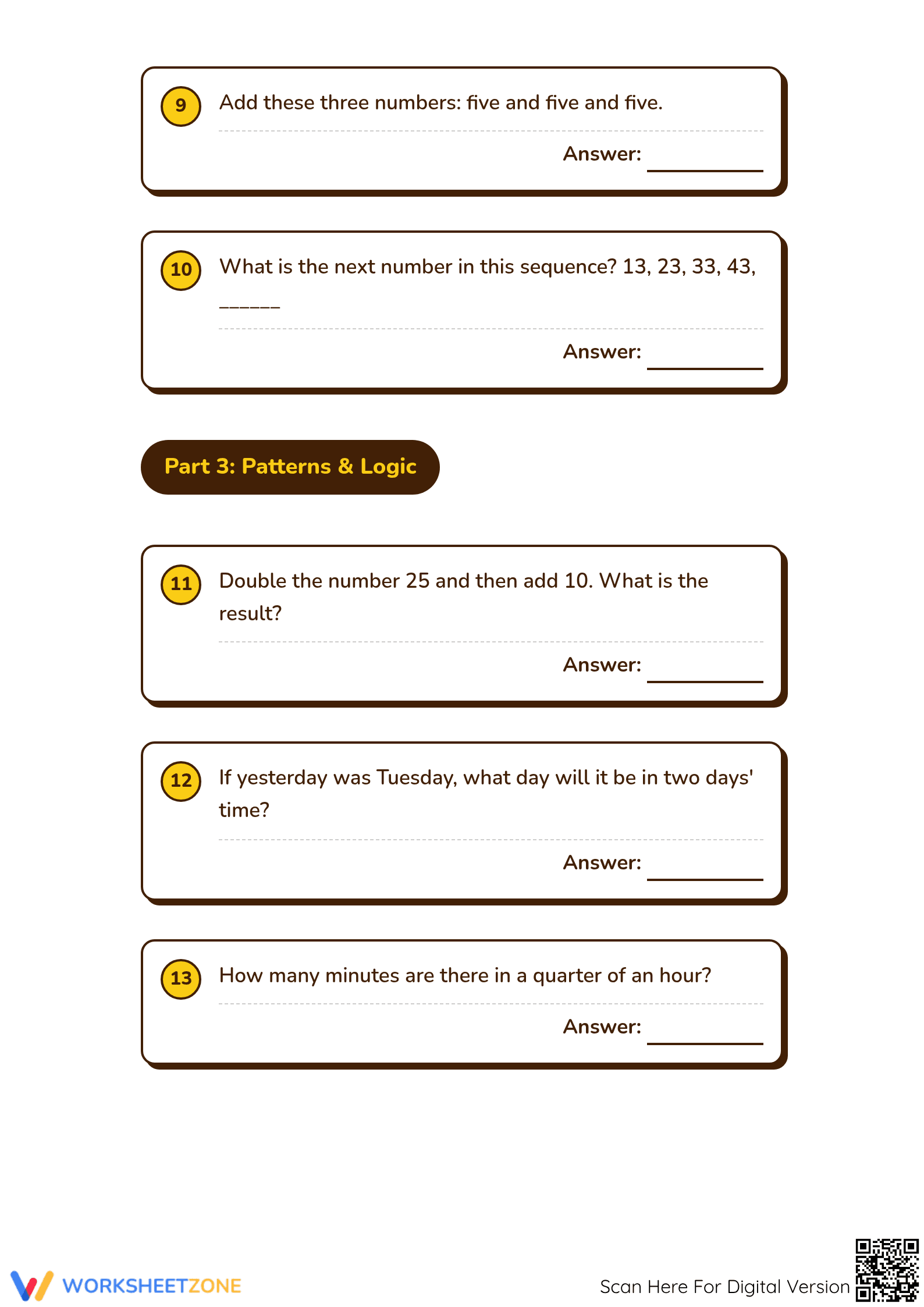
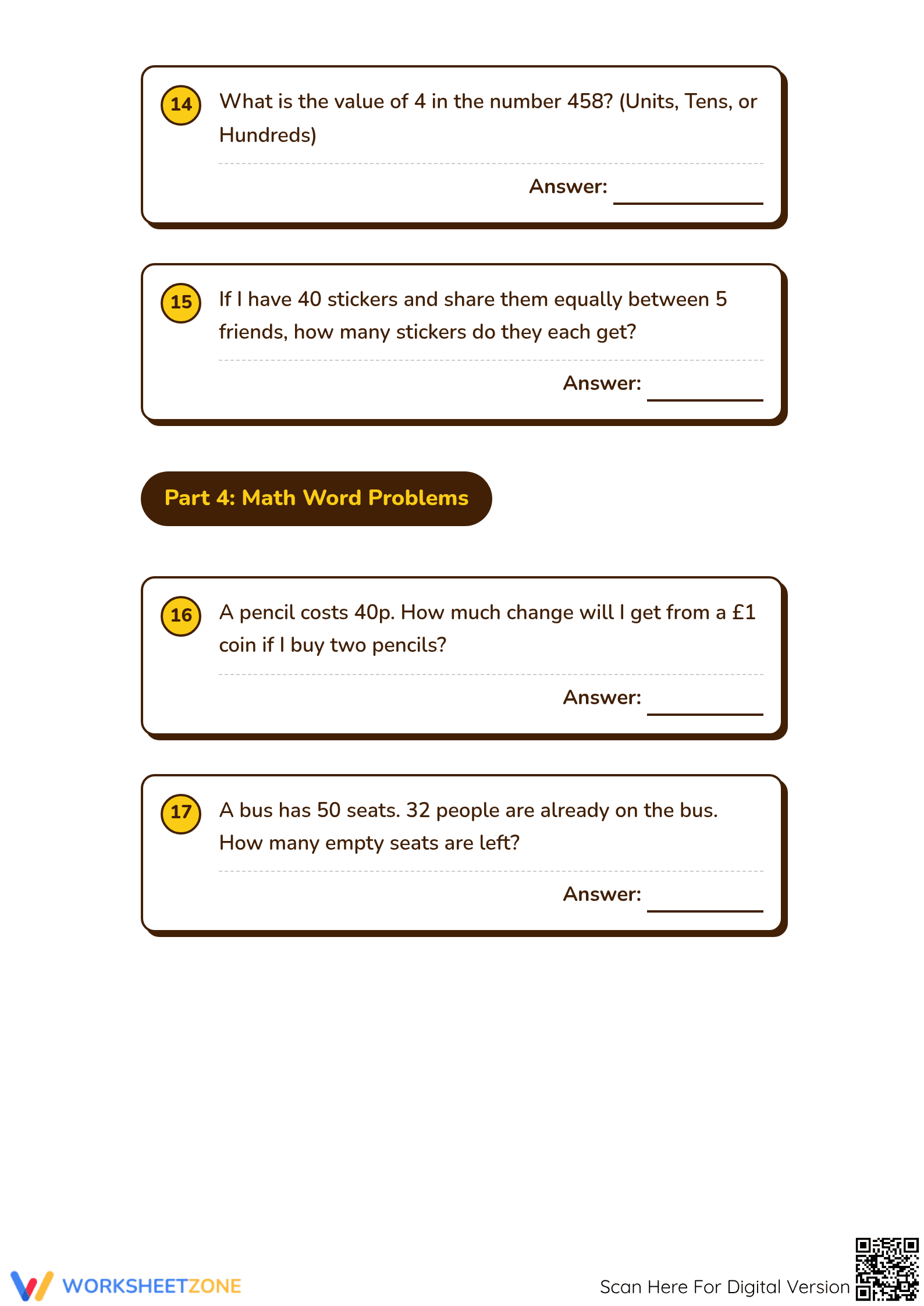
This Grade 3 mental math test provides a comprehensive assessment of students' arithmetic fluency and number sense. Through 60 carefully sequenced problems across five pages, learners will apply addition, subtraction, multiplication, and division skills without reliance on calculators, building speed and accuracy essential for higher-level math.
At a Glance
- Grade: 3 · Subject: Math
- Standard:
CCSS.MATH.CONTENT.3.NBT.A.2— Fluently add and subtract within 1000 using strategies.- Skill Focus: Mental Math, Mixed Operations
- Format: 5 pages · 60 problems · Answer key included · PDF
- Best For: Summative assessment, test prep, fluency practice
- Time: 25–40 minutes
What's Inside
This resource contains a five-page mental math test designed for third-grade students. It features 60 unique problems, with 12 questions per page, covering a range of arithmetic skills. A complete, page-by-page answer key is provided for efficient grading. The clean layout ensures students can focus on the calculations without distraction.
Evidence of Mastery
This test is structured to gather clear evidence on student proficiency with CCSS.MATH.CONTENT.3.NBT.A.2 and 3.OA.C.7. Each section can be scored to identify specific areas where a student excels or needs support. These scores provide concrete data points perfect for report cards, parent-teacher conferences, or informing the next phase of instruction.
Standards Alignment
This test is aligned to Common Core standard CCSS.MATH.CONTENT.3.NBT.A.2, requiring students to fluently add and subtract within 1000. It also incorporates skills from CCSS.MATH.CONTENT.3.OA.C.7 (multiplication and division). Both standard codes can be copied directly into lesson plans, IEP goals, or district curriculum mapping tools.
How to Use It
Use this as a summative assessment after a unit on arithmetic. Administer in a quiet setting, allowing 25-40 minutes. For formative use, observe students as they work, noting which problems cause hesitation; this can reveal gaps in understanding place value or number properties. The results also serve as an excellent pre-test for Grade 4 to gauge fluency retention.
Who It's For
Designed for Grade 3 students, this test's clean layout suits most learners. It is an excellent complement to a lesson on mental math strategies or a unit anchor chart on properties of operations. For students needing support, consider providing a number line or 100s chart as a scaffold.
Assessing computational fluency is a cornerstone of effective elementary mathematics instruction. This Grade 3 mental math test aligns with CCSS.MATH.CONTENT.3.NBT.A.2, focusing on the ability to flexibly and accurately compute. Research consistently shows that procedural fluency is a critical component of mathematical proficiency, enabling students to dedicate cognitive resources to more complex problem-solving. According to the RAND AIRS 2024 report on foundational math skills, regular practice with varied problem types, like the 60 items included here, is directly linked to improved number sense and long-term retention. By isolating mental math skills, this assessment provides a clear signal of a student's automaticity, a key predictor of success in later math coursework such as algebra. This data is invaluable for teachers targeting interventions and celebrating student growth in essential calculation abilities.


