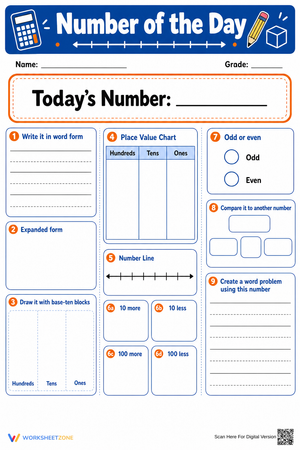
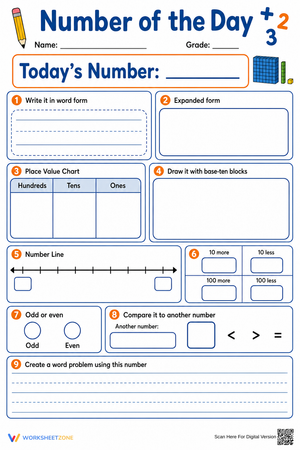
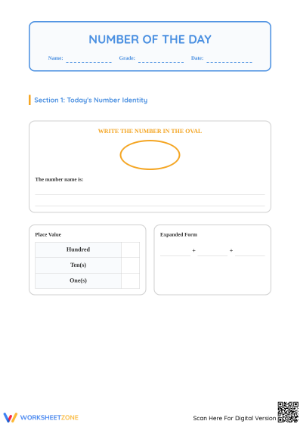
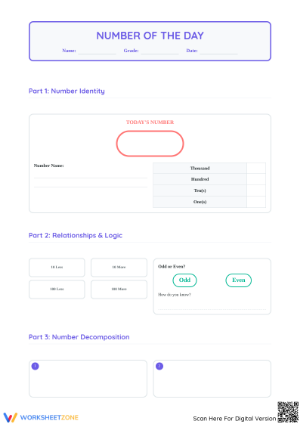
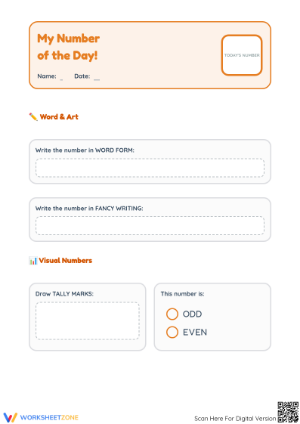
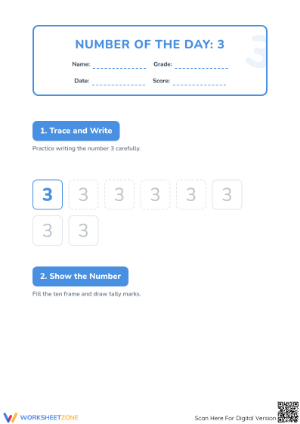
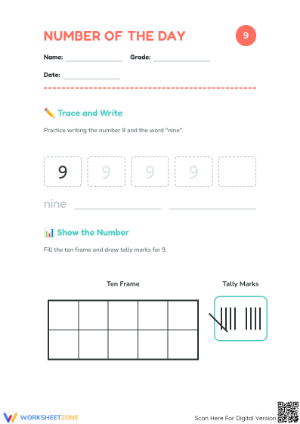
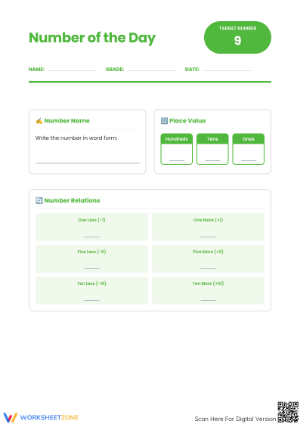
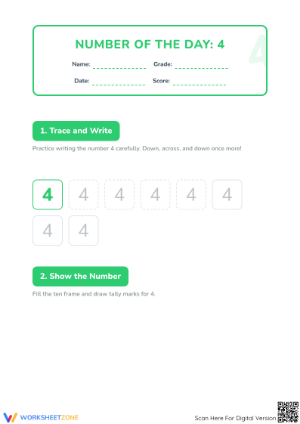
These number of the day printable worksheets for 2nd grade give teachers a low-prep, high-repetition tool for building place value fluency across the entire school year. Students work with a single target number each session — drawing base-ten blocks, writing expanded form, calculating ten more and ten less — while the format stays fixed and only the number changes. That predictability is the point: when students know exactly what's coming, they spend their cognitive energy on the mathematics, not on decoding the directions.
The Specific Skills Each Worksheet Targets
Each worksheet asks students to interact with one target number from multiple angles in a single sitting. The tasks across the set build toward the second-grade expectation that students can move fluidly between representations of the same quantity. Depending on the specific worksheet, students will:
- Write the number in standard form, word form, and expanded form
- Draw a base-ten block representation separating hundreds, tens, and ones
- Identify whether the number is odd or even and explain the reasoning
- Calculate 10 more, 10 less, 100 more, and 100 less from the target number
- Compare the target number to a second value using greater than or less than
- Place the number on an open number line between two given benchmark values
At this grade level, students are transitioning from counting-based thinking toward a more abstract understanding of quantity. Requiring them to show the same number four different ways in one sitting — visually, symbolically, in words, and on a number line — accelerates that transition in a way that single-representation practice does not.
How to Build These Worksheets Into Your Daily Schedule
The most reliable placement is the 6–8 minutes between when students arrive and when morning meeting begins. A worksheet sits on every desk as students unpack, and by the time attendance is taken, most of the class has finished. No transition, no re-explaining directions. This works even on Monday mornings after a long weekend — the automaticity of a familiar format carries students through the first few problems before they've fully settled in.
Running the routine at the front of the math block is a reasonable alternative. A five-minute whole-class debrief — projecting the worksheet and cold-calling students to defend why 247 is odd, or asking someone to walk through why 10 less than 342 is not 341 — doubles as oral language practice and surfaces reasoning errors before the main lesson. One practical setup worth the initial time investment: slide each worksheet into a heavy-duty dry-erase sleeve. Students complete it with a dry-erase marker, you photograph any work worth saving, then they wipe it clean. Daily repetition without daily copying.
Student Errors That Surface Fast in This Routine
The most consistent error in second-grade work appears in expanded form. A student who correctly identifies that 342 has 3 hundreds, 4 tens, and 2 ones will still write the expanded form as 3 + 4 + 2 rather than 300 + 40 + 2. The student understands the place labels verbally but reverts to single-digit notation the moment they pick up a pencil — a gap between conceptual understanding and symbolic representation. Because this shows up in the first week of using the routine, teachers can catch and address it before it hardens into a habit.
The second consistent error is in the mental math row. When asked for 10 less than 342, a meaningful portion of students write 341 — subtracting 1 rather than 10. They read "10 less" as a general instruction to decrease, then execute the subtraction at the ones place out of habit. Seeing this in the morning routine means pulling those students for a quick small-group session during center time the same day, rather than discovering the misunderstanding during a unit assessment three weeks later.
Standard Alignment
The worksheets directly address three standards from the Common Core State Standards for Mathematics: 2.NBT.A.1, 2.NBT.A.3, and 2.NBT.B.8. 2.NBT.A.1 requires students to understand that the three digits of a three-digit number represent hundreds, tens, and ones — and the base-ten block drawing task makes that structure visible every day. 2.NBT.A.3 requires reading and writing numbers to 1,000 in all three forms: base-ten numerals, number names, and expanded form, all of which appear in each worksheet. 2.NBT.B.8 targets the mental math standard, specifically adding or subtracting 10 or 100 from a given three-digit number. When number of the day printable worksheets for 2nd grade address all three of these standards inside a single 8-minute routine, they serve as daily spiral review for the entire NBT domain — keeping foundational standards active between units without pulling time from new instruction.
Adjusting the Set for a Range of Learners
The simplest differentiation lever is the target number itself. Students still working on two-digit place value receive numbers between 20 and 99; the worksheet format stays identical, but the task drops in complexity because there is no hundreds place to manage. On-level second graders work within 100 to 999. Students who have outpaced grade-level expectations receive four-digit numbers, which extends the same expanded form and mental math tasks into new territory without requiring a different worksheet.
For students who struggle to produce the base-ten block drawing from memory alone, having physical blocks available alongside each worksheet gives them a concrete manipulation step before they record anything — build the number first, then draw what was built. That concrete-to-representational sequence removes the barrier of a blank box for students who freeze when starting from nothing. On the other end, a student who finishes in three minutes can be asked to write a two-step word problem where the target number is the answer — working backward from a quantity, which is a meaningfully different demand from what the standard tasks require.
Frequently Asked Questions
How long should this routine take each day?
Most second graders finish independently in 5–8 minutes. Adding a whole-class debrief brings the full routine to 12–15 minutes. Keep the debrief focused — two or three targeted questions about word form, expanded form, and the mental math row. A full walkthrough of every cell turns a brisk warm-up into a slow one and is rarely necessary once the routine is established.
Can these worksheets work as an independent math center activity?
The number of the day printable worksheets for 2nd grade work well as a center once the format is fully internalized — typically by mid-October in most second-grade classrooms. Place a set of blank worksheets in the center along with a number cube or a deck of numeral cards. Students generate a target number, complete the worksheet, then self-check against an answer key posted inside the center folder. This works as a strong independent task during rotations precisely because students already know the format and require no teacher direction to begin.
What target numbers work best at the start of the school year?
Keep numbers in the 10–50 range during the first two weeks, even if students already know two-digit place value. The goal early on is establishing the routine, not measuring knowledge ceilings. Once students complete each worksheet without asking any procedural questions, shift target numbers into the hundreds. Most classes are ready for three-digit numbers before the end of September.
Do these worksheets support students with IEPs or learning differences?
The consistent, predictable format makes number of the day printable worksheets for 2nd grade a reliable fit for students who benefit from stable daily expectations. Accommodations layer in without disrupting the routine: reduce the number of active tasks per worksheet, pre-fill the standard form so students focus only on representations, or accept oral responses instead of written ones. The structure itself rarely needs to change — only the level of support around it.













 Interactive Worksheet Maker
 Quiz Maker
 Word Search Maker
 Crossword Puzzle Maker
 Word Scramble Generator
 Sentence Scramble Generator
 Handwriting Worksheet Generator
 Name Tracing Generator
 Fill In The Blank Generator