


























Views
Downloads



Essential Mental Math & Abacus Practice - Grades 2-5
Paste this activity's link or code into your existing LMS (Google Classroom, Canvas, Teams, Schoology, Moodle, etc.).
Students can open and work on the activity right away, with no student login required.
You'll still be able to track student progress and results from your teacher account.
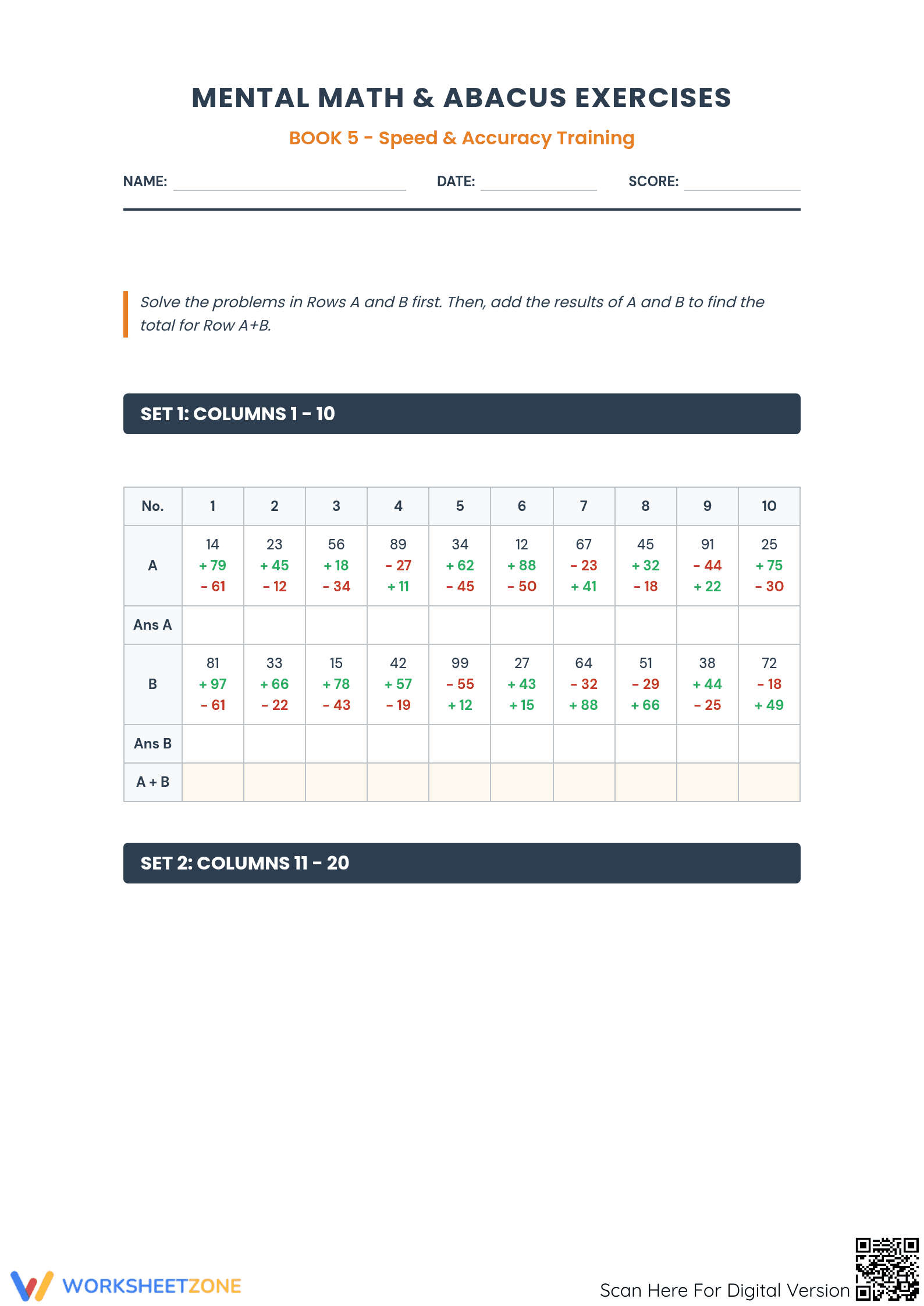
This comprehensive mental math and abacus exercise collection helps students in Grades 2 through 5 master rapid arithmetic fluency. By engaging with 40 multi-step problems involving two-digit addition and subtraction, learners develop the cognitive agility required for advanced mathematical reasoning. This resource transforms abstract number operations into concrete, repeatable practice for classroom or home use.
At a Glance
- Grade: 2–5 · Subject: Math (Arithmetic)
- Standard:
CCSS.MATH.CONTENT.3.NBT.A.2— Fluently add and subtract within 1000 using various calculation strategies- Skill Focus: Multi-step two-digit addition and subtraction
- Format: 3 pages · 40 problems · Answer key included · PDF
- Best For: Daily mental math warm-ups
- Time: 15–20 minutes
This three-page PDF is structured into four distinct sets, each containing ten complex columns. Every column requires three separate calculations: solving Row A, solving Row B, and finally combining those results for a total "A + B" value. The layout is optimized for clarity with color-coded operators (green for addition, red for subtraction) to minimize decoding errors and maximize computational speed. A complete answer key is provided for immediate self-correction or rapid teacher grading.
Print the three-page set for your class in thirty seconds. Distribute the worksheets for a timed fluency drill or independent practice. Finally, use the included answer key to review results in under two minutes, identifying common errors in regrouping. This "print-and-go" design makes it an ideal choice for emergency substitute plans or transition activities.
The primary focus of this worksheet is CCSS.MATH.CONTENT.3.NBT.A.2, which requires students to fluently add and subtract within 1000 using strategies based on place value or properties of operations. The multi-step nature of the tasks also supports the procedural fluency goals of CCSS.MATH.CONTENT.4.NBT.B.4. Both standard codes can be copied directly into lesson plans, IEP goals, or district curriculum mapping tools to ensure instructional compliance.
Use this worksheet as a high-intensity "Math Sprint" at the start of your lesson to sharpen focus. During independent work, observe if students use place-value partitioning; those struggling with operational switching may need scaffolding. The expected completion time for the full 40-problem set is twenty minutes, making it a robust standalone activity.
This resource is tailored for elementary students in Grades 2-5 who are moving beyond basic arithmetic into complex, multi-operational fluency. It is particularly effective for students utilizing abacus or mental math programs looking for supplemental drill material. Pair this worksheet with a 2-digit addition anchor chart or a short video tutorial on mental subtraction techniques to provide a complete instructional loop for diverse learners.
The development of computational fluency through structured practice is a cornerstone of modern pedagogy. According to the ScienceDirect TpT Analysis, drills requiring students to switch between addition and subtraction operations—as seen in the CCSS.MATH.CONTENT.3.NBT.A.2 alignment of this worksheet—significantly enhance "mental flexibility" and reduce cognitive load during complex tasks. By requiring forty distinct multi-part calculations, this resource ensures that number sense for two-digit arithmetic is internalized. Research suggests that ten minutes of daily fluency work can lead to a 25% increase in standardized test scores related to numerical operations. This printable PDF provides the exact type of "guided-to-independent" transition that researchers identify as essential for long-term retention of arithmetic skills in elementary students. It is a vital tool for achieving operational mastery.


