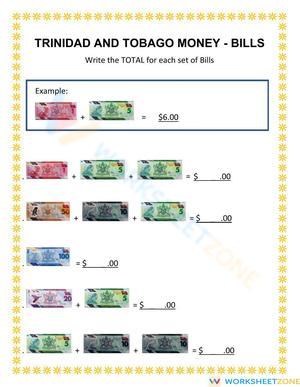
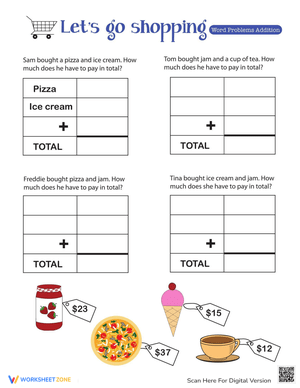
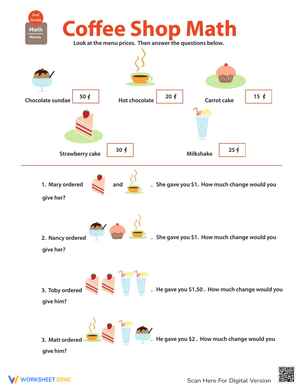
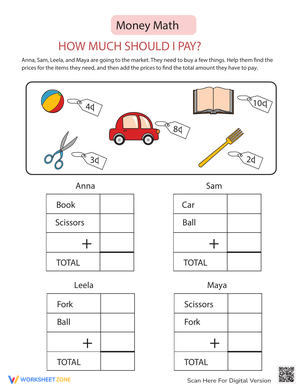
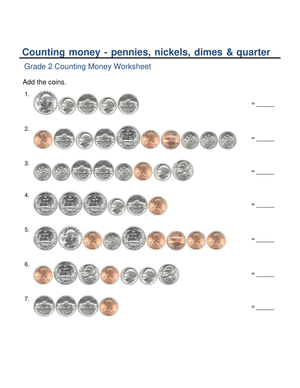
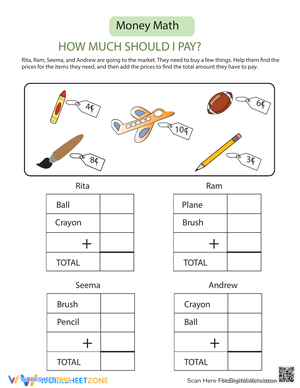
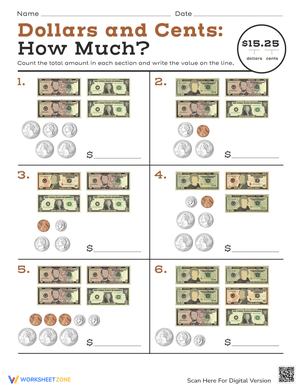
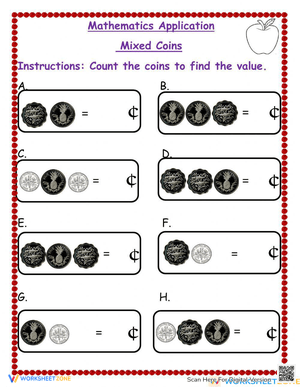
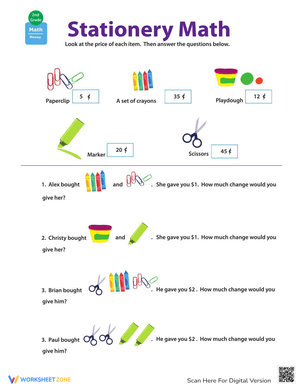
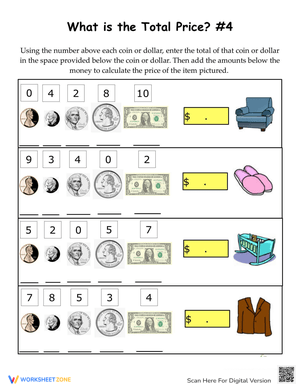
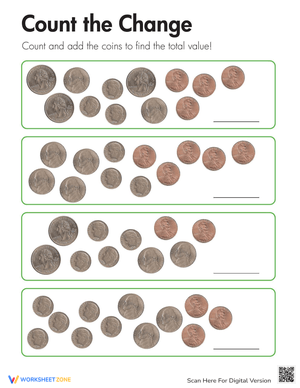
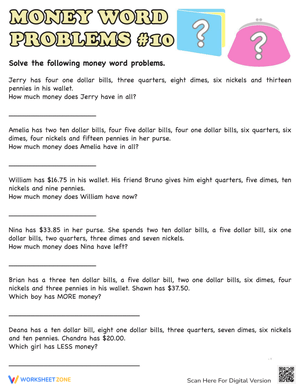
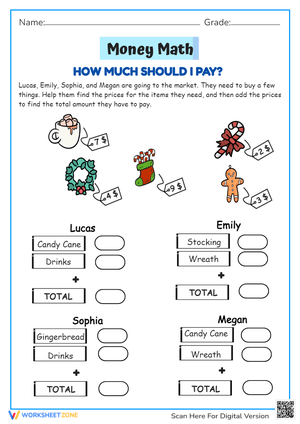
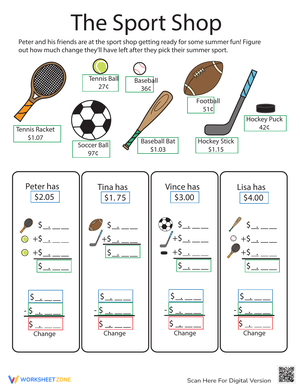
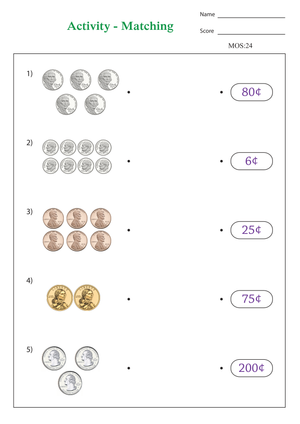
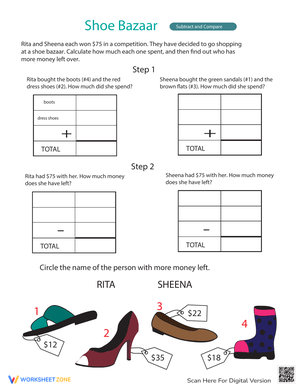
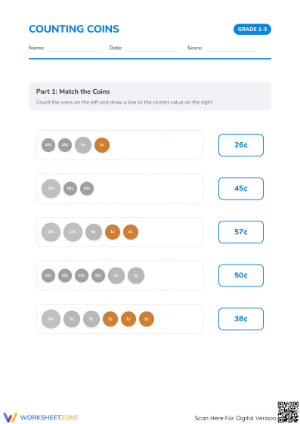
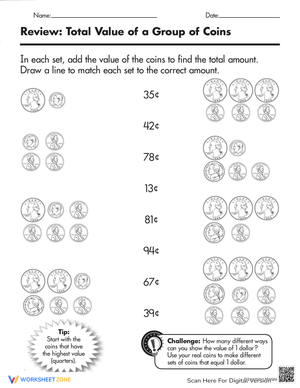
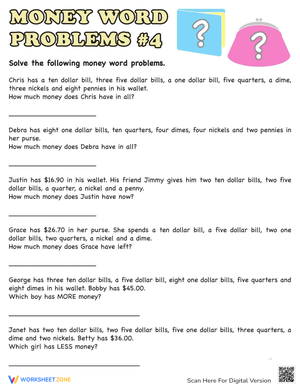
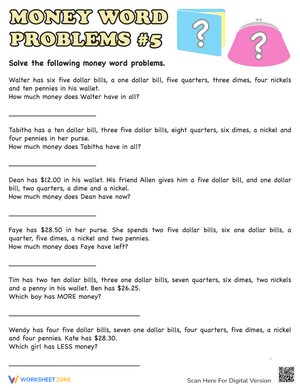
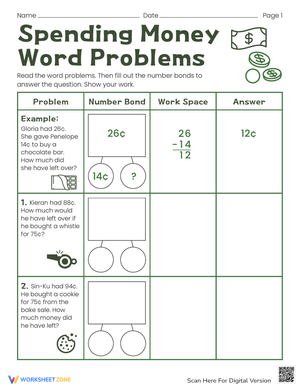
These 2nd grade operations with money printable worksheets give teachers a focused set of standalone practice resources that move students past coin identification into genuine computation — adding collections of mixed denominations, finding totals, and calculating the change left after a purchase. Each worksheet targets a specific slice of the money operations strand, making it straightforward to assign them in sequence during a unit or pull one worksheet to close a gap spotted on a quick exit check. The range spans pure coin-counting exercises, symbol notation practice, and multi-step word problems — the full combination that 2.MD.C.8 actually demands.
The Specific Skills Each Worksheet Targets
The set works across five related but distinct competencies that build on each other across a two- to three-week unit:
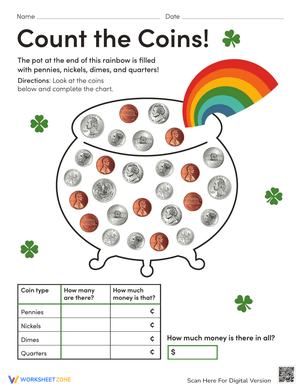
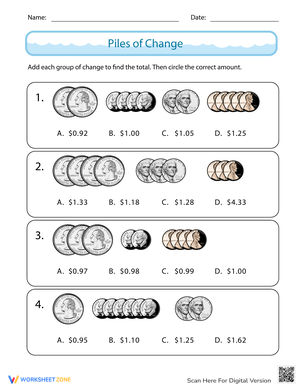
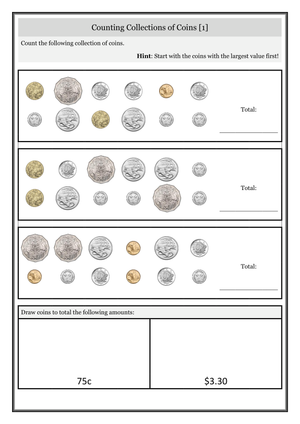
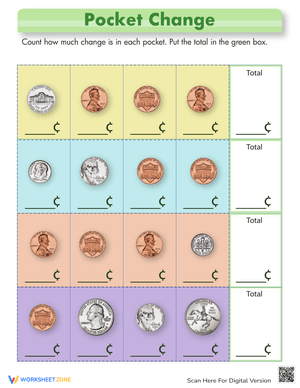
- Counting mixed coin collections by starting with the highest denomination — quarters first, then dimes, then nickels, then pennies — and counting on from there
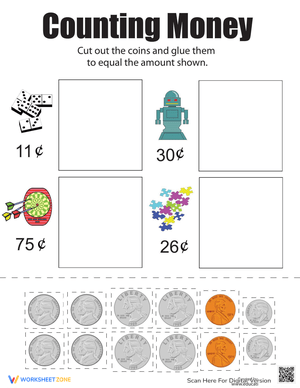
- Writing totals using the correct $ and ¢ symbols, including amounts that cross the dollar threshold
- Adding two separate coin amounts to find a combined total within 100 cents
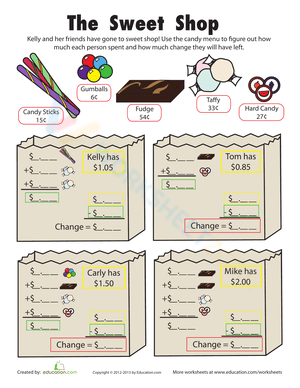
- Subtracting a price from a given amount to find change, using both the standard algorithm and the counting-up method
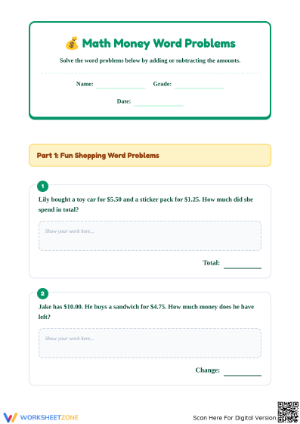
- Solving one-step and two-step word problems set in familiar shopping scenarios — a school book fair, a snack stand, a small class store
Student Mistakes Worth Catching Early
The most predictable error in this strand is symbol confusion, and it appears even in students whose arithmetic is correct. A student who adds 3 dimes and 2 nickels, arrives at 40, and then writes "$.40" has the right number and the wrong symbol. Students default to the dollar sign because it is visually dominant and more familiar than the cent sign. Worksheets that require students to choose the correct symbol — rather than printing one symbol throughout — surface this habit quickly and give you something concrete to address.
The quarter creates a second, less obvious problem during counting sequences. Students who count by 25s handle 25, 50, 75 without trouble. But 75 plus a dime means switching to counting by 10s mid-sequence, and 85 plus three pennies means switching to 1s. That shift — 75 → 85 → 86 → 87 → 88 — requires three different counting rhythms in under five seconds. Students who handle straight dime-and-nickel problems cleanly will often fall apart the moment a quarter appears in the collection.
Making change is the hardest single operation in the set. Students who learned subtraction as "take away" struggle to reframe change as the distance between a price and an amount paid. Teaching the counting-up method is faster and more intuitive for most second graders than running a standard algorithm: if an item costs 63 cents and the student pays a dollar, count from 63 to 70 (7 cents), then 70 to 100 (30 cents), change is 37 cents. That reasoning path is more accessible than 100 minus 63 for most 7-year-olds, and several worksheets in the set are formatted specifically to practice it.
Standard Alignment
These worksheets address CCSS 2.MD.C.8, which requires second graders to solve word problems involving dollar bills, quarters, dimes, nickels, and pennies using the $ and ¢ symbols appropriately. In most pacing guides, this standard lands in the third or fourth quarter of the school year — after students have built fluency with addition and subtraction within 100 under the 2.NBT standards. That sequencing matters in practice: money word problems require at minimum two operations (find the total, then apply a second operation), and students still laboring over basic subtraction facts hit a wall before they even process the money context. These worksheets assume that underlying fact fluency and use money as an application layer, not an entry point into two-digit arithmetic.
Fitting These Worksheets Into Your Weekly Math Routine
The clearest entry point is math centers. While a small group works with the teacher on guided instruction, a second group can work independently on one worksheet from this set. The word problem format sustains attention better than a bare computation drill during a 15-minute rotation, and because each worksheet is self-contained, students do not need mid-activity direction — you do not need to introduce new content before assigning.
These 2nd grade operations with money printable worksheets also work well as Monday morning warm-ups during the week after your money unit closes. Spaced retrieval — returning to a skill roughly a week after initial instruction — produces stronger retention than massed practice, and money is a topic that fades quickly without revisiting. Five problems at the start of Monday's math block, followed by a brief whole-class discussion of two or three errors, keeps the skill active without pulling time from new instruction. For a whole-class launch during the unit itself, try projecting a simple fictional café menu, giving students a spending limit of 85 cents, and having them record their order on a worksheet and verify they stayed within budget — that constraint pushes estimation alongside exact calculation in a way that bare computation problems do not.
Adjusting the Set for Different Student Levels
For students who can identify and count individual coins but are not yet ready for word problems, use the computation-only worksheets first and provide a coin reference strip — Quarter = 25¢, Dime = 10¢, Nickel = 5¢, Penny = 1¢ — taped at the corner of their workspace. The reference does not do the counting; it removes the retrieval burden so attention stays on the operation itself. Once a student completes those worksheets with fewer than two errors consistently, pull the reference and try again.
Students who move through the standard problems without much effort benefit from an added verification requirement: after solving, they must check their answer using a different method than the one they used to solve. If they counted up to find change, they verify by subtracting. If they grouped coins from largest to smallest, they recount from smallest to largest. That cross-checking is more demanding than the original problem for most second graders and keeps faster students genuinely working rather than coasting.
For students still developing English, the shopping-scenario word problems work well with a picture-supported adaptation — replace item names with simple images while keeping all quantities and operations identical. The math stays unchanged; the language demand decreases. That adjustment keeps the 2nd grade operations with money printable worksheets on target for 2.MD.C.8 rather than turning them into a simplified reading task.
Frequently Asked Questions
How do these worksheets fit into a math centers rotation?
Each worksheet works as a standalone independent practice task — students do not need teacher direction mid-activity. In a three-rotation model, assign one worksheet as the independent or partner station. Laminating two or three copies of your most-used worksheets and pairing them with dry-erase markers creates a reusable station you can reset between groups without reprinting.
In what order should I assign these across a money unit?
Start with single-denomination counting, move to mixed-coin totals, then add two separate coin amounts together, and save making-change problems for last. That sequence mirrors the shift from concrete to abstract: counting a handful of identical coins is still close to the physical experience; making change is the most abstract operation in the strand. Assigning a making-change worksheet in the first week of a unit almost always produces frustration instead of usable practice data.
How do I help students who count coins correctly but fall apart on word problems?
The breakdown usually happens at the translation step — reading the problem and deciding what to do with the numbers. Before students touch any calculation, have them underline what they know and circle what they need to find, then restate the story in one sentence without any numbers: "She starts with some money, buys something, and we need to find what's left." Once that habit takes hold, the 2nd grade operations with money printable worksheets word problem format stops feeling like a reading task and becomes a math task — which is exactly where students' attention needs to be.













 Interactive Worksheet Maker
 Quiz Maker
 Word Search Maker
 Crossword Puzzle Maker
 Word Scramble Generator
 Sentence Scramble Generator
 Handwriting Worksheet Generator
 Name Tracing Generator
 Fill In The Blank Generator