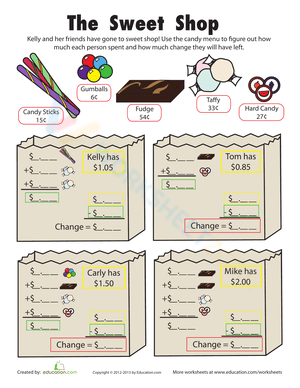
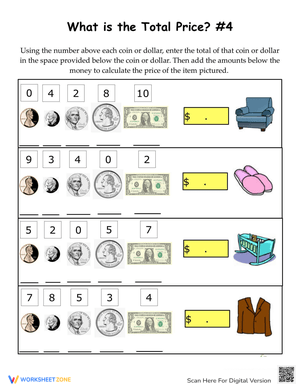
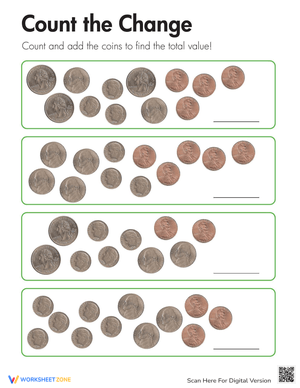
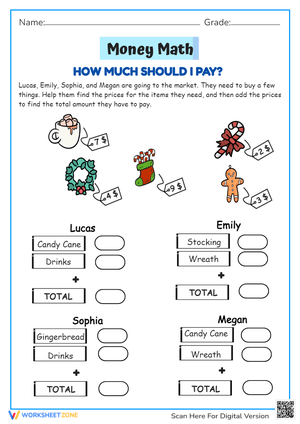
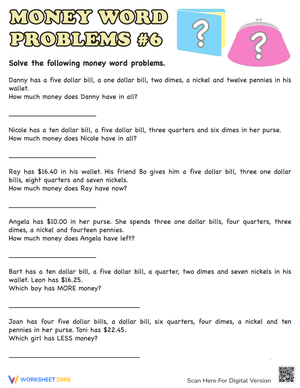
These 2nd grade adding money printable worksheets give teachers a targeted set of problems moving from like-coin addition through mixed-denomination totals and real-world purchase scenarios, all aligned to CCSS 2.MD.C.8. The set is organized so each worksheet stands alone — teachers can pull one for a morning warm-up, drop one into a math center, or use one as an exit ticket without needing to run the full set in order. The progression is deliberate: students who can skip-count by 25s and 10s separately are not automatically ready to switch between them mid-problem, and the worksheets address that gap directly.
The Skills Each Worksheet Builds
The set works through four layers of money addition that second-grade instruction typically covers in sequence. Pulling one worksheet from the right layer, rather than assigning everything at once, keeps the task matched to where a student actually is.
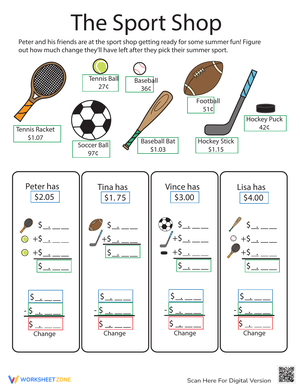
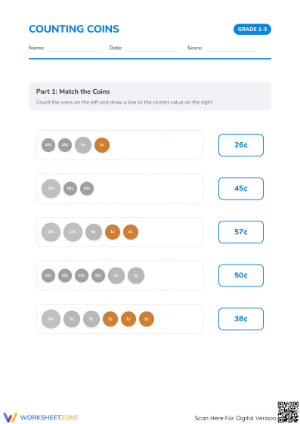
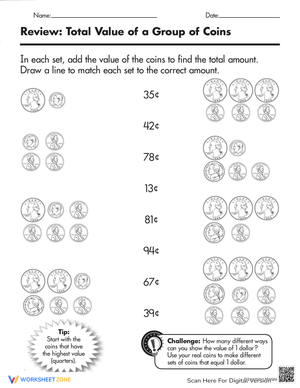
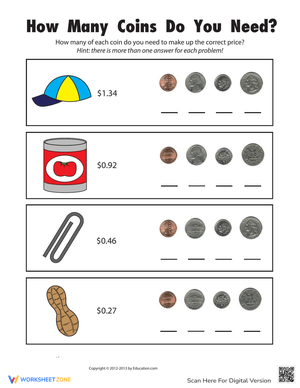
- Like-coin addition: Students total groups of nickels, dimes, or quarters before mixing denominations. This step reinforces skip-counting by 5s, 10s, and 25s in a context that feels concrete — counting actual coin values rather than abstract multiples.
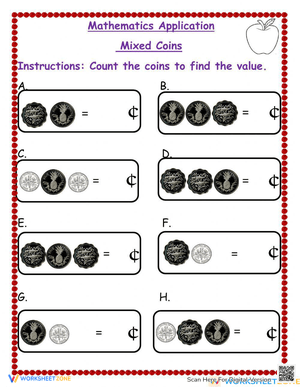
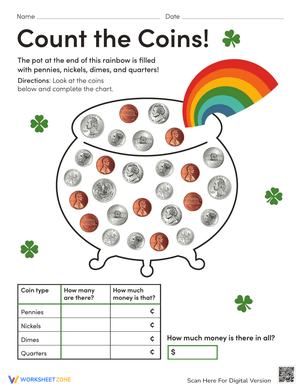
- Mixed coin sets: Students add two or more different coin types to reach a total. This requires switching skip-counting intervals mid-problem, which is the hardest cognitive jump in the sequence.
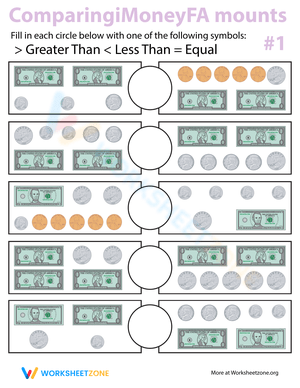
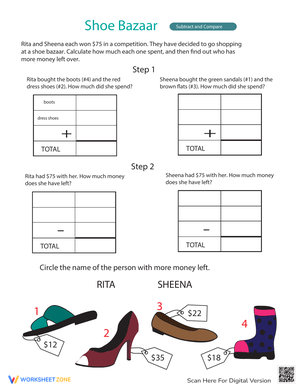
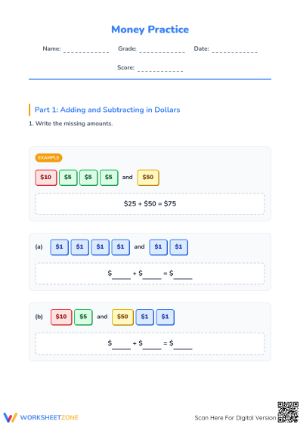
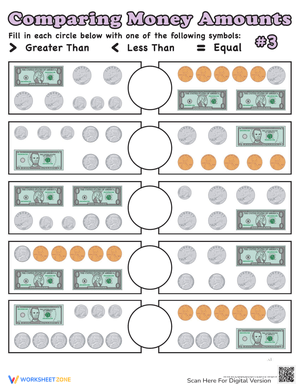
- Coins and dollar bills together: Each worksheet at this level asks students to combine whole-dollar amounts with coin totals. Even without formal decimal instruction, students begin to see the structure — 100 pennies equal one dollar the same way 10 tens equal one hundred.
- Symbol conventions: Students write totals correctly — 85¢ rather than ¢85, and $1.25 rather than $1.25¢. This procedural habit needs repeated, explicit practice to stick.
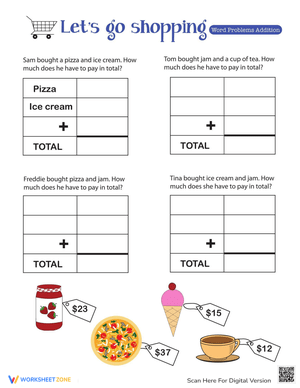
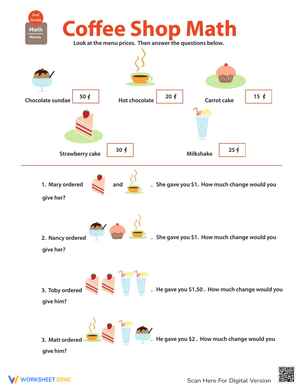
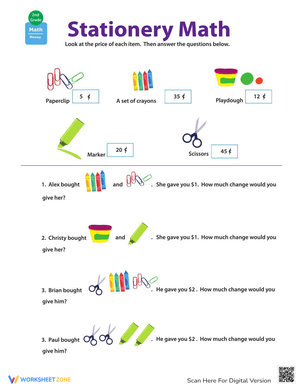
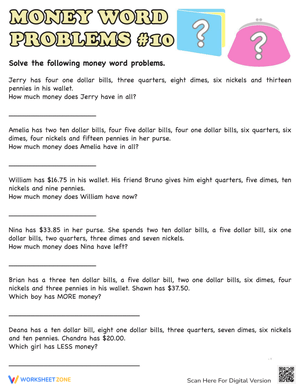
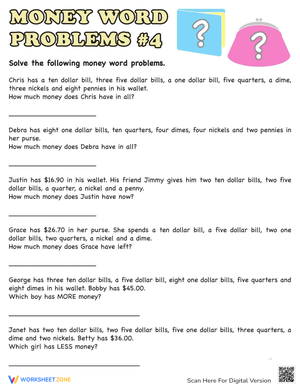
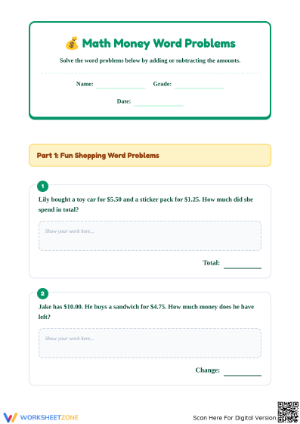
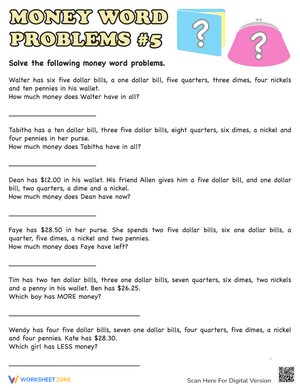
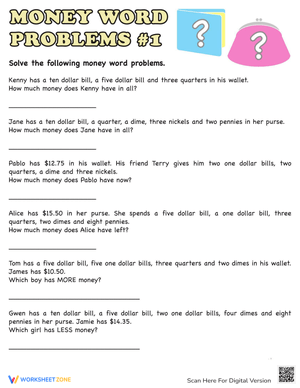
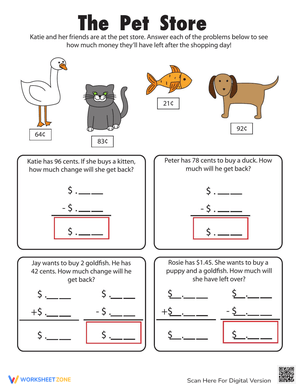
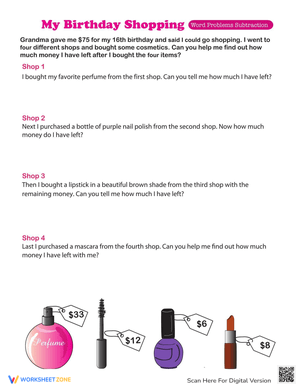
- Word problems: Contextual scenarios ask students to identify which values matter, translate the problem into an equation, and write the answer with the correct symbol. A problem like "Priya has 3 dimes and 2 nickels. She finds a quarter. How much does she have now?" requires students to track three separate amounts and combine them in order.
Frequent Student Errors Worth Watching For and Correcting
The dime-nickel confusion outlasts most teachers' expectations. Because the dime is physically smaller than the nickel, students who can recite "a dime is worth ten cents" will still hesitate — or silently reverse the values — when they see both coins on the same worksheet. This is perceptual interference, not a knowledge gap. It resolves through repeated exposure to realistic coin images paired with their values, not through re-explaining which coin is worth more.
The more instructive error happens during mixed-coin problems. A student adding two quarters and four dimes will correctly reach 50¢ on the quarters, then shift from counting by 25s to counting individual cents: 51, 52, 53, 54. That student knows a dime is ten cents in isolation — they just lose the skip-counting interval the moment the coin type changes. Students who show this pattern benefit from writing a running total after each coin before moving to the next. That small annotation step makes the interval shift visible and deliberate rather than automatic and error-prone.
Symbol placement generates a third reliable error. Second graders frequently write "$85¢" — applying both signs to the same amount — or place the cent sign before the number: "¢85." This is a logical mistake: students observe that the dollar sign precedes the number and assume the cent sign follows the same rule in reverse. Having students read each finished answer aloud before checking the symbol ("eighty-five cents, written as...") forces them to slow down at precisely the step where these errors occur.
Standard Alignment
CCSS.MATH.CONTENT.2.MD.C.8 requires students to solve word problems involving dollar bills, quarters, dimes, nickels, and pennies using the $ and ¢ symbols correctly. In classroom terms, this standard lands after students have solidified two-digit addition with regrouping — typically late winter or spring of second grade — because the arithmetic demands of mixed-coin addition require fluency that most students do not have earlier in the year. Teachers who introduce 2.MD.C.8 too early often find that students' errors are really two-digit addition errors wearing a money costume, not genuine money-reasoning gaps. Each worksheet in the set directly addresses the compose-and-decompose thinking the standard targets: students do not just total coins mechanically — they reason about value, choose a recording convention, and represent amounts accurately in writing.
Recommended Lesson-Planning Strategies for These Worksheets
The like-coin worksheets work well as five-minute warm-ups during the introductory week of a money unit — placed after morning meeting but before formal instruction begins. At that point in the day, students are available for focused practice without the cognitive weight of a full lesson already underway. The mixed-coin and word-problem worksheets fit better in a math center rotation, where students can work independently while the teacher runs a small group on the side.
For formative assessment, one worksheet at the close of a money lesson functions as an exit ticket. Two problems — one straight coin addition, one word problem — reveal whether errors are computational, perceptual (coin identification), or symbolic ($ and ¢ conventions). That distinction matters for planning the next day. A student who totals coins correctly but writes "$75¢" needs a two-minute symbol correction, not a full re-teach. A student who writes 60¢ for two quarters needs to revisit coin values before moving forward.
The 2nd grade adding money printable worksheets covering word problems also hold up well as Friday review during the weeks after the money unit closes. Dropping one worksheet into the last ten minutes of math on Friday keeps the skill active — particularly useful before spring assessment windows when money questions appear alongside other measurement and data content.
Differentiating These Worksheets Across Ability Levels
The range in readiness across a single second-grade classroom is wide enough that assigning one worksheet to every student at the same time rarely serves anyone well. These 2nd grade adding money printable worksheets are organized so teachers can pull the specific one that matches where a student currently is — one student might be working on word problems while another still needs like-coin practice on a separate worksheet.
Students who are still counting all coins from one rather than skip-counting benefit from a coin value reference strip taped to their desk while they work. The strip offloads the value-recall step so students can concentrate on the addition sequence itself. Once a student completes three problems independently and correctly, the strip comes off. Students who consistently misidentify coin names by sight — not just ordering values incorrectly mid-problem — may need more time with physical coin manipulatives before printable worksheets become productive. Rushing to paper before a student can reliably identify a quarter on sight adds a layer of difficulty that has nothing to do with the intended challenge.
For students who have the standard process down, the strongest extension is an inversion task: show a total like 67¢ or $1.35 and ask the student to find three different coin-and-bill combinations that reach it. This uses the same addition skill but reverses the problem structure, pushing students toward the flexible reasoning that 2.MD.C.8 assessment tasks often demand. A handwritten prompt in the margin of any worksheet launches the task — no extra materials required.
Frequently Asked Questions
What exact standard do these worksheets address?
The set targets CCSS.MATH.CONTENT.2.MD.C.8, which requires second graders to solve word problems involving dollar bills, quarters, dimes, nickels, and pennies using the $ and ¢ symbols correctly. Each worksheet in the set is built around the compose-and-decompose reasoning that standard demands, not just mechanical coin totaling.
Do the worksheets cover dollar bills or only coins?
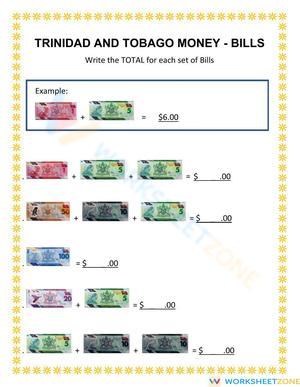
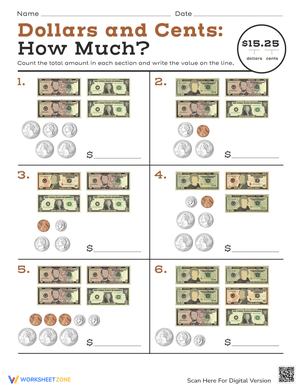
Both. Earlier worksheets focus on coins alone. Later ones introduce one- and five-dollar bills alongside coins, so students practice writing totals in both ¢ and $ formats before the unit ends.
How do these connect to the two-digit addition students are already practicing?
Working through these 2nd grade adding money printable worksheets gives students the same arithmetic as standard two-digit addition — adding 35¢ and 25¢ is adding 35 and 25 — but in a context that makes regrouping feel purposeful rather than procedural. Ten dimes become one dollar the same way ten tens become one hundred. Teachers who run these alongside a place-value unit often find the money context gives students a concrete reason to regroup instead of treating it as an abstract rule they are supposed to memorize.
Can these be sent home for family practice?
Yes. The PDF format prints clearly on standard paper, and the coin images remain large enough to identify on a basic home printer. Each worksheet includes enough context in its own instructions that a parent or caregiver can support a student without needing additional materials from the teacher.













 Interactive Worksheet Maker
 Quiz Maker
 Word Search Maker
 Crossword Puzzle Maker
 Word Scramble Generator
 Sentence Scramble Generator
 Handwriting Worksheet Generator
 Name Tracing Generator
 Fill In The Blank Generator