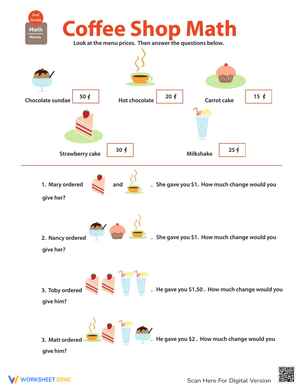
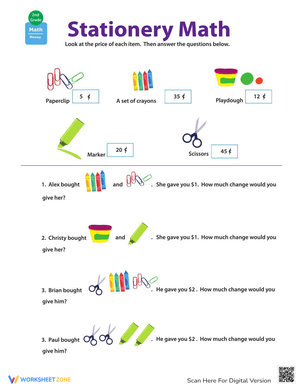
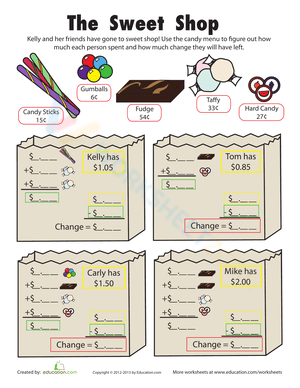
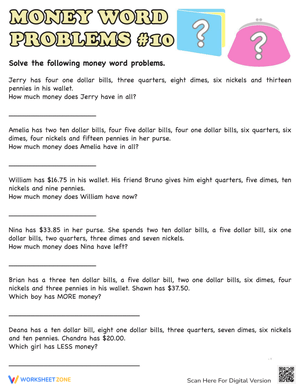
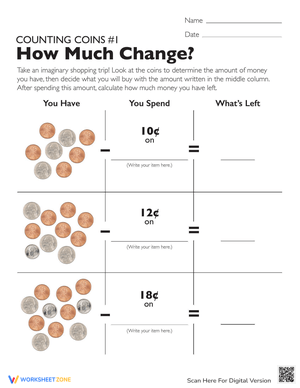
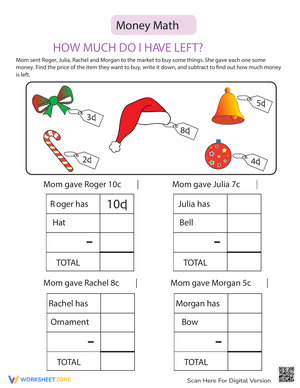
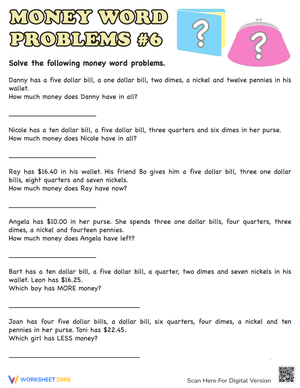
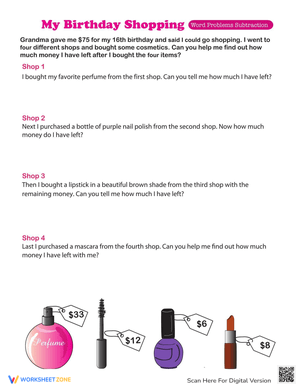
These 2nd grade subtracting money worksheets give teachers a direct path from whole-number subtraction into the messier work of currency math — the kind of targeted practice students need before they can reliably make change or compare two prices without counting on their fingers. The set covers cent-only problems, dollar-and-cent subtraction with and without regrouping, and word problems framed around familiar buying situations. Each worksheet stands alone, so you can assign exactly what a group is ready for rather than working through a fixed sequence.
The Specific Skills Students Work Through
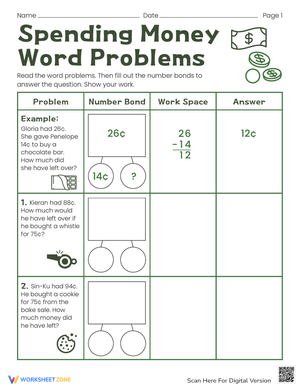
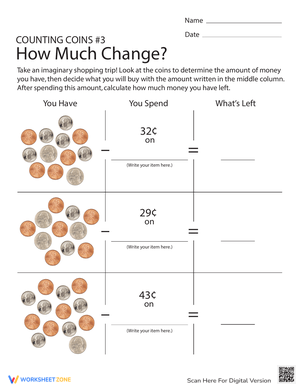
Early worksheets keep everything in cents — subtracting 27¢ from 83¢, for instance — so students can practice the standard subtraction algorithm without the decimal point adding visual noise. Once that format feels automatic, the worksheets shift to dollar-and-cent notation and the alignment rule that trips up so many second graders: decimal points stack vertically, and the answer's decimal point drops straight down. Later worksheets bring in regrouping across zeros, which is the sharpest skill spike in the set. A problem like $1.00 − $0.68 requires borrowing across two columns simultaneously, and that is where most second graders noticeably slow down.
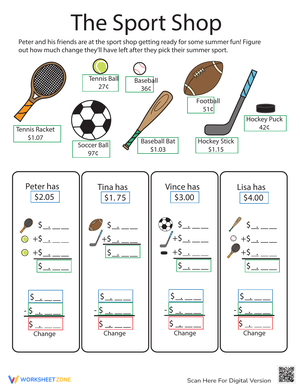
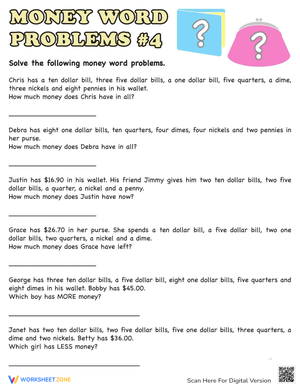
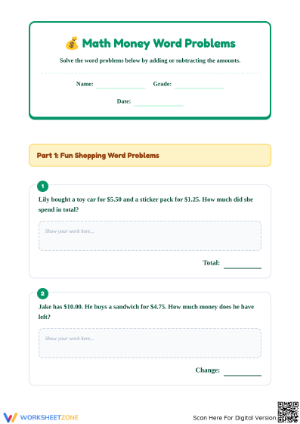
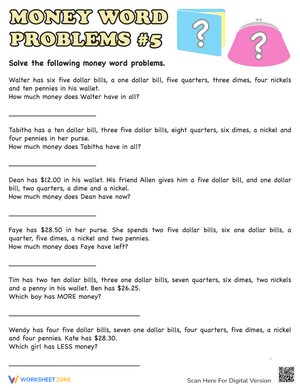
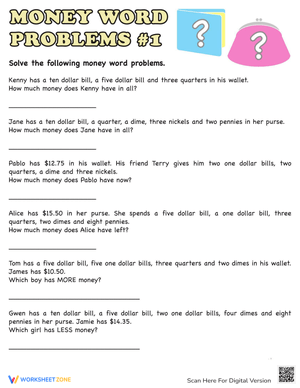
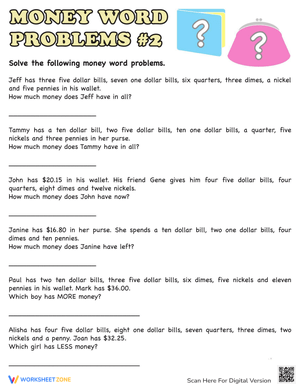
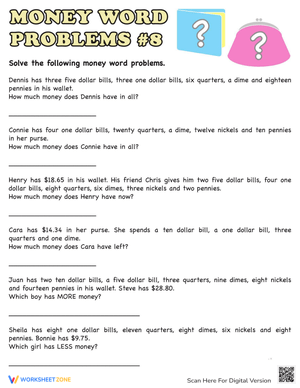
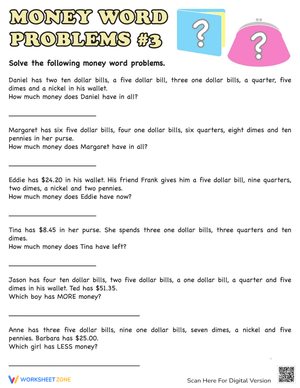
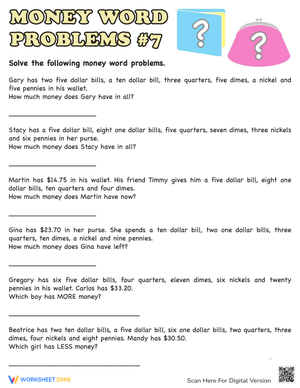
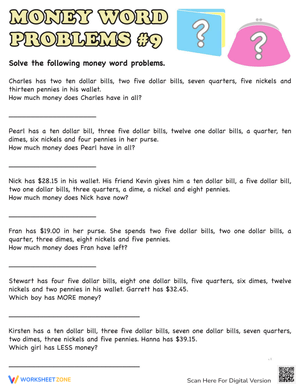
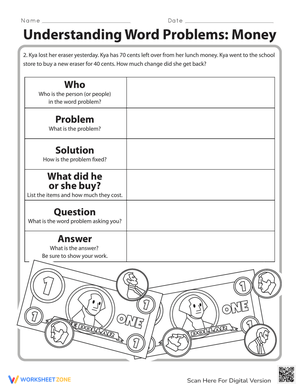
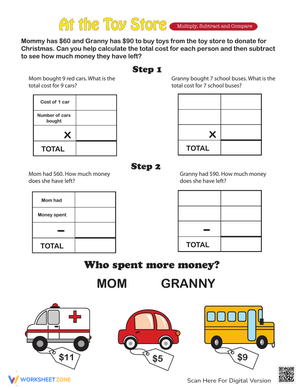
Word problems appear throughout the set rather than only at the end. Students read short scenarios — buying a pencil, comparing two snack prices, calculating what's left after a school store purchase — and must identify the correct operation themselves. That decision step, distinguishing a "how much more?" problem from a "what's the total?" problem, is a reading-comprehension task as much as a math task, and regular exposure to these problem types builds both capacities at once.
Student Mistakes Worth Knowing Before You Hand These Out
The most consistent error in second-grade money subtraction work is misaligned decimal points. Students who have been doing whole-number subtraction in a lined notebook will write $1.35 directly beneath $0.78 without pausing to think about column position. The result is a subtraction attempt where the 1 lands in the ones column instead of the dollars column, producing a nonsense answer the student accepts without question. Several worksheets in this set include a pre-drawn alignment grid — two columns with a center dot — that removes this problem entirely for students who need that visual anchor.
A second error shows up specifically with whole-dollar minuends. When a problem reads $2.00 − $1.47, students frequently write $0.47, subtracting only the cents and leaving the dollar portion untouched. They're treating the cents as a separate calculation rather than reading the entire amount as a single number. The fix that actually works: ask the student to rewrite $2.00 as 200 cents and $1.47 as 147 cents, complete the subtraction as a plain whole number (53), then reattach the cent label. That small reframing keeps the student's attention on the borrowing procedure instead of splitting it between the mechanics and the notation rules.
Building These Worksheets Into Your Week
The most efficient use of a 2nd grade subtracting money worksheets is as a Monday warm-up after morning meeting, especially during the two weeks following initial money subtraction instruction. One worksheet at the start of class re-activates the algorithm before new content begins and surfaces students who lost ground over the weekend — the ones still crossing out zeros incorrectly, or forgetting to regroup entirely. That five-minute diagnostic moment shapes your small-group pulls for later in the day without requiring a separate assessment.
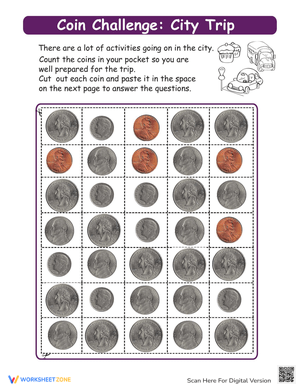
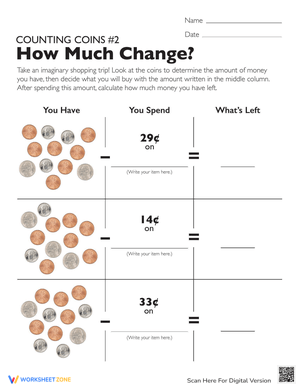
For math centers, consider pairing one worksheet with a small tray of play coins. Students solve a problem on paper, then physically count out the answer in coins to check their work. When the paper answer and the coin count disagree, students have to locate the error themselves rather than just receiving a correction. That self-checking loop is more instructionally productive than answer keys for most second graders because it requires them to explain the discrepancy, not just acknowledge it.
The word-problem worksheets function well as a five-minute exit ticket at the close of a money lesson. Three problems give a clear read on who can apply the algorithm in a new context versus who can only execute it when the equation is pre-formatted. That distinction drives your next lesson's grouping decisions better than a unit test will.
Standard Alignment
CCSS.MATH.CONTENT.2.MD.C.8 requires second graders to solve word problems involving dollar bills, quarters, dimes, nickels, and pennies, using the $ and ¢ symbols appropriately. This standard sits in the Measurement and Data domain rather than Operations and Algebraic Thinking, which signals that the expectation is applying subtraction inside a money context — not isolated computation. These worksheets address that framing directly: problems use realistic coin and bill combinations, require correct symbol placement, and stay within amounts second graders actually encounter — mostly under $5.00, with a small number of problems reaching $10.00 for students who are ready.
Adjusting the Set for the Range in Your Room
For students still shaky on basic two-digit subtraction, start them on the cent-only worksheets and stay there until borrowing with whole numbers feels automatic. Rushing to the decimal format before that groundwork is in place creates two simultaneous problem sources — the algorithm and the notation — and it becomes very difficult to identify which one is causing the error. Keep a set of base-ten blocks within reach. Physically modeling 83¢ as 8 rods and 3 cubes, then removing 27¢, makes the regrouping action visible before it becomes abstract.
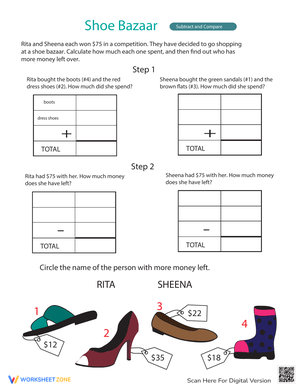
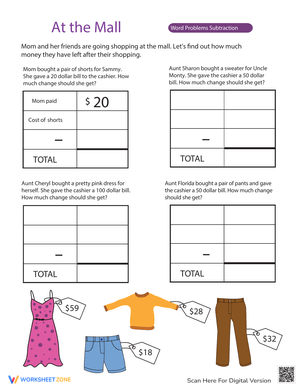
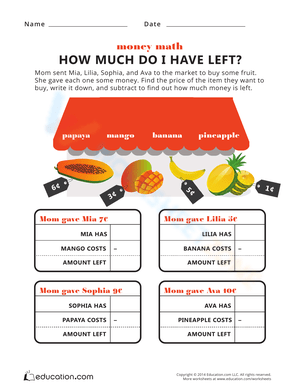
Students who arrive already comfortable with the algorithm need problems where the numbers are not pre-formatted for them. Write two money amounts on an index card — say, $3.15 and $1.78 — and ask them to set up and solve the problem entirely on their own without an alignment guide. Move those students to the word-problem worksheets quickly. Several problems in that group include a small table of item prices, requiring students to select the correct values before subtracting — that extra interpretation step keeps the work substantive for faster finishers without adding a separate assignment to manage.
Frequently Asked Questions
Can I use these worksheets with students who haven't been formally introduced to the decimal point yet?
Yes, with a deliberate sequencing choice. Start those students exclusively on the cent-only worksheets, where everything is expressed as a plain number followed by the ¢ symbol. The subtraction algorithm they practice there is identical to what they'll use with dollar-and-cent notation — the only change introduced later is the decimal placement rule. When you're ready to make that transition, a 2nd grade subtracting money worksheets that clearly separates cent-only problems from dollar-and-cent problems makes it easy to point directly to the connection between the two formats rather than presenting them as different topics.
How do I handle "subtract from a whole dollar" problems without losing the class?
Temporarily drop the dollar sign and decimal point. Present $1.00 − $0.35 as 100 − 35 on the board. Students complete the subtraction (65), and then reintroduce the notation: "65 cents, written as $0.65." This keeps the borrowing procedure — the genuinely difficult cognitive work — completely separated from the formatting rules. Most second graders can borrow from a 1 across two zeros once they stop staring at a dollar sign they associate with complexity. Reattaching the currency symbols after the calculation produces a confidence moment that carries directly into the next similar problem.
Are these worksheets better suited to in-class practice or homework?
Both settings work, but with different constraints. In class, you can catch decimal misalignment in real time, before it becomes a habit. At home, a student can repeat the same regrouping error across an entire worksheet without realizing it. If you assign a 2nd grade subtracting money worksheets for homework, choose one that focuses on a problem type the student has already practiced with you — not first exposure to regrouping across zeros. Reserve the harder borrowing worksheets for class time where you can step in quickly when the errors start.













 Interactive Worksheet Maker
 Quiz Maker
 Word Search Maker
 Crossword Puzzle Maker
 Word Scramble Generator
 Sentence Scramble Generator
 Handwriting Worksheet Generator
 Name Tracing Generator
 Fill In The Blank Generator