


























Views
Downloads


3-Digit Addition with Regrouping | Essential Grade 2-3 Math
Paste this activity's link or code into your existing LMS (Google Classroom, Canvas, Teams, Schoology, Moodle, etc.).
Students can open and work on the activity right away, with no student login required.
You'll still be able to track student progress and results from your teacher account.
This comprehensive math worksheet helps students master three-digit addition with regrouping through a structured, multi-page approach. Students move from basic computation with visual scaffolds to complex word problems and logic-based missing digit puzzles. By completing these exercises, learners build the computational fluency required for advanced arithmetic and real-world mathematical applications.
At a Glance
- Grade: 2-3 · Subject: Math
- Standard:
CCSS.MATH.CONTENT.2.NBT.B.7— Add within 1000 using strategies based on place value and properties of operations- Skill Focus: 3-Digit Addition with Regrouping
- Format: 5 pages · 28 problems · Answer key included · PDF
- Best For: Independent practice and formative assessment
- Time: 30–45 minutes
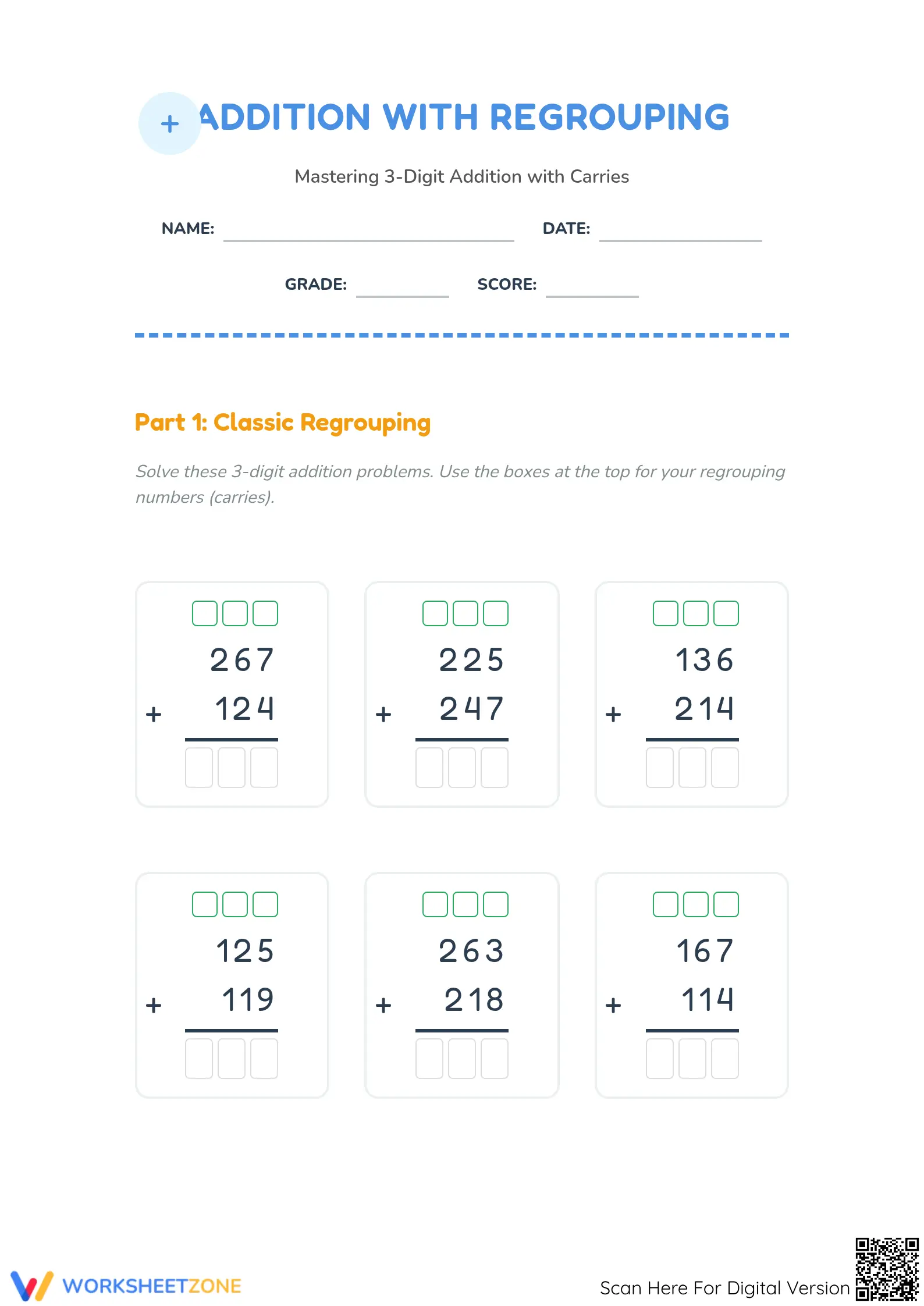
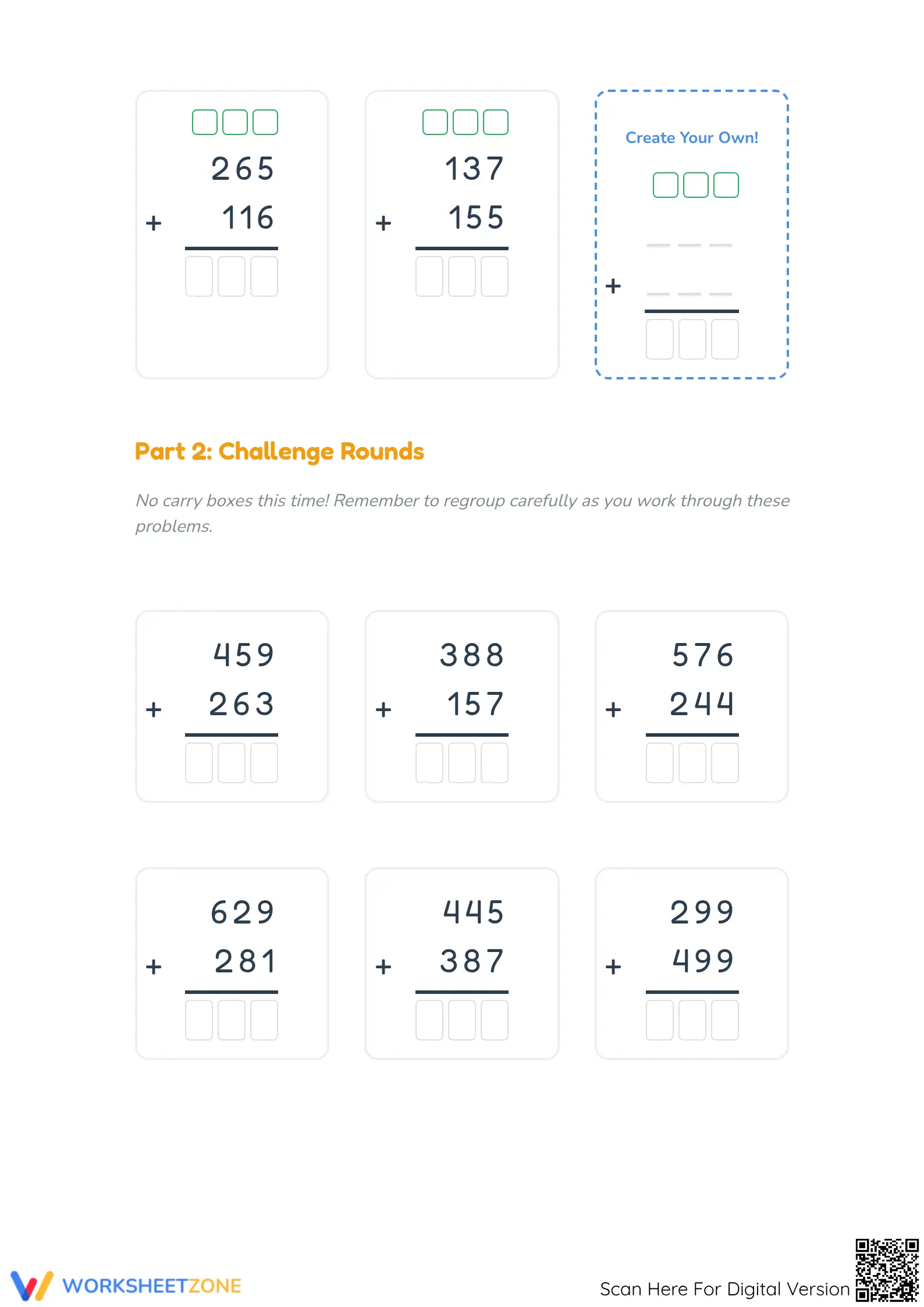
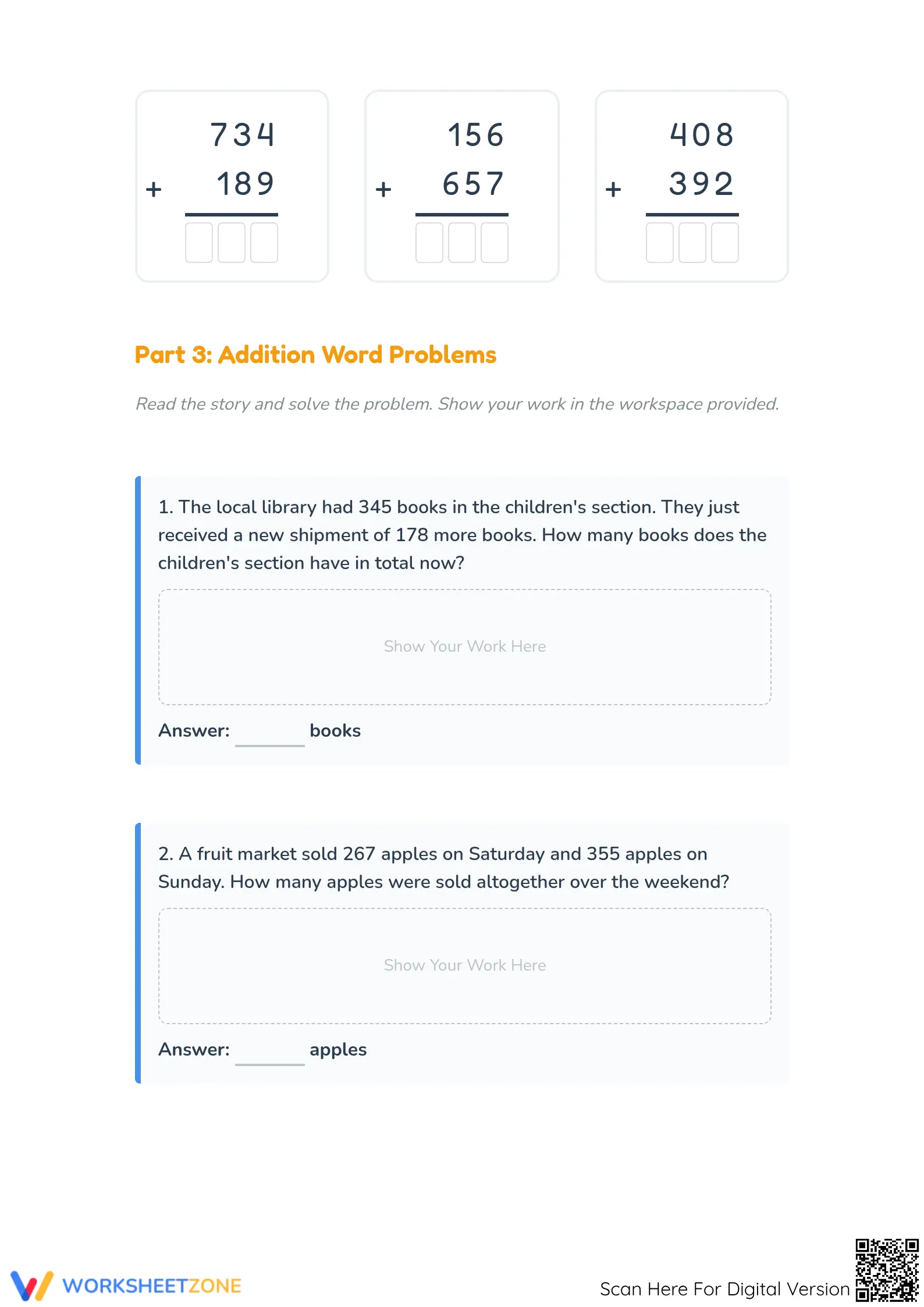
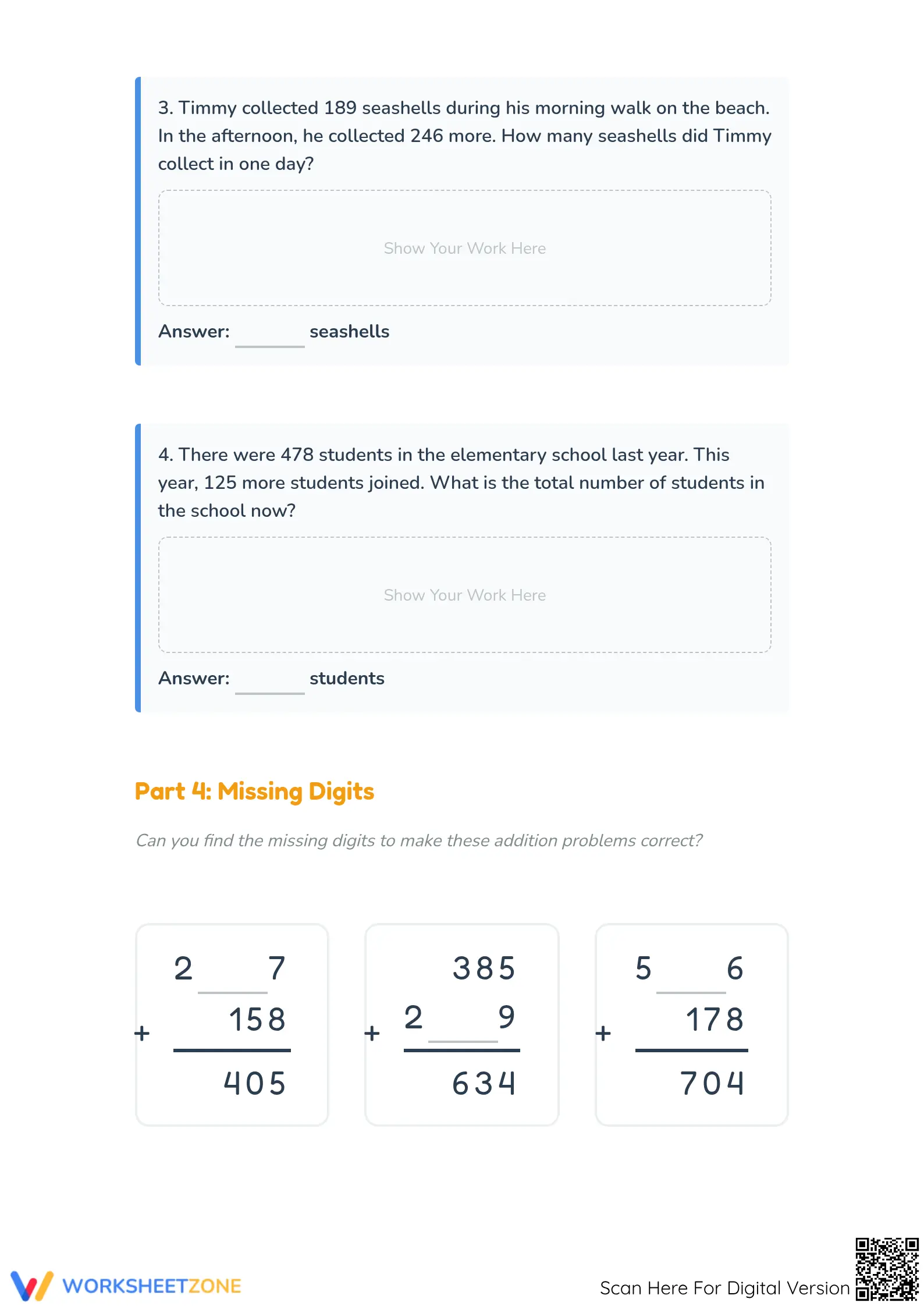
The packet contains five distinct pages of content designed to reinforce place value concepts. It includes 17 vertical addition problems, 4 detailed word problems, and 6 "Missing Digit" challenges that require higher-order thinking. A "Create Your Own" section allows for student agency, while a full five-page answer key ensures quick and accurate grading for teachers or parents.
Skill Progression
- Guided Practice: The first page provides explicit carry boxes above the hundreds, tens, and ones columns to scaffold the regrouping process for 8 initial problems.
- Supported Practice: The "Challenge Rounds" remove the carry boxes, requiring students to mentally track regrouped values across 9 vertical addition tasks.
- Independent Application: The final sections transition to word problems and missing digit puzzles, forcing students to apply their skills in non-routine contexts.
This gradual-release model follows the "I Do, We Do, You Do" instructional framework to ensure student confidence and procedural mastery.
Standards Alignment
The primary focus is `CCSS.MATH.CONTENT.2.NBT.B.7`, which requires students to add within 1000 and understand that in adding three-digit numbers, one adds hundreds and hundreds, tens and tens, ones and ones. It also supports `CCSS.MATH.CONTENT.3.NBT.A.2` by building fluency in addition within 1000. Both standard codes can be copied directly into lesson plans, IEP goals, or district curriculum mapping tools.
How to Use It
Use this resource during the "Independent Practice" phase of a lesson on multi-digit addition. It works effectively as a multi-day center activity where students complete one page per day. For formative assessment, observe students during the "Missing Digits" section to identify if they understand the inverse relationship between addition and subtraction. Completion typically takes 30 to 45 minutes.
Who It's For
This resource is designed for second-grade students introduced to regrouping and third-grade students needing fluency intervention. It serves English Language Learners well through its clear vertical formatting and minimal text in the computation sections. Pair this worksheet with base-ten blocks or a place value anchor chart to support students who struggle with the abstract nature of carrying.
This 3-digit addition resource aligns with the CCSS.MATH.CONTENT.2.NBT.B.7 standard, focusing on the procedural fluency and conceptual understanding of place value regrouping. Research from Fisher & Frey (2014) emphasizes the importance of the gradual release of responsibility, which this worksheet mirrors by transitioning from scaffolded carry boxes to independent word problems. By providing 28 varied tasks, the material ensures sufficient repetition to move skills from short-term working memory into long-term mastery. According to the RAND AIRS 2024 report, high-quality instructional materials that integrate both computational drill and contextual application, such as word problems, significantly improve student outcomes in early elementary mathematics. This worksheet provides that balance, offering teachers a reliable tool for both instruction and formative assessment. The inclusion of missing digit puzzles further supports algebraic thinking, a key component of modern standards-based math curricula designed to prepare students for middle school mathematics and complex problem-solving.


