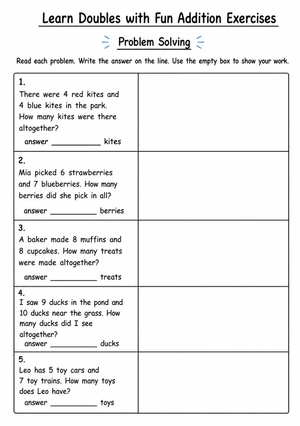
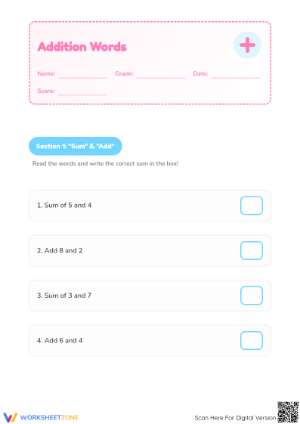
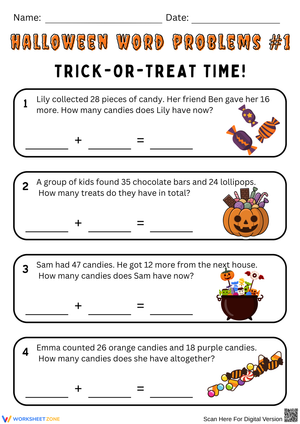
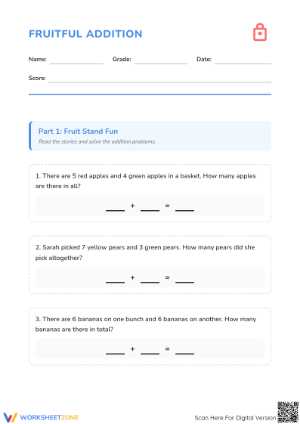
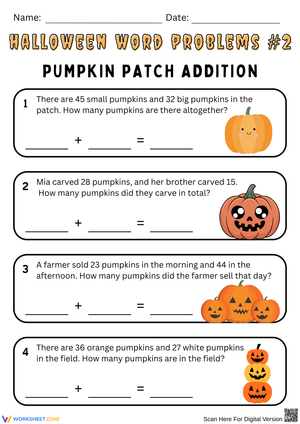
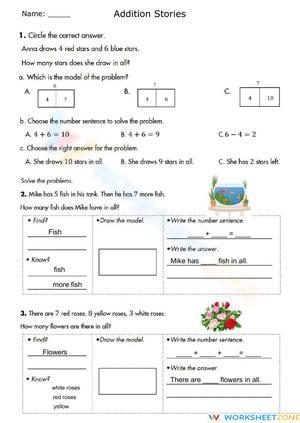
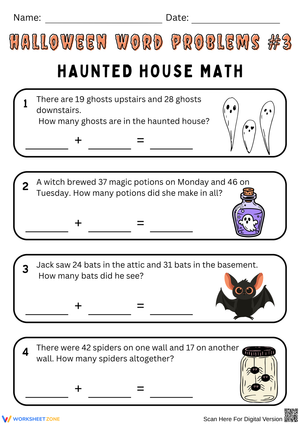
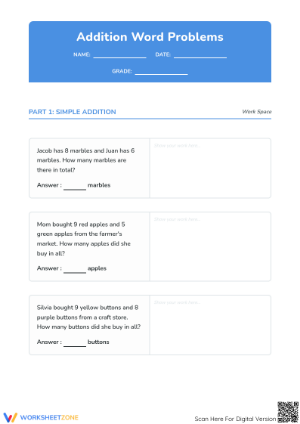
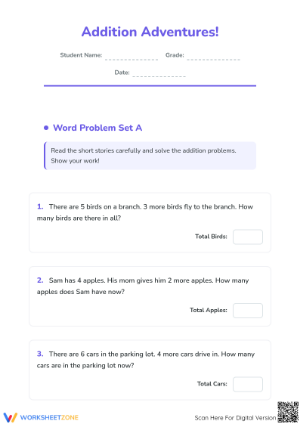
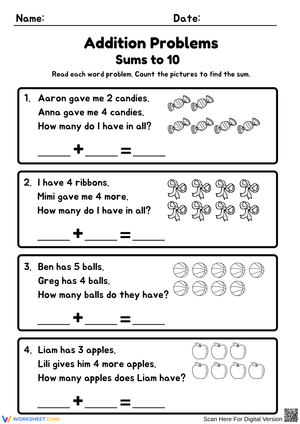
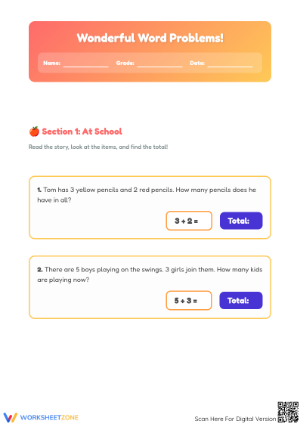
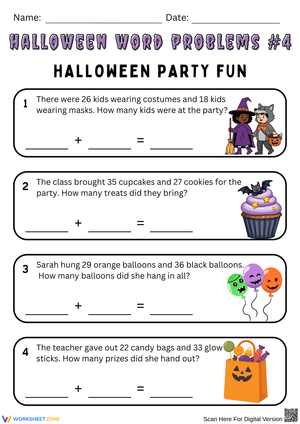
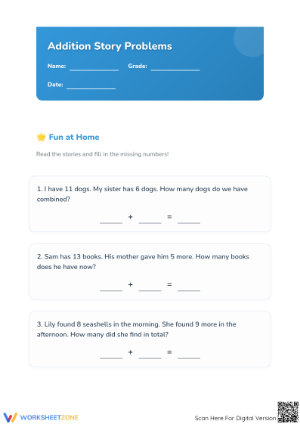
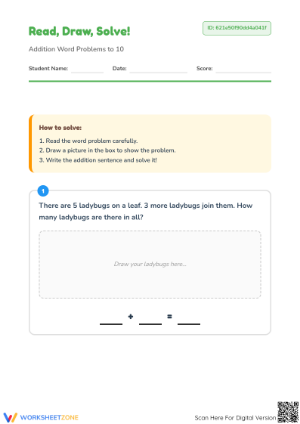
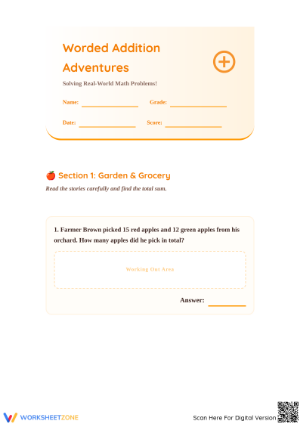
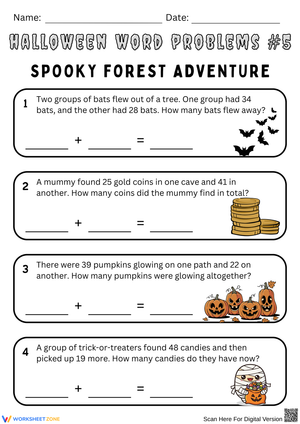
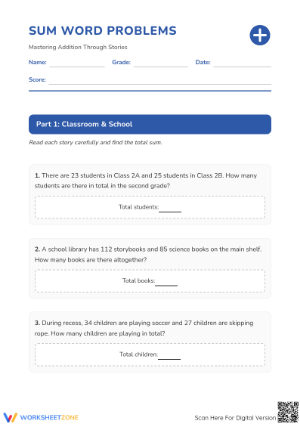
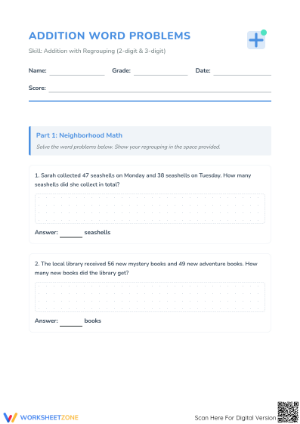
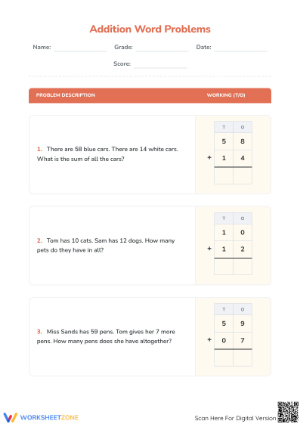
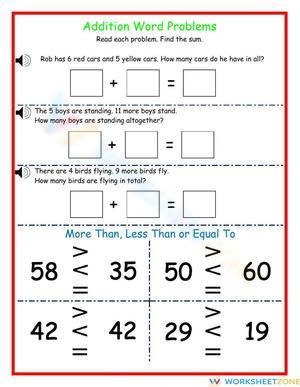
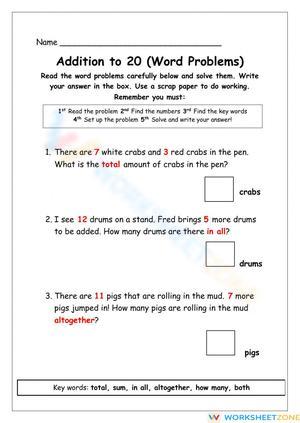
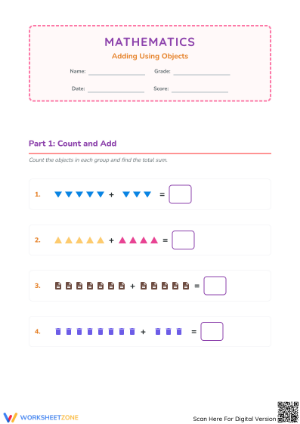
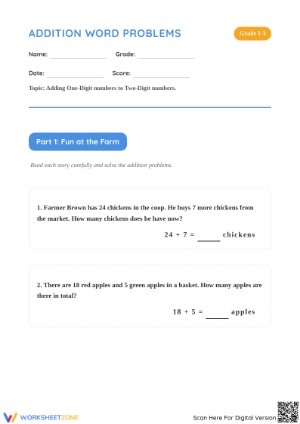
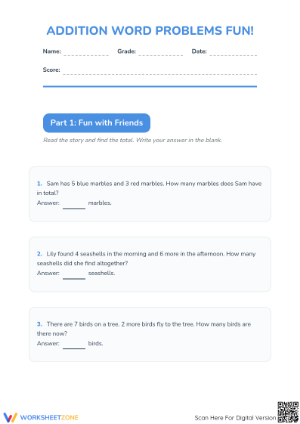
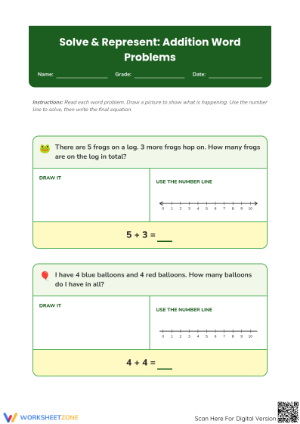
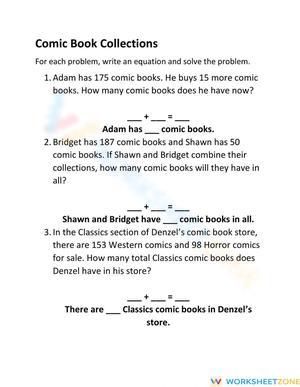
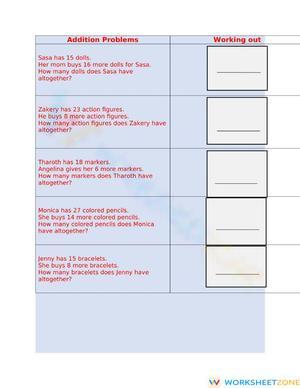
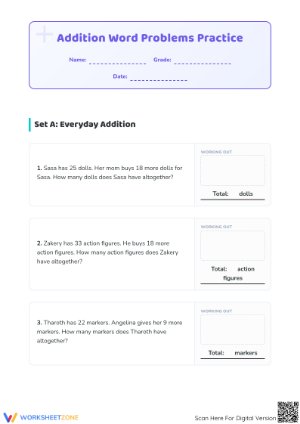
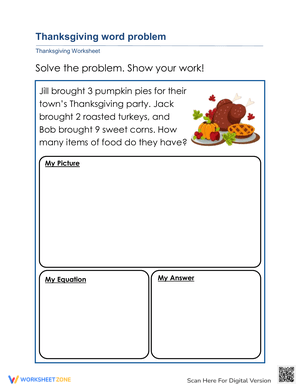
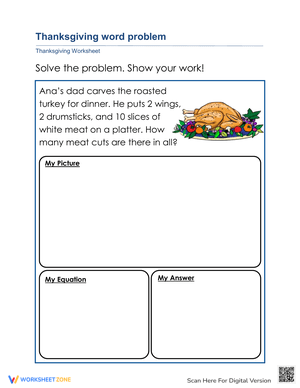
These addition word problem printable worksheets for 2nd grade address the precise moment in the year when students know their basic facts reasonably well but still freeze the moment a story wraps around those numbers. Each worksheet moves students from the equation format they're comfortable with into the messier, more meaningful territory of applied math — the kind that shows up on every benchmark and state assessment from 2nd grade onward.
The Three Problem Structures Students Work Through
Not every word problem asks the same question, and students who have only practiced result-unknown problems tend to fall apart the first time they encounter a change-unknown or start-unknown situation. The set covers all three structures within the addition context, and that variety is the pedagogical point.
- Result unknown: The starting amount and the change are both given; students find the total. These are the most intuitive and serve as the entry point for less confident students.
- Change unknown: Students know where a situation started and where it ended up, but must figure out what was added. A problem might read: "Mia had 14 stickers. Now she has 31. How many did she get?" Students must resist the pull to subtract and recognize this as a missing-addend situation.
- Start unknown: The initial quantity is missing. Students see the change and the result and must work backward — which at 7 and 8 years old requires genuine algebraic reasoning before they've learned to call it that.
Rotating through all three structures within the same week — rather than spending a week on each in isolation — pushes students to read the problem first and decide on the operation, rather than pattern-match to whatever type they practiced yesterday.
Mistakes Students Make That These Worksheets Surface Early
The most consistent error we see across 2nd grade classrooms is what might be called number harvesting: a student reads the problem, circles every digit on the worksheet, and adds them all together regardless of role. A problem that reads "Ben had 12 crayons. He gave 3 to his friend and then found 5 more under his desk. How many does he have now?" frequently produces an answer of 20 because the student added 12, 3, and 5 without attending to structure. These worksheets surface that error quickly because problem types alternate, which makes the harvest strategy fail visibly and opens a conversation about why it failed.
Start-unknown problems produce a different but equally common mistake. Students often read "Some birds were on a fence. Six more landed. Now there are 19. How many were there at first?" and write 25 as their answer — they spot the join action and add both numbers they can see. Having students draw a tape diagram before writing any equation slows that impulse and gives them somewhere to mark what they know versus what they need to find.
How to Build These Worksheets Into Your Instructional Week
Early in a word problem unit, use each worksheet as a whole-group task rather than independent work. Display the problem, have students annotate it — underline the question, circle the numbers, mark any information that isn't needed — then discuss before anyone writes an equation. The annotation routine takes the first week to establish but cuts independent-work errors noticeably afterward, because students stop reading problems for numbers and start reading them for meaning.
Later in the unit, the same addition word problem printable worksheets for 2nd grade work well in math stations. Print on cardstock and slip into dry-erase sleeves so students can reuse them across multiple rotations without consuming paper. For the last ten minutes of a math block — when students are too tired for new instruction but still need something productive — use a single worksheet as a quick written-response exit task. It gives you immediate data on who understood the lesson and who is still guessing the operation.
Two-step problems deserve their own pacing decision. When introducing them, require students to write the answer to step one as a complete sentence — "There are now 23 children at recess." — before they begin step two. That physical pause prevents the most common two-step error: adding all three numbers in one expression because the student never acknowledged the intermediate answer.
Standard Alignment
These worksheets align to CCSS.MATH.CONTENT.2.OA.A.1, which requires students to use addition and subtraction within 100 to solve one- and two-step word problems involving situations of adding to, taking from, putting together, taking apart, and comparing. The addition word problem printable worksheets for 2nd grade in this set target specifically the "adding to" and "putting together" problem types across all three unknown positions — result, change, and start. This standard sits at the front of the 2nd grade Operations and Algebraic Thinking cluster, so the worksheets work best introduced mid-year, once students have consolidated addition facts within 20 and are extending to sums within 100. Using them before that fluency is solid often means students exhaust their working memory on the arithmetic and have nothing left for the problem structure.
Adjusting the Set for a Range of Learners
For students who are still shaky on the computation itself, keep a number line or hundred chart on the desk during word problem work. The goal at this stage is that students correctly identify the operation and set up the equation — the hundred chart removes the arithmetic barrier so you can assess the reasoning separately from the calculation. That separation matters because a student who sets up 14 + ? = 31 correctly but miscounts deserves different feedback than a student who writes 14 + 31 and doesn't understand why that's wrong.
Students who move through result-unknown problems quickly can be handed the change-unknown and start-unknown worksheets in the same session rather than waiting for the class. You can also extend any problem by asking students to rewrite it with a different unknown — turning a result-unknown problem into a change-unknown version of the same scenario requires genuine understanding of how the numbers relate, not just a procedural solution written and forgotten.
For students receiving reading support, read the problem aloud once while they follow along, then let them reread independently. The comprehension demand in these worksheets is intentional — understanding what a story is asking is part of the standard — but students with decoding challenges should not be misread as struggling in math because of a reading barrier.
Frequently Asked Questions
Should I teach keyword strategies for identifying addition?
Keyword strategies work in the short term and cause real problems by mid-year. Students trained to trigger off in all or altogether will add numbers in subtraction problems the moment they find those words. A more durable approach is teaching students to describe what is happening in the story — are two groups joining? is something being added to a set? — and then match that action to an operation. The addition word problem printable worksheets for 2nd grade in this set use natural story language rather than keyword-heavy phrasing, which pushes students to read for meaning rather than hunt for trigger words.
How many word problems should students work through in one session?
Two to four problems per session is the practical ceiling for most 2nd graders when you require annotation, drawing, and a labeled answer. More than that tends to produce rushed work — students write "8" instead of "8 apples" — because they're trying to finish rather than reason. Each worksheet contains enough problems to fill a focused 15-to-20-minute block without hitting the fatigue point where quality collapses.
When in the year do two-step problems make sense?
Most 2nd graders are ready to attempt two-step addition problems after January, once they have reliable fluency with addition within 100 and a consistent strategy for single-step problems. Introducing two-step problems before that point produces students who add all the numbers in the problem together — not because they don't understand the story, but because they have no working memory left for the problem structure after performing the computation for step one. Waiting until fluency is solid means students can spend their cognitive effort where it belongs: on figuring out what the problem is actually asking.













 Interactive Worksheet Maker
 Quiz Maker
 Word Search Maker
 Crossword Puzzle Maker
 Word Scramble Generator
 Sentence Scramble Generator
 Handwriting Worksheet Generator
 Name Tracing Generator
 Fill In The Blank Generator