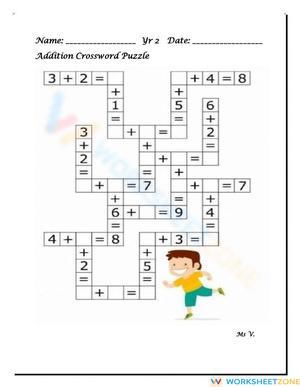
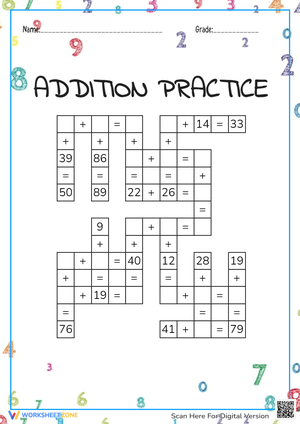
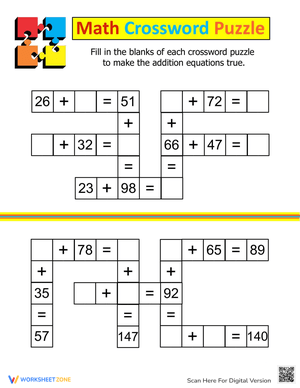
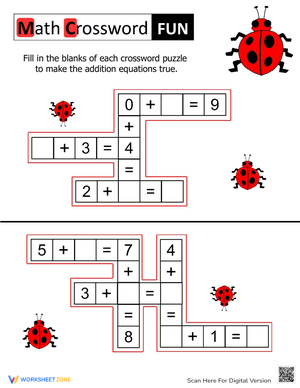
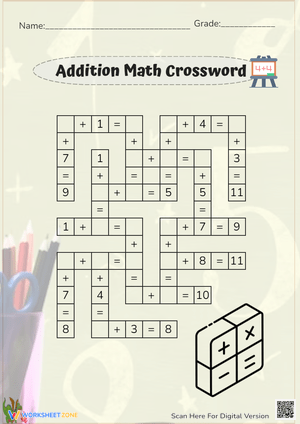
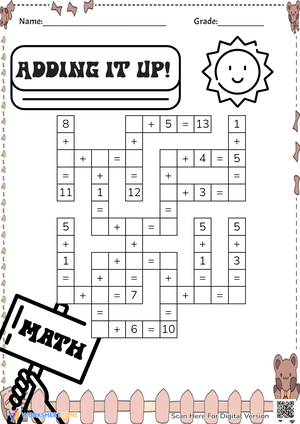
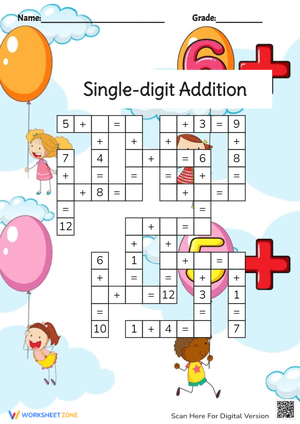
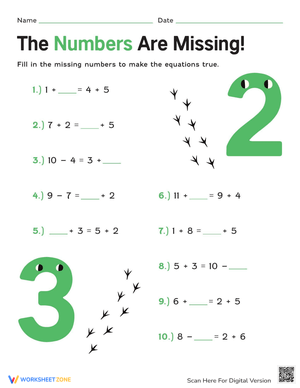
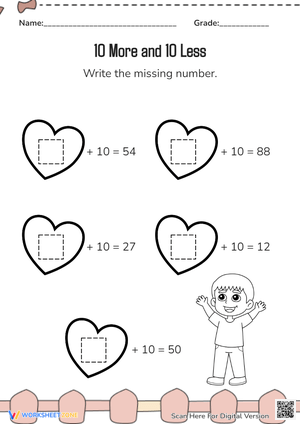
2nd grade missing addends printable worksheets give students their first real encounter with algebraic thinking — not as an abstract concept, but as a concrete puzzle with a deliberate missing piece. The equation 8 + ? = 15 looks nothing like the column addition students have been drilling since first grade, and that structural difference is exactly what makes it developmentally significant. What teachers get here is a set of standalone worksheets that move across number ranges and problem positions, building the kind of flexible number sense that carries directly into multiplication, division, and formal algebra.
The Skills These Worksheets Build
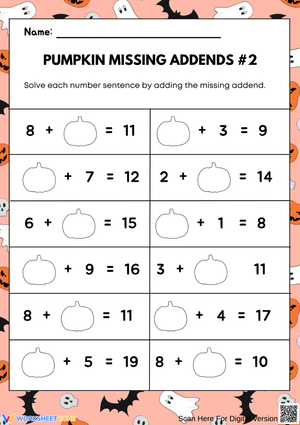
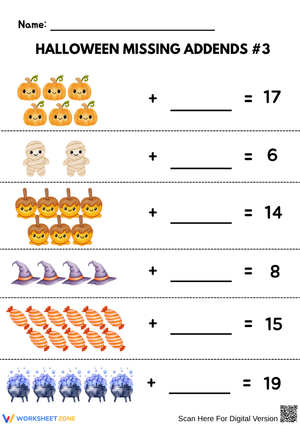
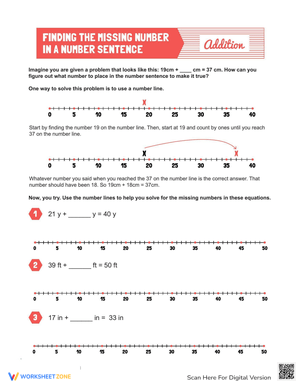
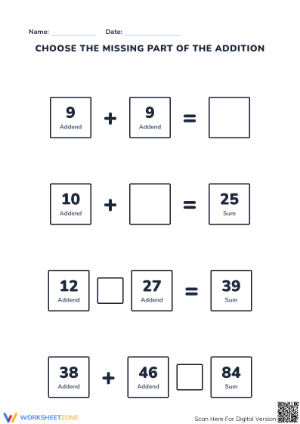
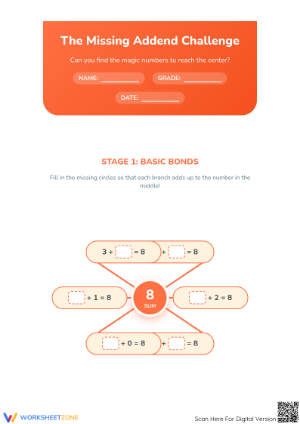
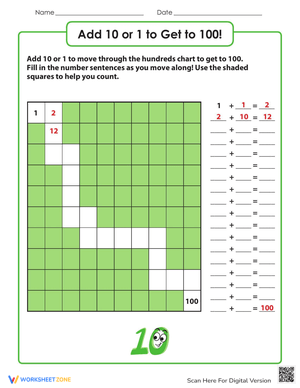
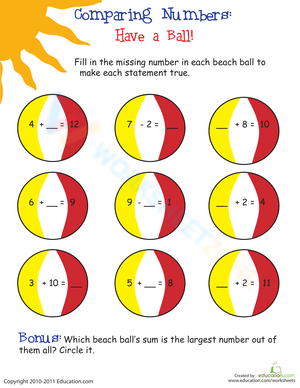
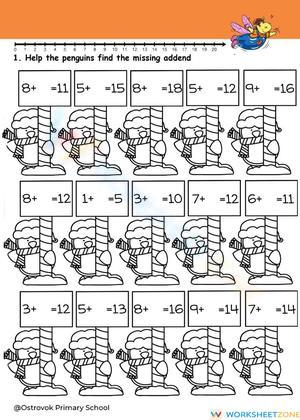
Each worksheet focuses on identifying the unknown number in an addition sentence — the unknown positioned as the first addend, the second addend, or occasionally embedded in a word problem where the structure isn't flagged by a visible box. The number ranges move from sums within 20 up to two-digit equations with regrouping, depending on which worksheet in the set a teacher selects. Students work with multiple strategies across the collection: counting on from the known addend, using number lines, applying subtraction as the inverse operation, or reasoning through a part-part-whole diagram. Several worksheets pair symbolic equations with visual models — tape diagrams and part-whole boxes — so students who cannot yet hold both quantities in working memory have a concrete starting point that doesn't require them to abandon the problem.
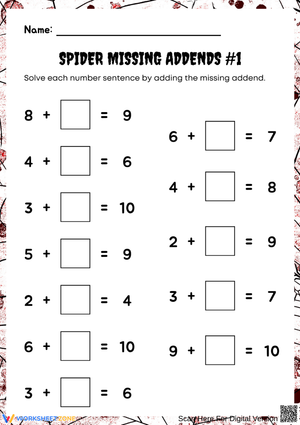
- Single-digit addends with sums within 20, with and without ten-frame support
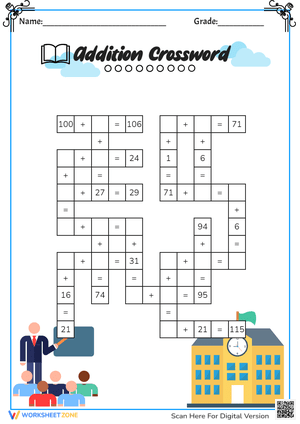
- Two-digit addends, sums within 100, no regrouping
- Two-digit addends requiring regrouping, for students ready to extend
- Missing first-addend problems, which consistently trip up students who have only practiced missing second-addend formats
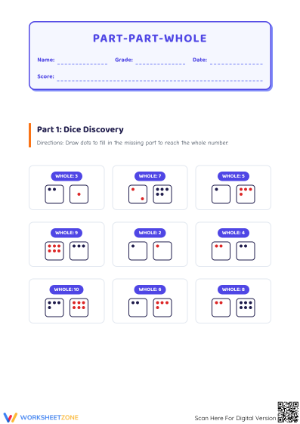
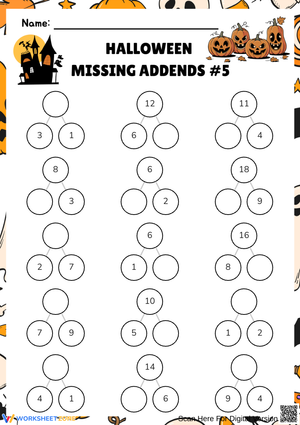
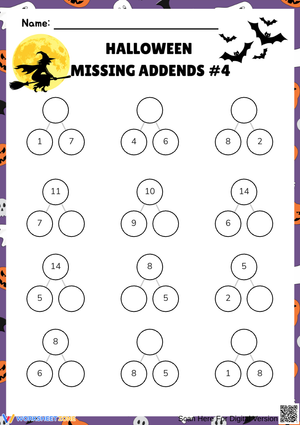
- Part-part-whole diagrams paired with number sentences on the same worksheet
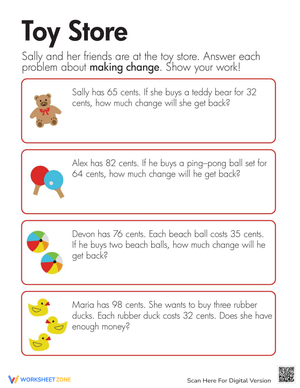
- Short word problems where the unknown is embedded in context rather than marked by a visible box
Mistakes Students Make That These Worksheets Help Teachers Catch
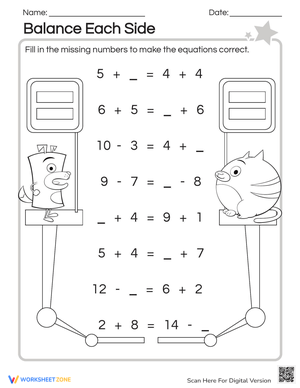
The most persistent error at this level is students treating the equals sign as a signal to do something rather than as a symbol of balance. A second grader who has only ever seen equations written as 5 + 3 = __ will look at 8 + ? = 15 and write 23 — they added both visible numbers because combining both numbers is the only pattern they know. When every problem in a column of a completed worksheet follows this same error, the paper tells you exactly what the misconception is before the student says a word.
A second gap surfaces specifically when the unknown falls in the first position. Students who can reliably solve 9 + ? = 16 by counting up from 9 will stall at ? + 9 = 16. They have internalized "start from the known addend and count up," but that strategy requires knowing which quantity to start from — and when the unknown is on the left, they don't know where to begin. A common result: they double the visible number (writing 9 + 9 = 18) or leave the box empty. Worksheets that alternate the unknown position within the same set surface this gap quickly, which is far faster than identifying it through oral questioning during whole-group time.
Standard Alignment
The set addresses 2.OA.A.1 — the Operations and Algebraic Thinking standard requiring students to use addition and subtraction within 100 to solve one- and two-step word problems with unknowns in all positions. The phrase "unknowns in all positions" is the instructional spine of that standard, and it maps directly to the structural variety built across these worksheets. Missing addend work also reviews 1.OA.D.8, which matters for teachers doing targeted review at the start of second grade when students arrive with uneven fact fluency. The connection to 2.OA.B.2 — the fluency standard for addition and subtraction — is equally direct: a student who solves 9 + ? = 16 by recalling 16 minus 9 is drawing on the same mental retrieval that fluency practice targets.
How to Work These Worksheets Into Your Lesson Plans
These resources fit naturally at the start of a math block as a warm-up — short enough that students can finish one worksheet in the first ten to twelve minutes before whole-group instruction opens, and the results give real-time information about where the class stands before teaching begins. During small-group time, two or three students can work through the same worksheet while the teacher sits alongside, watching where pencils pause. That hesitation before a two-digit problem is often more diagnostic than the final answer written in the box.
The 2nd grade missing addends printable worksheets in this set also serve cleanly as exit tickets. A single problem — 27 + ? = 64, for example — handed to students in the last four minutes of a lesson takes roughly forty seconds per paper to read afterward and tells you whether the day's instruction landed. When the error rate on those slips runs above half the class, returning to the part-part-whole worksheet the following morning is a reliable re-entry point before moving forward.
Adjusting the Set for a Range of Learners
For students still building fluency within 10, start with the worksheets that keep sums at or below 20 and include ten-frame diagrams. The visual support reduces the cognitive load of holding both quantities in memory simultaneously, so students can direct their attention to the structural concept — finding the missing part — rather than managing two unfamiliar demands at once. Pull the ten-frame support only when a student can explain, without prompting, why their answer makes the equation balance.
Students ready for a greater challenge can work through the two-digit worksheets without visual models, then write their own missing addend equations for a partner to solve. That generation task — constructing a valid equation with a deliberate unknown — demands a stronger grasp of number relationships than solving a given equation does. One worksheet in the set introduces two unknowns in the same equation (? + ? = 18, find three different solutions), which pushes into early combinatorial thinking without leaving the addition context.
For students with IEPs or significant language processing needs, 2nd grade missing addends printable worksheets that include visual models and reduce the problem count lower the working memory load without changing the mathematical concept. Cutting a ten-problem worksheet to five problems and allowing a number line reference keeps those students engaged with the same reasoning their peers are practicing, just with fewer simultaneous demands.
Frequently Asked Questions
What exactly is a missing addend, and how does it differ from a standard addition problem?
In a standard addition problem, students know both addends and find the sum: 6 + 9 = __. A missing addend problem gives students the sum and one addend, and they identify the other: 6 + __ = 15. The difference matters because it asks students to reason about the relationship between a part and a whole rather than combining two known parts. It also directly addresses the equals sign as a balance symbol rather than a place to record a computed result — a conceptual shift that has long-term consequences for how students read and write equations.
Can second graders use subtraction to solve missing addend problems?
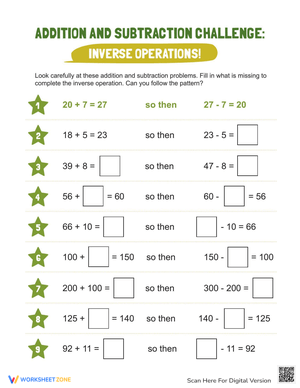
Yes, and teaching students to use subtraction explicitly is one of the most effective instructional moves at this level. When a student sees 8 + ? = 21, rewriting it as 21 - 8 = ? gives them a familiar operation to execute. The 2nd grade missing addends printable worksheets include equation formats that prompt students to record the related subtraction fact alongside their answer, which reinforces the inverse relationship and strengthens subtraction recall at the same time — two benefits from one practice format.
How do I know when a student is ready to drop the visual models and work with equations only?
The clearest signal is whether students use the diagram or ignore it. Once a student consistently skips the ten-frame or part-whole box and solves the equation directly, the visual support has served its purpose. Move that student to a worksheet without embedded models and check whether accuracy holds on two-digit problems specifically. If it drops there, the issue is usually working memory demand rather than conceptual misunderstanding — a smaller number range is the right adjustment, not a return to diagrams.
Are these worksheets meant for the beginning, middle, or end of a missing addends unit?
Different worksheets in the set serve different points in the unit. Those with sums within 20 and visual support belong at the opening. Worksheets with two-digit addends and no diagrams fit the middle and end. The word-problem worksheets and the two-unknown format are summative tools — they reveal whether students can apply the concept in an unfamiliar context, which is the clearest measure of whether the understanding has genuinely transferred.













 Interactive Worksheet Maker
 Quiz Maker
 Word Search Maker
 Crossword Puzzle Maker
 Word Scramble Generator
 Sentence Scramble Generator
 Handwriting Worksheet Generator
 Name Tracing Generator
 Fill In The Blank Generator