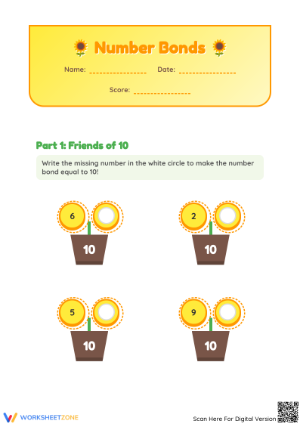
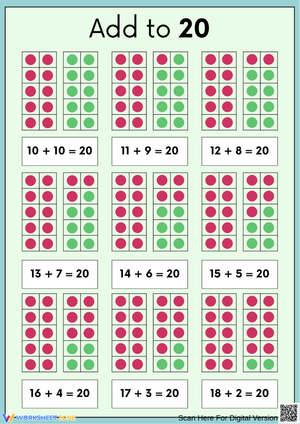
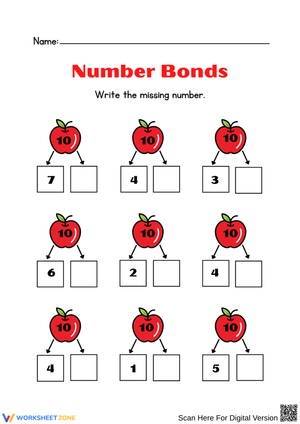
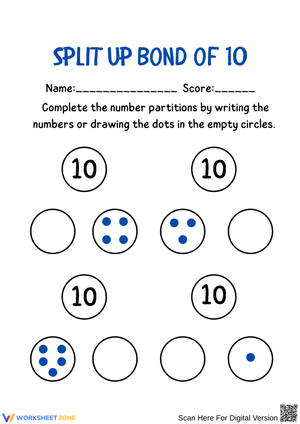
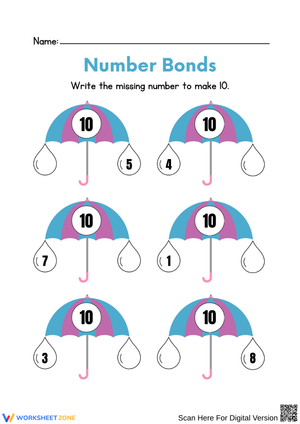
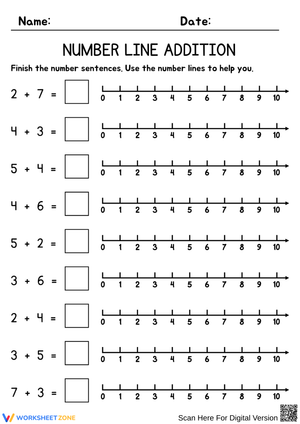
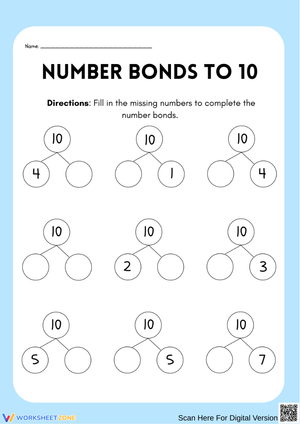
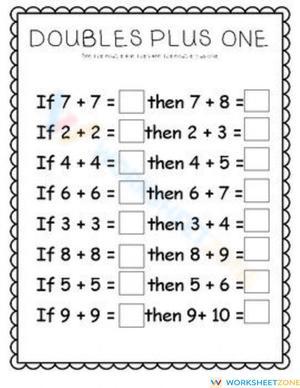
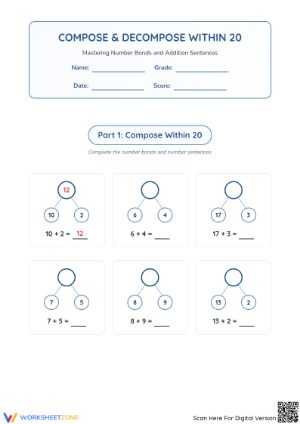
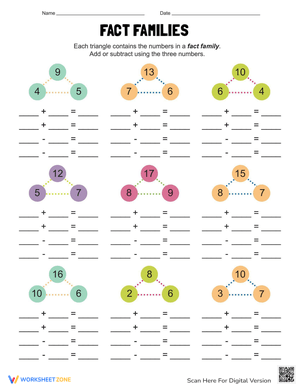
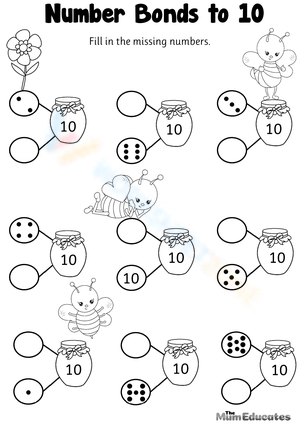
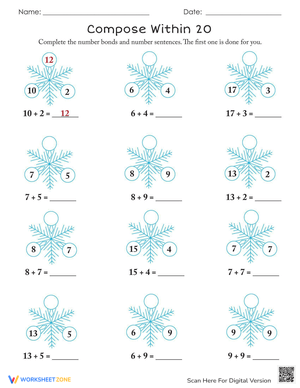
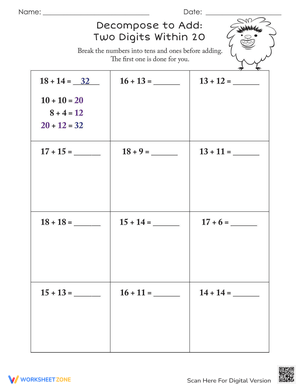
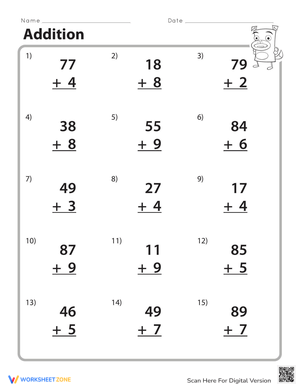
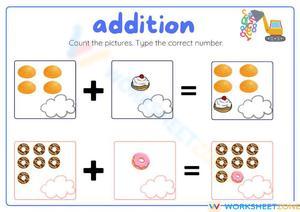
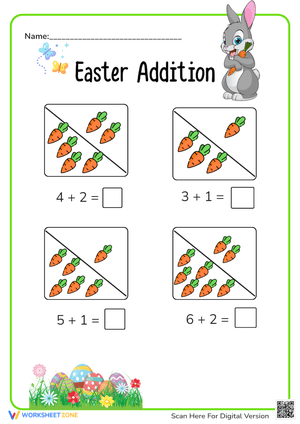
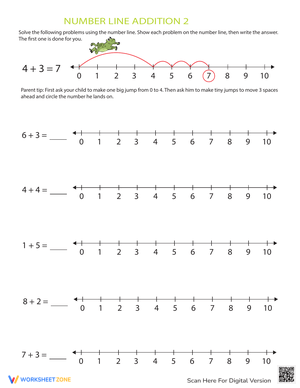
2nd grade addition strategies printable worksheets give teachers a focused set of practice tools for the specific methods second graders need to move past counting on fingers and toward genuine number sense. The set covers making ten, open number lines, partial sums, and base-ten block drawings — the four strategies that appear most consistently across current second-grade math curricula. Teachers get resources they can drop into math centers, small-group sessions, or homework folders without spending time building the materials themselves.
The Strategies Each Worksheet Targets
Each worksheet focuses on one method, keeping the practice tight enough that students understand exactly what they are rehearsing and why. The four strategies in the set are:
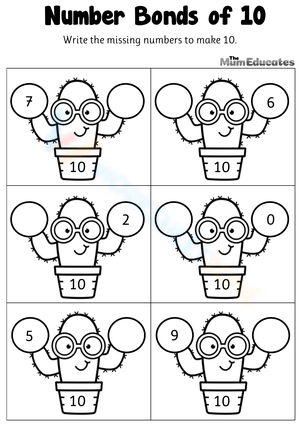
- Making ten: Students identify how much the first addend needs to reach ten, pull that amount from the second addend, and add the remainder. For 8 + 5, they move 2 from the 5 to bridge 8 to 10, then add the remaining 3. Ten frames on each worksheet make the structure visible rather than abstract.
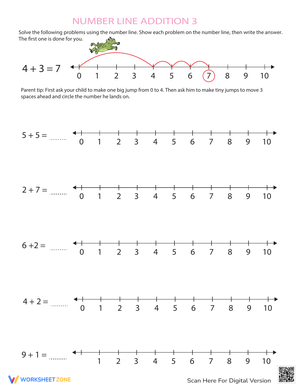
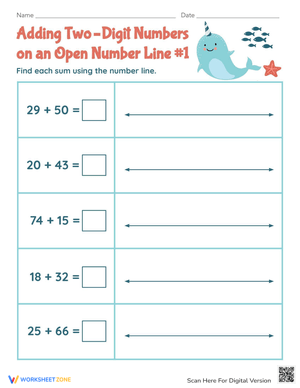
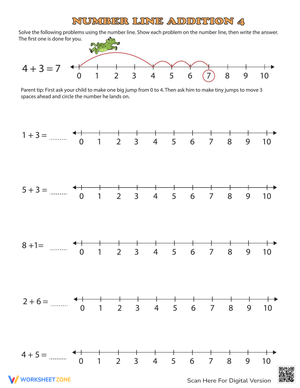
- Open number lines: Students mark a starting number on a blank line and draw forward hops, deciding whether to jump by tens or ones depending on the problem. The format requires active planning — students have to choose their jumps — rather than filling in a preset template.
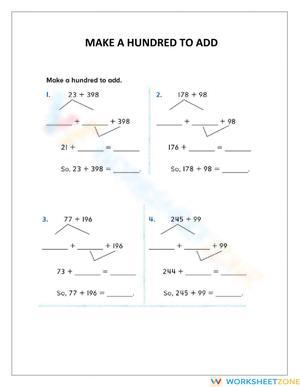
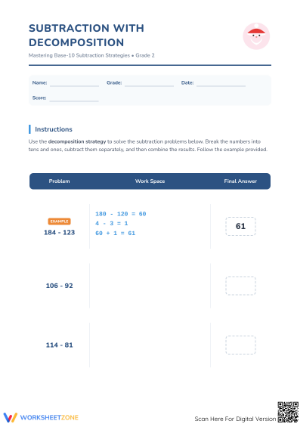
- Partial sums: Students decompose each addend into tens and ones, add the tens together, add the ones together, and then combine both partial results. For 45 + 32, that means (40 + 30) + (5 + 2) = 70 + 7 = 77. Every step demands real place-value understanding rather than procedural mimicry.
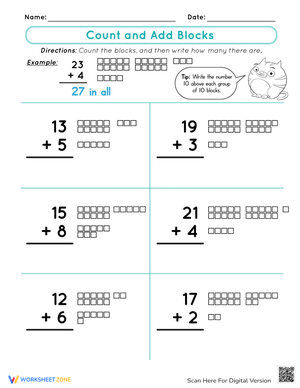
- Base-ten block drawings: Students draw tens rods and ones units to represent each addend before combining them into a total. This sits closest to physical manipulatives and works as the natural entry point for students who still need a visual count to feel confident.
Where Student Errors Surface and What to Watch For
The making-ten strategy produces a specific, recurring error that disappears in whole-class work but shows up clearly in written practice. When students work through 8 + 6, they correctly note that they need 2 more to reach ten and pull that 2 from the 6. Then, writing the second part of the equation, they write 10 + 6 = 16 instead of 10 + 4 = 14. The original addend stays in working memory and overwrites the adjusted remainder. Having students record every step on the worksheet makes this visible where it would otherwise stay hidden inside a student's mental calculation.
Open number line worksheets reveal a different pattern: students frequently count the starting number as their first jump. For 34 + 20, a student marks 34 on the line, counts "35" as one, and arrives at 53 instead of 54. The answer is close enough that students rarely question it. With partial sums, the predictable mistake is stopping before the final step — students correctly compute 40 + 30 = 70 and 7 + 2 = 9, then write "70, 9" as two separate answers rather than combining them into 79. That error appears in roughly a third of student work the first week they encounter the method, and it is worth addressing directly before it becomes a habit.
Standard Alignment
These 2nd grade addition strategies printable worksheets target 2.NBT.B.5 directly: fluently add and subtract within 100 using strategies based on place value, properties of operations, and/or the relationship between addition and subtraction. This standard sits in second grade because it marks the shift from counting-based methods — which work for small numbers but fail as quantities grow — to place-value-based thinking that scales. Crucially, the standard calls for fluency through strategies, not through one prescribed algorithm, which is why practicing four distinct methods serves 2.NBT.B.5 more thoroughly than drilling a single procedure. The base-ten drawing and partial sums worksheets also reinforce 2.NBT.A.1, since understanding that tens and ones are distinct units is the conceptual foundation every strategy builds on.
Fitting These Worksheets Into Your Week
The 2nd grade addition strategies printable worksheets in this set work especially well for a three-strategy comparison exercise mid-unit. Pick a two-digit addition problem — something like 36 + 47 — and have students solve it on three different worksheets: open number line, partial sums, and base-ten block drawings. Staple the three together and ask which approach felt most efficient for that specific problem. Even five minutes of class discussion around that question builds more strategic flexibility than completing a full set of identical problems in one strategy.
For Monday morning warm-ups, the open number line worksheet reliably reactivates prior knowledge after the weekend — the visual structure guides students back into the strategy without requiring a full re-teach. During math centers rotations, assigning one strategy per station keeps practice focused. The making-ten station stays most concrete and works well as the entry point for students who need more time before moving to abstract computation. In small-group guided math, the base-ten block drawing worksheet is the clearest starting point: drawing tens rods and units together with four or five students gives immediate, visible feedback on who understands decomposition and who is still counting every unit individually.
Tiering the Practice for Different Points of Readiness
A set of 2nd grade addition strategies printable worksheets has a built-in differentiation advantage: the progression from concrete to abstract is already embedded in the strategies themselves. Base-ten block drawings stay closest to physical manipulatives. Making ten with ten frames adds one layer of abstraction. Open number lines require students to plan hops without visual groupings. Partial sums demand full symbolic work without picture support. Teachers can assign students to the right entry point without needing separate materials — the sequencing is already there.
For students who grasp the methods quickly, harder numbers are rarely the right push. A better extension: give them the same problem solved correctly on two different worksheets and ask them to write one sentence explaining which method is more efficient and why. That task demands flexible mathematical reasoning in a way that extra computation does not. For students who need more support, the ten-frame and base-ten drawing worksheets carry the most meaning visually, reducing language load without lowering the mathematical expectation.
Frequently Asked Questions
Which strategy should I introduce first?
Start with base-ten block drawings. They stay closest to the physical manipulatives students may already know, and decomposing numbers into tens and ones is the conceptual foundation every other strategy builds on. Once students can draw and count tens rods and ones units accurately, the logic of partial sums — and even making ten — becomes significantly more intuitive.
How do I know when a student is ready to stop relying on visual models?
Watch for students who draw the ten frame or number line but do not look at it while they work — they are solving from memory and using the drawing as a formality. That is the signal. Move them to a partial sums worksheet with no visual models and see if accuracy holds. If it does, they are moving toward the mental fluency 2.NBT.B.5 expects.
Does the standard require students to master all four strategies?
No. 2.NBT.B.5 asks for fluency through strategies based on place value — it does not mandate a specific set of methods. The goal is for every student to have at least one reliable strategy that makes sense to them. What these worksheets give you is usable classroom data: you can see which strategies are working for which students and adjust instruction accordingly.
Can I use these worksheets with first or third graders?
The making-ten and base-ten drawing worksheets work as extension material for first graders who are ahead on 1.OA standards. Third graders who came in without solid place-value foundations — which happens more than curriculum timelines assume — can use the open number line and partial sums worksheets for targeted review. The number range goes up to 100, so the material does not feel too elementary for that age group.













 Interactive Worksheet Maker
 Quiz Maker
 Word Search Maker
 Crossword Puzzle Maker
 Word Scramble Generator
 Sentence Scramble Generator
 Handwriting Worksheet Generator
 Name Tracing Generator
 Fill In The Blank Generator