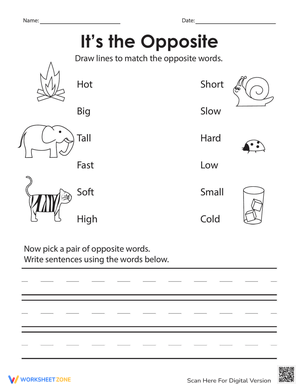
Effective Antonym Instruction: Using Printable Opposites Worksheets for 2nd Grade Literacy Centers
These opposites printable worksheets for 2nd grade give students repeated, focused contact with antonym pairs at the stage when vocabulary growth accelerates most sharply. Each worksheet targets a specific task type — matching, sentence completion, word-bank sorting — so teachers can slot them into literacy rotations, morning warm-ups, or small-group review without any prep beyond printing.
What Each Worksheet Targets
Second grade is when students begin connecting words by meaning rather than by sound or letter pattern, and antonym instruction sits directly at the center of that shift. These worksheets move students past obvious pairs like hot/cold and big/small toward the descriptive vocabulary that shows up in grade-level texts: ancient/modern, generous/selfish, graceful/clumsy. The progression matters — students who only practice concrete sensory pairs are underprepared for the figurative and evaluative language they encounter in both nonfiction reading and narrative writing.
Task types across the set include:
- Matching columns where students draw lines between word pairs — the lowest-demand entry point for students still building word recognition
- Sentence-level fill-in-the-blank, where an underlined word must be replaced with its opposite and the answer must fit the surrounding context
- Word-bank sorting tasks that group antonym pairs by semantic category: size, emotion, speed, temperature
- Short rewriting activities where students flip the overall meaning of a sentence by swapping its key descriptive words
Where Student Thinking Goes Off Track
The most persistent error at this level isn't failing to know a word's opposite — it's confusing semantic neighbors with true opposites. A student who pairs loud with noisy has matched by category rather than by contrast; both words describe high sound intensity, but they're synonyms. The same pattern appears when students write gigantic as the opposite of small in a context where the intended answer is tiny or minuscule. Watch also for the over-application of un- prefixes: once students discover that unhappy works as the opposite of happy, some try the same move on words that don't take that prefix and produce uncold or unfast. The sentence-level items in these opposites printable worksheets for 2nd grade require students to read full context before selecting an answer, which exposes the difference between "same category" and "true contrast" in a way that isolated matching tasks simply do not.
How to Work These Worksheets Into Your Lesson Plans
The set works best distributed across the week rather than assigned as a block. A matching worksheet on Monday establishes the pairs; a sentence-completion worksheet mid-week puts those pairs into context; a rewriting activity on Friday asks students to apply the concept independently. That three-session spread builds spaced retrieval into the routine without any extra planning — and it means each task format gets used at least once per cycle rather than rotating unpredictably.
For literacy centers, one worksheet per rotation runs cleanly in 12 to 15 minutes. Students who finish early can flip the worksheet and write two of their own antonym sentences using pairs they encountered in their current independent reading book — that extension moves the skill from recognition into production without a separate assignment. The opposites printable worksheets for 2nd grade format also holds up well in partner work: two students comparing answers before checking will surface disagreements that neither would have caught alone, and arguing about whether chilly is the opposite of warm or hot is exactly the kind of semantic discussion worth having.
Standard Alignment
These worksheets align with Common Core Language Standard L.2.5b, which asks second graders to "distinguish shades of meaning among closely related adjectives and verbs." Antonym instruction sits at the heart of that standard because students cannot distinguish shades of meaning until they understand where words stand relative to each other on a semantic scale. In most pacing guides, antonym work fits naturally in Q1 alongside foundational word study, then resurfaces in Q3 when students are writing longer narratives and need a wider range of precise descriptive choices. Teachers who treat L.2.5b as a one-and-done unit miss the second instructional window — which is often where the vocabulary actually sticks.
Adjusting These Worksheets for a Range of Learners
For students still consolidating basic vocabulary, start with the matching worksheets and have them sketch a quick image next to each word pair. Drawing what narrow looks like beside wide takes 30 seconds and anchors an abstract word to something visual. Students who can read a word but cannot picture it will guess randomly on sentence-level tasks; the sketch step closes that gap before it becomes a pattern.
Students who move through matching quickly often stall on independent generation — not because they lack vocabulary, but because they haven't thought about antonyms as existing on a continuum rather than as binary switches. Give these students the rewriting tasks with a specific instruction: find the antonym that makes the sentence feel most different, not just technically correct. The hallway was wide becoming The hallway was narrow is accurate; The hallway was so narrow two people couldn't pass each other is richer. That distinction develops precision without requiring any additional materials.
Frequently Asked Questions
Which antonym pairs do second graders find hardest?
Pairs where both words carry positive or neutral connotations cause more confusion than pairs with obvious emotional valence. Shy and bold trip students up more than happy and sad because both shy and bold can be desirable traits depending on context. Descriptive pairs — graceful/clumsy, generous/selfish — also take longer to internalize than physical-property pairs like heavy/light. The opposites printable worksheets for 2nd grade set sequences from concrete to descriptive, so students have a meaningful progression rather than encountering all difficulty levels at once.
How many antonym pairs should second graders know by end of year?
There is no single benchmark, but vocabulary research suggests that 6 to 8 new Tier 2 word pairs per unit, revisited across multiple task formats, produces stronger retention than longer lists practiced once. Students who can use enormous and minuscule accurately in a sentence have more usable vocabulary than students who can recite 25 antonym pairs from a memorized list. Depth matters more than breadth at this stage, and the task variety in each worksheet supports that kind of multi-angle exposure.
Can these worksheets substitute for direct vocabulary instruction?
No worksheet replaces explicit teaching. Use these as practice after introducing pairs during a shared reading lesson, a read-aloud discussion, or a brief word-sort demonstration. The worksheet reinforces — the direct instruction instills. Teachers who assign antonym practice without prior instruction find that students on the stronger end guess correctly from prior knowledge while students who genuinely need the concept are left with no starting point, and nothing new gets learned on either end.