Mastering Abbreviations with Printable 2nd Grade Practice Sheets
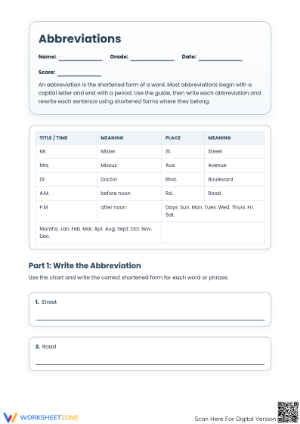
These abbreviations printable worksheets for 2nd grade target three categories that second graders encounter constantly but rarely examine directly: calendar terms (days of the week and months), titles of address such as Mr., Mrs., and Dr., and street designations like St., Ave., and Rd. Each worksheet focuses on one category at a time — the period-plus-capitalization rule needs to become automatic before students apply it reliably across different word types.
What Students Practice
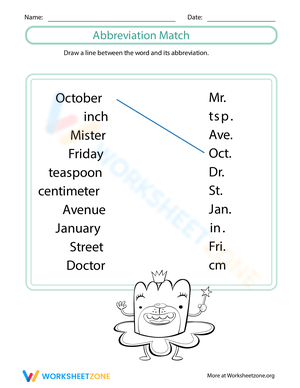
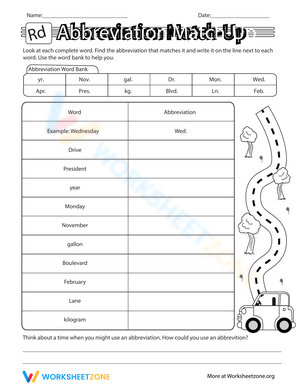
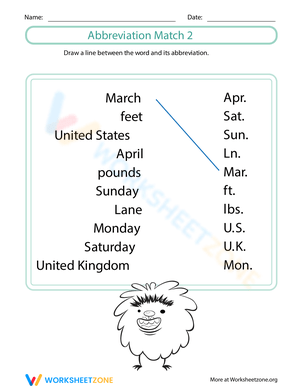
The set covers three task formats that build on each other. Matching activities pair full words with their abbreviated forms, asking students to attend to two features simultaneously: the period at the end and the capital at the beginning. Rewriting tasks present a complete sentence — Doctor Reyes walked down Maple Street on Tuesday — and ask students to substitute the correct abbreviated form for each indicated word. Error-correction tasks are the most demanding format and do the most instructional work: students receive a list of abbreviations, some correct and some deliberately wrong, and must identify and fix each error.
That last format requires students to hold the rule in mind and test it against each example — a different cognitive move than copying a pattern by recognition. A student who completes a matching task successfully will still miss errors on the correction task, which tells you something specific about where their understanding stops.
Street designations get less classroom time than days and months, but they're worth the lesson. Students who learn that Dr. means Doctor in one sentence and Drive in another — as in Oak Dr. — are beginning to understand that abbreviations carry context, not just shortened spelling. That's a more sophisticated observation than most second-grade grammar instruction asks for, and it's worth surfacing in a brief discussion when you reach that worksheet.
Errors Students Make That These Worksheets Help You Catch
The most consistent error is the missing period. Second graders treat Mon as simply a shorter version of Monday — a word, not a mark-bearing symbol. The period feels optional in a way that sentence-ending punctuation doesn't, because students haven't yet absorbed the idea that abbreviations are a category of their own with a rule attached. This error shows up across the full range of learners, not just struggling readers.
The second pattern is selective capitalization failure — specific to months. A student who writes Monday and Tuesday correctly every time will still produce jan. or mar. in a journal entry. The reason is developmental: months that fall mid-sentence feel less like proper nouns than days of the week do, even though the rule is identical. Students need an explicit reminder that months are proper nouns regardless of where they land in a sentence, and that their abbreviations follow the same rule.
A third error is worth anticipating: all-caps titles. Students who have seen MRS. JOHNSON on a name placard or classroom door sign will write titles in all caps because that's the version most visible to them in large print. A short conversation about display formatting versus writing conventions usually clears this up for most of the class, though a few students need to encounter several non-all-caps examples before the printed-label version stops overriding what they know.
How to Work These Worksheets Into Your Lesson Planning
Calendar time is the most natural entry point. If you already point to the abbreviated day name on your morning board, you're one step from making that a deliberate teaching moment. The abbreviations printable worksheets for 2nd grade fit cleanly right after morning meeting — while students still have the abbreviated day visible on the board, the matching task feels connected rather than abstract. That sequence takes about eight minutes and works as a standalone warm-up before the reading block without cutting into it.
The error-correction worksheet works best as a closing activity late in the unit, after direct instruction is complete. Assign it on a Thursday and use the results to decide whether Friday needs a reteach or can move forward into application. Students who miss the period on most items are still treating abbreviations as shortened words rather than punctuation-marked symbols — a distinction worth addressing before they're asked to use abbreviated forms in their own writing.
During writing workshop, the rewriting task makes a useful bridge. Post one rewriting worksheet during editing time and ask students to find at least one title or date in their current piece and apply the correct abbreviated form. That's where the rule transfers from practice to actual writing — and it takes less than five minutes to set up.
Standard Alignment
This set addresses CCSS.ELA-LITERACY.L.2.2, the second-grade language standard requiring command of capitalization, punctuation, and spelling conventions in writing. Abbreviations sit at the intersection of two components: the capitalization requirement (proper nouns keep their capitals in abbreviated form) and the punctuation requirement (the abbreviation period is a distinct, rule-governed mark — not a sentence-ending period). In classroom terms, this makes abbreviation practice more efficient than it might appear; students reinforce two convention skills simultaneously. Teachers using abbreviations printable worksheets for 2nd grade alongside a conventions unit will find the error-correction and rewriting tasks pair naturally with capitalization work on holidays and geographic names under L.2.2a, since the underlying proper-noun rule threads through both topics.
Adapting the Worksheets for Different Student Levels
Students who need additional support do better with a reference card on their desk — the full word on one side, the abbreviation on the other — while they work. This keeps working memory available for applying the rule rather than recalling individual items. Sequencing also matters: matching tasks before rewriting tasks. Asking students to produce an abbreviation from memory before they can recognize it reliably adds frustration without adding learning value.
Students who finish early don't need separate materials. Ask them to write three original sentences each containing at least one abbreviation, then exchange with a partner and check each other's work for the period and capital letter. That peer-editing step adds accountability and gives both students additional repetitions with the rule in a low-stakes format.
For students significantly above grade level who find the mechanical tasks routine, a short constrained writing piece — a postcard or a brief invitation — that must include at least four different abbreviated forms used correctly puts the conventions in a genuine writing context. The constraint is small, but it shifts the focus from exercise completion to actual craft decision-making.
Frequently Asked Questions
Do all the abbreviations in this set require a period?
Yes — for days, months, titles, and street types, a period follows every abbreviated form. This is a reliable rule for second-grade instruction. Postal abbreviations for states (CA, TX) are an exception some teachers ask about, but those follow a separate formatting convention and aren't part of the standard 2nd-grade scope. Keeping the period-always rule intact for this set prevents confusion that genuinely isn't worth introducing at this stage.
What sequence works best for teaching these categories?
Days of the week first, then months, then titles, then street designations. Days are the most immediately familiar — students have heard them thousands of times before they're asked to read them — so the abbreviated form connects quickly to a clear referent. Months apply the same period-and-capital rule, making transfer straightforward. Titles arrive naturally during a letter-writing unit, giving students a purposeful writing context right away. Street abbreviations come last because they appear less frequently in student writing and carry the added complexity of terms like Dr. serving double duty as both a title and a street type.
My students consistently forget the period. What actually helps?
Make the period a physical act early in instruction: have students tap their pencil on the period mark each time they write an abbreviation. The kinesthetic reinforcement slows students down enough to register whether they've written it. Combine that with the error-correction format, where omitted periods appear as visible mistakes to find and fix, and students get the dual experience of producing the mark and identifying its absence. Most classes reduce omission errors significantly after two or three rounds of that combination. If the problem persists, check whether your room displays abbreviations without periods on anchor charts, calendar labels, or name placards — environmental inconsistency in print is often the cause that goes unnoticed.
Can these worksheets function as formative assessments?
A single error-correction worksheet, collected and scanned quickly for period use and capitalization, tells you within a few minutes which students have internalized the rule and which are still applying it inconsistently. The abbreviations printable worksheets for 2nd grade in this set format each item on a separate line, which makes error patterns visible at a glance across the whole class — you're looking for clusters, not just individual scores. Use that data to group students for the next day's targeted reteach rather than waiting until an end-of-unit test to discover gaps.
Clear All